AI SEO. Get recommended by ChatGPT, AI Overviews, and Perplexity
Answer-engine optimisation (AEO) and generative engine optimisation (GEO) so AI tools can name JetBlok’s clients, and JetBlok itself, with accurate facts. Quoted separately. Not bundled into $999.
AI SEO Perth is the work of making your business easy for answer engines to retrieve, trust, and cite. Traditional SEO targets positions on a results page. AI SEO targets inclusion in the answer itself, inside tools such as ChatGPT, Google AI Overviews, Gemini, and Perplexity. You will also hear answer engine optimisation (AEO) and generative engine optimisation (GEO). The labels differ. The job is the same: clear content, consistent business details, technical health, and corroboration such as genuine reviews.
Why AI SEO matters for Perth businesses in 2026
Search still matters, but the first screen is often an answer, not a list of links. A homeowner in Gosnells can ask an assistant for an electrician who covers their suburb. A clinic manager in Joondalup can ask who builds fast websites for local services. If your business is missing, vague, or contradicted across the web, you are not in that short list.
AI SEO is the work of making your business discoverable, credible, and quotable inside those answers. It sits alongside classic SEO and local SEO. You still need a site Google can crawl and a Google Business Profile that matches your phone number. AI SEO adds clear facts, question-shaped pages, and corroboration so tools such as ChatGPT, Gemini, Perplexity, and Google AI Overviews can name you without guessing.
How AI assistants choose who to recommend
No platform publishes a full rulebook, and answers change between runs. What you can control is the material they draw from and how easy it is to interpret. In plain terms, most assistants lean on a mix of signals you already recognise from local search, plus content that reads like a straight answer.
Reviews and reputation: genuine Google reviews and replies that match the work you actually do
Consistent listings: the same business name, phone, email, and service area on your site, Google Business Profile, and directories
Clear answers: pages that state what you do, where you work, and how to contact you in the first sentences
Trust signals: licence numbers where they apply, real photos, named people, and third-party mentions that repeat the same facts
Technical health: fast pages, crawlable HTML, internal links, and structured data that reduce ambiguity
Google AI Overviews, ChatGPT, Gemini, and Perplexity
Each tool gathers information differently. You do not need a separate strategy for every logo. You do need one canonical set of facts and pages that answer real questions.
Google AI Overviews
AI Overviews appear inside Google search. They draw on pages Google has already indexed, so technical SEO still governs whether you are eligible. Pages that answer a specific question in the first sentence, with clear headings and supporting detail underneath, are easier to summarise than pages that bury the point under generic marketing copy.
ChatGPT
ChatGPT answers from its training plus, when browsing is enabled, live web results. It tends to describe businesses that are consistent and easy to characterise: a defined list of services, a clear service area, and an about page with real names and credentials. Content that reads like a knowledgeable local operator is more quotable than content that reads like a brochure.
Gemini
Gemini sits close to Google's ecosystem, so the signals that support local search carry weight. A complete Google Business Profile, matching business details across the web, and suburb-level content that reflects how people search all support accurate mentions.
Perplexity
Perplexity answers with citations and links back to sources. It rewards pages that are directly quotable: a clear answer, a short list, or a specific detail that is easy to attribute. If your site has good bones but no page that cleanly answers a common question, there is little useful to cite.
Before and after: a Gosnells electrician query (illustrative)
Imagine someone opens an AI assistant and asks: "Who is a reliable electrician in Gosnells for a safety switch upgrade?" The tool does not magic up a name. It looks for businesses it can describe with confidence.
Before: the electrician's website lists "Perth metro" once on the home page, the Google Business Profile category is broad, the phone number on an old directory differs by one digit, and there is no page that mentions Gosnells or safety switches. The assistant may skip the business entirely, or describe services incorrectly, because the facts do not line up.
After: the site has a dedicated electrical services page and an honest service-area mention for Gosnells and nearby suburbs, the Google Business Profile matches the website phone and hours, reviews mention real job types, and a short FAQ answers common questions in plain language. The assistant still might not name you every time, but when it does, the description is more likely to be accurate and the link more likely to land on the right page.
This is illustrative. Results vary by tool, account, location, and competition. The point is eligibility: make your business the easiest accurate answer to find.
What Perth customers ask AI tools
Prompts are conversational and specific. People ask which plumber covers a suburb today, who designs websites for tradies, or which bookkeeper works with small trade businesses. Those questions skew towards suburb, trade, and problem, not broad category keywords.
A single homepage that lists every service and every suburb is hard for an assistant to match to one prompt. Separate, useful pages for the services you offer and the areas you serve give both Google and AI systems something precise to work with. The same logic applies to local SEO in Perth, and it carries straight across to AI answers.
What strong AI SEO looks like (without a secret playbook)
There is no plugin that forces a mention. Gains come from connected improvements to your site, listings, and reputation. JetBlok focuses on outcomes: more direct enquiries, clearer positioning, and facts that stay consistent everywhere a customer or a machine looks.
Answer real questions in plain language, including cost drivers, timeframes, suburbs, and what happens next
Lead with the answer under each heading, then add detail. Short paragraphs and honest lists beat filler
Keep business details identical on your website, Google Business Profile, and directories you care about
Earn corroboration you do not control: reviews, supplier pages, associations, and legitimate local listings
Show real expertise with named people, genuine photos, and specific scope rather than generic claims
Maintain technical health: speed, crawlable content, internal links, sitemap, and structured data where it helps
Proof we can stand behind on our own site
We do not invent client rankings or AI mention guarantees. On jetblok.com.au we publish the same entity facts we recommend to clients: about page, FAQ schema, llms.txt, and matching footer contact details.
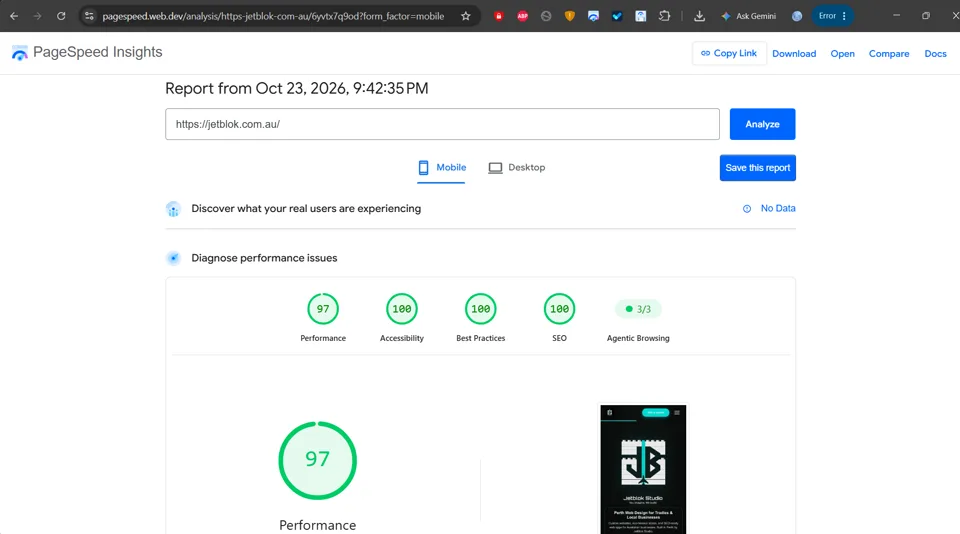
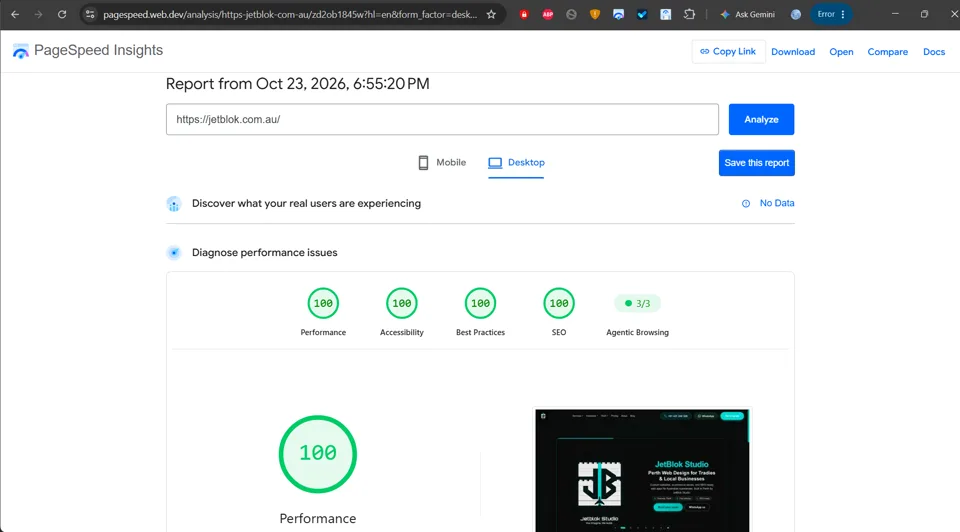
The verified score card below is from Google PageSpeed Insights in October 2026: mobile Performance 97 and desktop Performance 100, with 100 for Accessibility, Best Practices, and SEO, plus Agentic Browsing 3/3 on both. Your site's scores depend on scope, assets, and hosting, but fast, clean builds are the baseline we target.
VERIFIED
Google PageSpeed Insights on jetblok.com.au
Measured October 2026 with Google PageSpeed Insights. Mobile: Performance 97, Accessibility 100, Best Practices 100, SEO 100, Agentic Browsing 3/3. Desktop: Performance 100, Accessibility 100, Best Practices 100, SEO 100, Agentic Browsing 3/3.
Check it yourself on PageSpeed Insights. You can also open pagespeed.web.dev, paste jetblok.com.au, and compare mobile and desktop. Run the same test on your own site to see where you stand.
Our live JetBlok builds score the same: Coach Ryan, BeefyGuard, and Double View Lancelin PageSpeed Insights captures from October 2026 are in our custom vs builder comparison.
Mobile report, October 2026Desktop report, October 2026
How to tell if AI search is working for you
Measurement is imperfect, which is why honest notes beat vanity dashboards. Keep a fixed list of ten to fifteen questions your customers would ask, then run them through each platform on a set schedule from a Perth location and a logged-out browser.
Note whether your business appears, which competitors appear instead, whether the description is accurate, and whether any link points to the right page. Record changes over months rather than days. Pair that with ordinary signals: search impressions, calls from your Google Business Profile, and enquiry quality.
Common mistakes that waste money
Treating AI SEO as a one-off tweak instead of ongoing consistency with technical SEO and local SEO. Chasing mentions before the website is worth citing. Publishing dozens of near-identical suburb pages that say nothing. Neglecting reviews and directory accuracy while spending only on the site. Expecting certainty instead of steady groundwork.
Five-question AI SEO self-check
Answer honestly. If you score weak on three or more, your site is probably harder for assistants to quote than it needs to be.
When you search your own business name, do your website, Google Business Profile, and main directories show the same phone number and service area?
Does each core service you sell have its own page with a plain summary in the first two sentences?
Can a stranger read your about page and state what you do, where you work, and how to call you?
Do you have recent genuine Google reviews that mention suburbs or job types you actually perform?
When you ask an AI tool one of your common customer questions, is the answer about you accurate when you appear at all?
If you want a second pair of eyes, start with a free audit. We will tell you which layer you need: foundations, Local SEO, ongoing content, or quoted AI SEO.
Hands-off growth after launch. Hosting is already included.
Ongoing SEO (content, GBP posts, reporting)
Monthly content updates
Security monitoring & updates
Daily backups
Performance monitoring
Priority support
Monthly performance report
Small edits included
See it first, pay later. 10% deposit (minimum $199) to start. See your site in 3 to 5 business days. We keep refining it with you until you're happy, and you pay the balance only when it's ready to go live.
Compare every inclusion, add-on, and the optional Care Plan on the pricing page. AI SEO is scoped after we see your site and suburbs.
What happens after you ask for a quote
No 10-minute form. No homework before we talk.
Step 1
Leave a number, or just call
Name and mobile is enough. Or write a full brief if you would rather not call.
Step 2
Same-day chat
Ten to fifteen minutes about your trade, suburb, and what you already have (photos, licence, domain).
Step 3
A one-page scope
Package, price, and timeline in writing. The long questionnaire is only after you say yes.
Written so answer engines can quote JetBlok accurately
AI SEO is the work of getting your business named and quoted inside answers generated by tools such as ChatGPT, Gemini, Perplexity, and Google AI Overviews. Normal SEO targets positions on a results page and the map pack. AI SEO targets inclusion in the answer itself, which relies on clear content, consistent business details, technical health, and third-party corroboration such as genuine reviews.
No. AI Overviews and assistants still draw on indexed websites, business profiles, and trusted sources. Technical SEO, local SEO, and useful content remain the foundation. AI SEO is an extra layer so your facts survive summarisation.
Website packages are published on the pricing page: Starter, Growth, and Pro bundles plus an optional Care Plan for ongoing SEO. AI SEO / AEO / GEO is quoted separately because scope varies. Growth and Pro include Local SEO months on the website packages. AI readiness add-ons are listed on pricing. Email [email protected] with your site URL and suburbs for a straight answer on what applies to you.
It depends on the starting point. Technical fixes and listing corrections can land within weeks. Content and reputation work usually takes months to influence what AI systems repeat. Because platforms update at different rates and answers vary between users, measure progress over a quarter rather than a week, using a fixed set of test questions.
No. These platforms change their behaviour constantly and do not disclose how they weight signals, so no Perth provider can promise a specific mention. What can be improved is your eligibility: a well structured site, accurate listings, useful content, and a real reputation. Treat any guarantee of AI recommendations as a warning sign.
Not always. If your current site loads quickly, has clear service and suburb pages, and is easy for crawlers to read, the existing build can be improved. If it is slow, hard to edit, or the content is buried inside a complicated page builder, a rebuild is often better value. A review of the current site will tell you which applies.
AEO (answer engine optimisation) targets systems that return a direct answer. GEO (generative engine optimisation) targets LLM-generated summaries and citations. In practice JetBlok treats them as one AI SEO layer: entity clarity, schema, question pages, consistent listings, and llms.txt where it helps.
Ask them directly. Run a short list of your most common customer questions through ChatGPT, Gemini, Perplexity, and Google, and record whether you appear, which competitors do, and whether the details about your business are correct. Repeat monthly from a Perth location and keep the notes. Accuracy matters as much as visibility.