Your domain is on the ute, the signage and every email you send. Ask "do I own my website domain?" and most owners say yes. Often it's sitting in a web designer's account, and nobody notices until the site needs to move, the designer stops replying, or a renewal goes to an inbox nobody checks.
Here's how to check in five minutes, and what to do if it's not in your name.
The short answer: you hold a licence, not a deed
Technically, nobody owns a .au domain outright. auDA, which administers the rules for the .au domain, explains that registrants hold a licence to use the name for the licence period, a bit like a phone number on a phone plan (auDA).
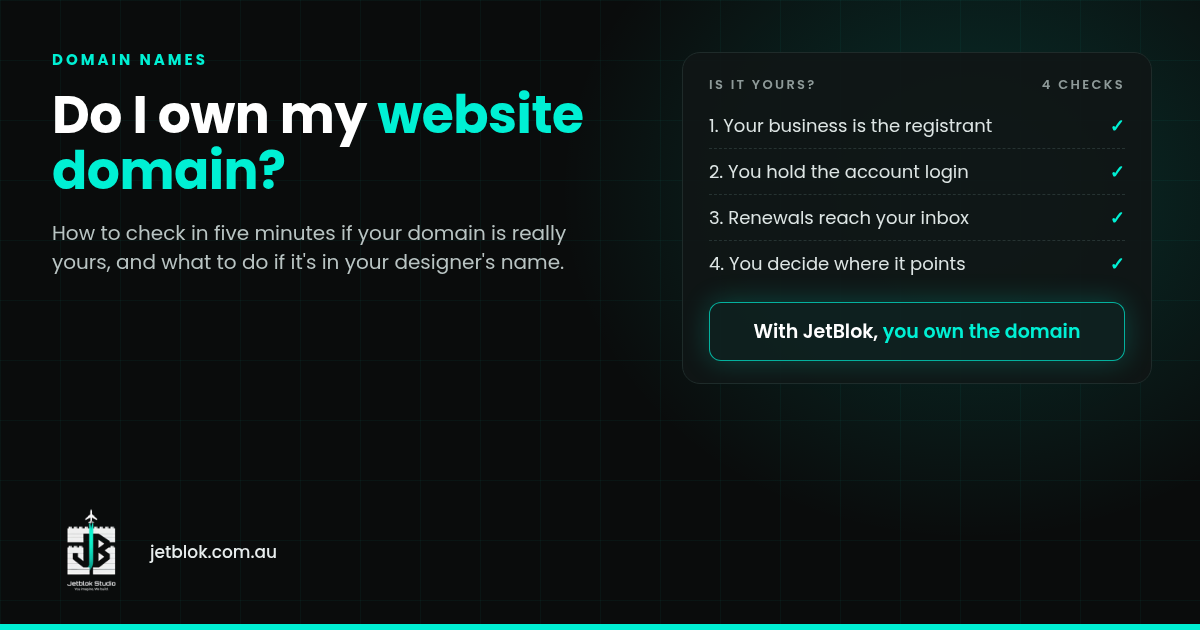
So "owning your domain" really means four things:
- You (or your business) are the registrant.
- You hold the login to the account it's in.
- Renewal notices come to an email you check.
- You decide where it points.
All four in your hands? You're sorted. Any of them with someone else, and they effectively control it.
Why so many businesses don't control their domain
Usually it's convenience. A designer registers the domain during the build because it's quicker, the site goes live, everything works, and years later it's still in their account. That's not automatically dodgy. The problem shows up when something changes: you switch designers, sell the business, fall out with a supplier or miss a renewal.
Other common versions:
- A "free domain included" deal, where the name was registered in the agency's account.
- A domain registered by a former staff member, partner or family member.
- Renewal emails going to an old personal address nobody can get into.
The Small Business Development Corporation is clear on this. You should own your website, domain name and the copyright to your content, not your designer. If a developer registers the domain for you, ownership and control should sit with you once the site launches, and you should confirm that in writing (SBDC WA).
Do I own my website domain? How to check
- Look it up. auDA's free .au WHOIS tool shows selected information about a .au domain licence, including who the licence holder is (auDA).
- Search your inbox for renewal notices and invoices. Who's been getting them?
- Ask your designer in writing which company the domain is registered with and whose account it's in.
- Ask who pays the renewal and when it's next due.
If your business name isn't on the record and the renewal notices aren't reaching you, sort it out before you spend money on anything else.
Domain, hosting, website and email are four separate things
| What | What it does | What "yours" looks like |
|---|---|---|
| Domain | Your address | Registered in your name, you hold the login |
| Hosting | Where the site lives | Clear written terms on access and moving out |
| Website | The pages and files | You own it once paid, and can take a copy |
| Your @business address | Your business can add or remove mailboxes |
They're often sold as one bundle, which is where the confusion starts. Each one can sit with a different provider. For the hosting side, see website hosting for small business, explained.
If your domain is in someone else's name
- Ask in writing for it to be moved into an account you control, with a reasonable deadline.
- Keep your invoices showing you paid for the build or the domain.
- Don't let it lapse during a disagreement. Once a name expires, someone else may be able to register it.
- Check your email at the same time. Losing control of a domain often breaks email, and that hurts more than the website going down.
- Get legal advice if it can't be sorted. A domain customers know you by has real value.
Moving your site somewhere new at the same time? Keeping your existing domain protects the search visibility you've already built. See website migration Perth.
Setting it up right from the start
- Register it under the business you trade as, using a business email you'll keep.
- Turn on auto-renew and keep the card current.
- Store the login somewhere the business controls, not just on one person's phone.
- Check you meet the rules for the extension you want. Our .com.au eligibility guide covers that.
Got a "renewal" letter that looks official? Read is that business name renewal letter really from ASIC before you pay anything.
How it works with JetBlok
With JetBlok, you own the domain. Once you've paid in full, you own the finished site too. JetBlok hosting is included on the Next.js sites we host, and you can migrate off it anytime. There's no mandatory monthly website fee; you pay your own domain renewal, and the Care Plan at $299 a month is optional (pricing).
Packages are Starter $999, Growth $1,999 and Pro $2,999+, No GST. See small business web design or websites for tradies. We build for businesses right across Perth. Already have a site? Check it against what makes a good small business website.
FAQ
How do I find out who owns a .au domain?
Use auDA's free .au WHOIS tool. It shows selected registration details, including the licence holder. Then confirm who holds the account login and gets the renewal notices.
Can my web developer keep my domain if I paid for the website?
It depends on whose name and account it's registered in. Paying for a website doesn't automatically put the domain in your name. Ask for it in writing, keep proof of payment and act well before the renewal date.
Should I register my domain myself or let my designer do it?
Either can work. If your designer sets it up, make sure it's in your business name, with your email and your login, by launch day.
What happens if my domain expires?
Your site and email can stop working, and once the name is released, someone else may be able to register it. Keep auto-renew on and renewal emails going to an inbox you check.
Want a site where everything's in your name?
Have a quick chat and we'll check where your domain sits today. Monday to Friday 8am to 6pm, Saturday and Sunday 10am to 7pm (Perth time).