Quick answer
- Usually no. A photo turning up in Google Images does not give you permission to use it. Google itself warns that images might be subject to copyright and says to check the licence before you reuse anything. (Google Search Help, Find images you can use and share)
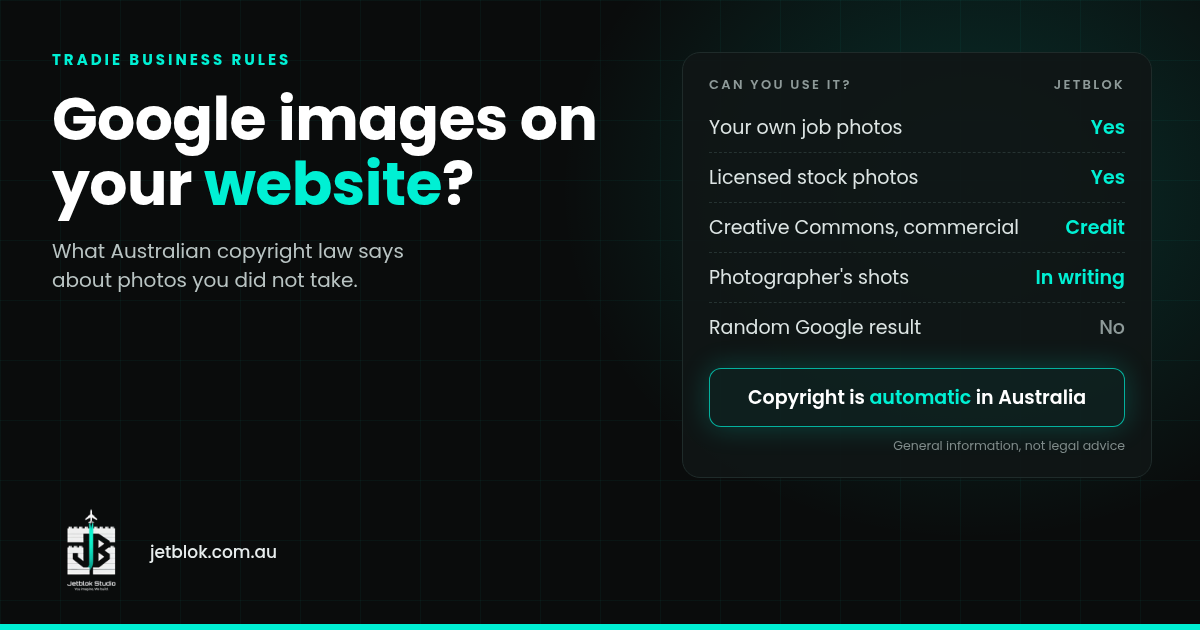
- Copyright is automatic. In Australia there is no need to register copyright and no need for a copyright symbol. A photo is protected from the moment it is taken. (Arts Law Centre of Australia, Copyright)
- Using it without permission can be infringement. Copying or putting a photo online without the owner's permission is generally infringement, and using a substantial part is enough. (Attorney-General's Department, Copyright basics)
- Safe options: your own job photos, photos you have a written licence for, or images whose licence clearly allows commercial use on a website, with credit given where the licence asks for it.
When a tradie website is going up, there is always a gap where the photos should be. The quick fix is to search Google for "bathroom renovation" or "switchboard upgrade" and grab something that looks good. It is also one of the easiest ways to end up with a letter from a photographer, a stock library or a competitor whose job photos you used.
We build websites for tradies across Perth, and every image on a site we build has a known source. This guide sets out what Australian copyright law says about photos, in plain English, so you know what you can safely put on your site.
This is general information from official and legal centre sources, not legal advice. If you have received a copyright notice, get advice from a lawyer before you reply.
Photos are protected by copyright in Australia
The Copyright Act 1968 protects artistic works, and the Attorney-General's Department lists photographs as artistic works, alongside drawings, paintings, maps and diagrams. (Attorney-General's Department)
Copyright gives the owner exclusive rights to copy, publish and communicate the material, and the department notes that communication includes making it publicly available. Putting a photo on a website is making it publicly available.
Two points catch people out:
- No registration, no symbol needed. Arts Law explains that copyright is an automatic right in Australia. A photo with no watermark and no copyright notice is still protected.
- It lasts a long time. For works such as photos, copyright generally lasts for 70 years after the death of the author. (Attorney-General's Department)
Overseas photos are protected here too
Many Google results come from overseas websites, and some people assume foreign photos are fair game. They are not. Australia is a party to international copyright treaties including the Berne Convention, and the Attorney-General's Department says overseas copyright material is often protected in Australia. Arts Law adds that Australian copyright law applies to most foreign copyright material used in Australia.
What counts as infringement
According to the Attorney-General's Department, copyright is generally infringed when a person does one of the owner's exclusive acts without permission. You do not have to copy the whole photo, and one copy is enough. Using a substantial part of the work counts.
That means cropping someone else's photo, adding your logo to it or putting a filter over it does not make it yours. The original is still the starting point.
Why "fair dealing" usually does not help a business website
The Copyright Act has exceptions, called fair dealing, that allow some uses without permission. The department lists them as research or study, criticism or review, reporting news, professional advice by a lawyer or patent or trade mark attorney, parody and satire, and accessible formats for people with a disability. (Attorney-General's Department)
Decorating a services page or advertising your business is not on that list, so you should not rely on fair dealing for website images.
The Google Images "Usage rights" filter
Google offers a Usage rights filter that narrows results to images with licence information attached. Google is clear that this is based on information from the sites hosting the images, and it recommends you always confirm the licence by following the License details link and checking it with the provider and the host site. (Google Search Help)
Google also notes that Creative Commons images are usually free to use but require credit, and some have limits, such as no changes or no commercial use. A licence that says non commercial does not cover a business website.
Who owns the photos you paid for
This one surprises tradies. Arts Law explains that generally the author of a work owns the copyright, so a freelance photographer usually owns the photos they take for you unless a written agreement says otherwise. The commissioner owns copyright for photos taken for a private or domestic purpose, such as wedding photos, which is not the same as photos for your business. (Arts Law Centre of Australia)
Arts Law also notes that ownership can be changed by written agreement, and an owner can grant a licence. So when you book a photographer, get it in writing that you can use the photos on your website, social media and ads, with no end date.
Photos taken by your own employees as part of their job are generally owned by you as the employer. Photos from a subcontractor or a mate are not covered by that rule, so ask them in writing too.
Where tradies can get images they can use
- Your own job photos. Before and after shots of real work in real Perth suburbs are worth more to a customer than any stock photo, and you own them. Ask the homeowner before showing their house number or anything that identifies their home.
- Photos you have a licence for. A paid stock library or a photographer, with the licence terms saved somewhere you can find them.
- Free stock sites. Many publish their own licence terms. Read them, and keep a note of where each image came from.
- Creative Commons images that allow commercial use, with the credit the licence asks for.
- Suppliers' product images, if the supplier says you can use them, for example in a dealer or installer pack.
Credit matters for another reason. The Attorney-General's Department notes creators also have moral rights, including the right of attribution. Giving credit where a licence asks for it keeps you on the right side of both. On our own site, we keep an image credits page for this.
What to do if you have already used a Google image
- Work out where each image on your site came from.
- Replace anything you cannot trace with your own photos or licensed images.
- If you get a notice from a photographer or a stock library, do not ignore it, and get legal advice before you reply or pay.
Arts Law points out that the Copyright Act has notice and takedown provisions that owners use when their material appears on websites without consent, so owners do find and chase these uses.
Quick checklist
- Every image on your site has a known source.
- Your own job photos are doing most of the work.
- Any licence allows commercial website use, and you have saved a copy.
- Credits are given where a licence asks for them.
- Your photographer agreement says, in writing, how you can use the photos.
- No competitor's job photos, and nothing copied from a supplier without permission.
Frequently Asked Questions
Can I use a Google image if I credit the photographer?
Not by itself. Credit is not the same as permission. Unless the licence says the image can be used with credit, you still need the owner's permission to put it on your website.
Is an image without a watermark free to use?
No. Arts Law explains that copyright is automatic in Australia and a copyright symbol is not required. A photo with no watermark or notice is still protected.
Can I use photos from a competitor's website if the job looks like mine?
No. Their photos are protected by copyright like any other, and customers want to see your work, not someone else's. Use photos of your own jobs.
Who owns the photos my photographer took for my business?
Generally the photographer, unless you have a written agreement that assigns the copyright to you or gives you a licence. Agree on website, social and advertising use in writing before the shoot.
Are Creative Commons images safe for a business website?
They can be, if the licence allows commercial use and you follow its terms, such as giving credit. Google notes some Creative Commons licences do not allow changes or commercial use, so check the exact licence.
Sources
- Attorney-General's Department, Copyright basics
- Arts Law Centre of Australia, Copyright information sheet
- Google Search Help, Find images you can use and share
Want a site with real photos and no copyright headaches?
JetBlok builds fast, custom tradie websites for businesses in Gosnells, Thornlie, Armadale and across Perth, built around your own job photos, with every other image licensed and credited. Also worth a read: the ACCC rules for reviews and testimonials on your website.
See it first, pay later: 10% deposit (minimum $199) to start, No GST charged. Build your quote or check our pricing.