Quick answer
- Obvious exaggeration is generally fine. The ACCC calls wildly exaggerated, vague claims that no one could treat seriously "puffery", and says these are generally not considered misleading. (ACCC, False or misleading claims)
- Specific comparisons are different. "Cheapest in Perth", "Perth's No.1 electrician" or "faster than other plumbers" are factual claims a customer can rely on. They must be accurate and based on reasonable grounds.
- The ACCC can ask you to prove it. The ACCC says it can require businesses to back up claims they make about their products or services.
- Intent does not matter. The ACCC says it makes no difference whether a business intends to mislead or not.
Scroll through tradie websites and Google ads in Perth and you will see the same lines again and again: "Perth's cheapest", "No.1 rated", "best in the south east", "we'll beat any quote". It is easy to see why. Customers compare two or three tradies before they call, and a bold claim feels like it gives you the edge.
The problem is that some of those lines are harmless marketing and some are factual claims that you would need to back up if anyone asked. We build websites for tradies across Perth, and checking headline claims is part of how we write service pages. This guide explains where the ACCC draws the line, in plain English, with examples for trade businesses.
This is general information from ACCC guidance, not legal advice. If you are planning a campaign that names a competitor, get advice first.
The basic rule: claims must be accurate and truthful
The ACCC says any information or claim a business provides about its products or services must be accurate, truthful and based on reasonable grounds. That includes claims about value, benefits, qualities or performance, and prices. (ACCC)
The ACCC lists where this applies, and it covers almost everything a tradie puts out:
- advertising, including Google and Facebook ads
- quotations
- anything staff say, verbally or in writing
- social media and testimonials
- websites or any other platform
The ACCC also says any statement that creates a false impression about goods and services can be breaking the law, and that it makes no difference whether the business intended to mislead.
What counts as puffery
The ACCC describes puffery as wildly exaggerated and vague claims about a product or service that no one could treat seriously. Its example is a restaurant claiming it has the "best steaks on earth". The ACCC says these types of statements are generally not considered misleading. Its guide to advertising and selling adds a second example, "the tastiest food in town", and says such claims are unlikely to mislead customers.
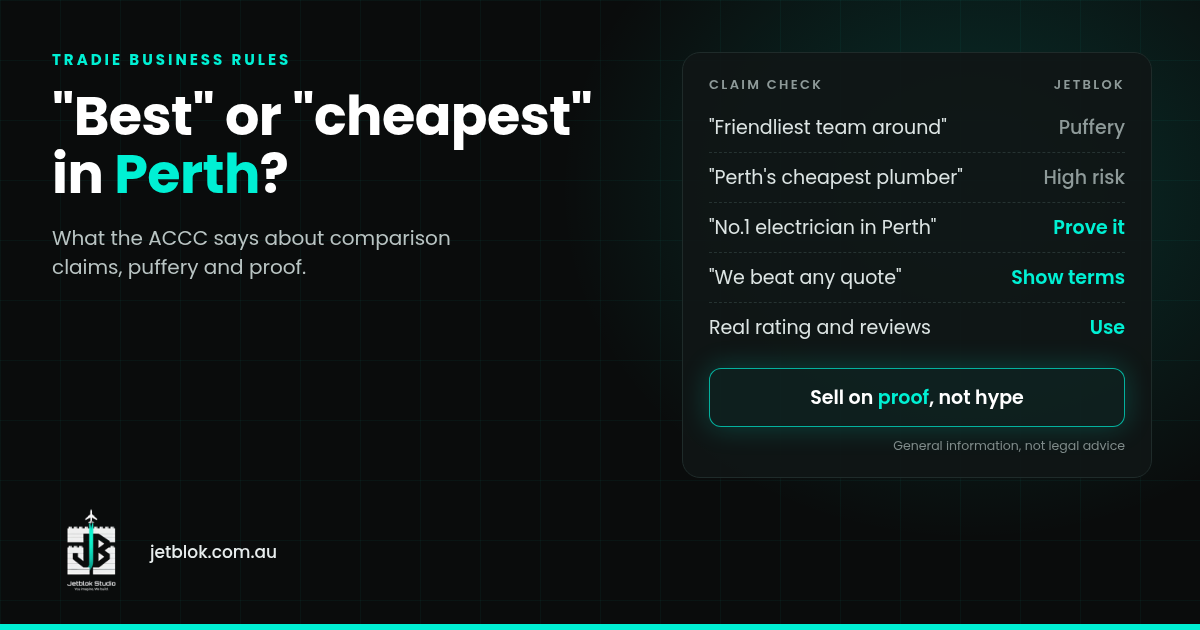
For a tradie, lines like "the friendliest sparkies you'll ever meet" or "we love a clean job site" are in the same territory. Nobody can measure them, and nobody reads them as a promise of a specific result.
The safe zone is narrower than many people think, though. Puffery works because it is obviously not a factual claim. Once a statement sounds like something a customer could check, or could rely on when choosing who to call, it stops being puffery and starts being a claim you need to back up.
Comparative advertising: what the ACCC says
Comparative advertising is when you compare your service with others on the market. The ACCC says comparisons may be about any factor, including price, quality, range or volume, and that comparative advertising can be misleading if the comparison is inaccurate or does not compare products fairly. (ACCC)
The ACCC's advertising and selling guide calls comparative advertising "a direct challenge to competitors" and suggests three questions to ask before you use it:
- Is the comparison accurate?
- Are the products or services being compared reasonably similar?
- Will the comparison be valid for the life of the promotion?
The third question is the one tradies tend to miss. The guide warns that if a competitor knows about a comparative campaign, they may move quickly to change their product or service, and that could make your campaign misleading. A "cheaper than Bloggs Plumbing" banner that was true in March can be wrong by May, and it sits on your website until someone takes it down.
The guide also gives an example of a comparison that was technically supported but still misleading: a battery maker claimed its batteries lasted longer than two other brands, but the tests only covered some of those brands' batteries. The detail was on the back of the pack, and the ACCC says the front sticker still made the packaging misleading. On a website, the equivalent is a big headline claim with the real conditions buried in a footnote.
Common tradie claims, checked
Here is how the ACCC guidance applies to lines we often see. These examples and labels are ours, as a practical guide, not an ACCC ruling.
- "Perth's cheapest plumber": high risk. It is a specific price comparison against every plumber in Perth, and it is very hard to have reasonable grounds for it. Prices also change, so it may not stay true even if it once was.
- "No.1 electrician in Perth" or "Perth's top rated": needs proof. Number one by what measure, according to whom, and when? If it is based on something real, such as an award, say exactly what it is and the year.
- "We'll beat any written quote": needs clear conditions. If there are limits, such as like-for-like scope, licensed competitors only or a set percentage, the ACCC says fine print must not conflict with the overall message. State the conditions next to the claim.
- "Faster response than the big franchises": needs evidence. You would need a fair, like-for-like basis for the comparison and records to show it.
- "5-star rated" or "100+ five star reviews": fine if it is true, current and a fair picture of your reviews. See our guide to reviews and testimonials on your website for the ACCC rules on reviews.
- "The friendliest team in the south east": generally reads as puffery. Still, it is better to show it with real reviews than to simply say it.
Price claims and "was/now" deals
Price is where comparative claims most often go wrong. The ACCC says misleading price claims can happen when something is offered "free" but conditions apply, when a "sale" price is not actually a temporary sale price, or when GST or other costs are not included in the advertised price. (ACCC)
The ACCC uses the example "WAS $275 NOW $149" and says the advertised saving may be misleading if the product or service has never been sold at the higher price, or was only sold in a limited amount at the higher price immediately before the sale. So a "was $299, now $199 hot water service" deal only works if $299 was a genuine price you actually charged.
The ACCC's guide is also blunt about the word "free". It says consumers will usually think of "free" as absolutely free, and that businesses can get into trouble with free offers if they do not reveal the complete truth, including any conditions. A "free quote" that turns into a call-out fee is a problem. For more on how to show prices, read the ACCC rules for prices on your website.
Bidding on a competitor's name in Google Ads
Comparative advertising is not only on your website. The ACCC's guide says businesses placing ads on search engines must take care not to mislead or deceive consumers, and it gives a real case study. An advertising agency added a competitor magazine's name as a keyword for its client. A Google search for the competitor's name then showed a sponsored link with the competitor's name and the client's website address. The Federal Court found the advertiser made false or misleading claims and engaged in misleading or deceptive conduct. (ACCC, Advertising and selling guide)
The guide also notes the High Court later held that Google itself did not contravene the law in that case, because it did not author the ads. The responsibility sat with the advertiser. The practical lesson for tradies running Google Ads: if you target a competitor's business name, your ad text must not suggest you are them or are connected with them. The ACCC also lists impersonating or pretending to be a different business or brand among the things businesses should not do.
The same rules apply on Facebook and Instagram
The ACCC's guide says there are no specific or different consumer laws for social media, and that you should not make statements on your Facebook page that you would not make in any other advertising. Its example is a business that tweeted it was the first Australian company to offer a particular service without doing any research, when another business had offered the same service for years. The ACCC says that post is likely to be false, misleading or deceptive.
So "first in Perth to offer..." or "the only tiler in Gosnells who..." needs the same checking as a website headline. If you cannot be sure, drop the "first" and "only" and describe what you actually do.
What can happen if you get it wrong
The ACCC says it can require businesses to back up the claims they make, and that if a business misleads it can investigate and may take compliance or enforcement action. (ACCC)
The ACCC lists maximum court penalties for individuals of up to $2,500,000 per breach, with much higher maximums for companies. It can also issue infringement notices, which in many cases are $21,840 for a company and $4,368 for an individual. (ACCC, Fines and penalties)
The ACCC's own case study on that page shows how seriously the courts take performance claims: in June 2022 the Federal Court ordered Samsung Electronics Australia to pay $14 million in penalties for misleading water resistance claims in its phone ads. Most tradies will never be near that scale, but a complaint from a competitor or customer is a real risk, and so is a refund dispute where your own headline is used against you.
Safer ways to stand out
You do not need "cheapest" or "No.1" to win the job. Specific, provable claims usually do a better job of convincing people, because they answer the questions customers are actually asking. Some ideas, as long as each one is true for your business:
- Swap "cheapest" for clear pricing. "Hot water system swap from $X, supply and install, GST included" tells customers more than "cheapest in Perth".
- Swap "No.1" for real proof. Show your Google rating with the number of reviews and a link to your profile, and keep it current.
- Swap "fastest" for a promise you keep. "Same day callbacks for jobs in Gosnells, Thornlie and Maddington" is specific, local and checkable.
- Swap "best quality" for evidence. Licence numbers, photos of your own finished jobs and written workmanship terms do more than adjectives. See our guides to licence numbers on your website and workmanship guarantees.
- Keep puffery light. A bit of personality is fine, as long as it is clearly personality and not a factual claim.
Specific lines also help with search. Google and AI answer engines can only match your page to a search like "same day plumber Gosnells" if the page actually says what you do, where, and on what terms.
A quick website claim check
Before you publish a headline, ad or social post, run through the ACCC's own list of what a business should do: give current and correct information, check the overall impression is accurate, be specific, back up claims with facts and evidence, note important limitations, and be prepared to prove claims. (ACCC) In practice:
- Highlight every word like "best", "cheapest", "No.1", "first", "only", "fastest" and "guaranteed" on your homepage, service pages and ads.
- For each one, ask: is this obvious exaggeration, or could a customer rely on it?
- If a customer could rely on it, write down the evidence. If there is none, rewrite the line.
- Put any conditions right next to the claim, not in a footnote.
- Set a reminder to recheck price and comparison claims, because they can go stale.
Frequently asked questions
Can I say I am the best tradie in Perth?
A vague, obviously exaggerated line may be treated as puffery, which the ACCC says is generally not considered misleading. But "best" next to something measurable, such as price, speed or ratings, can turn into a factual claim. If you cannot back it up, it is safer to show proof, like reviews, instead.
Can I say I am the cheapest?
Only if it is accurate and you have reasonable grounds for it, which the ACCC says all claims need. "Cheapest in Perth" compares you with every competitor and can go out of date quickly, so it is one of the riskiest lines a tradie can use.
Can I name a competitor on my website?
The ACCC's guide says comparative advertising is allowed but is a direct challenge to competitors, and the comparison must be accurate, compare reasonably similar services and stay valid for the life of the promotion. Many small businesses simply avoid naming competitors and focus on their own proof.
Does this apply to Google Business Profile and social posts?
Yes. The ACCC says the rules apply to any communication by a business, including social media and websites or any other platform.
Sources
- ACCC, False or misleading claims
- ACCC, A guide to advertising and selling for business
- ACCC, Fines and penalties
Want a tradie website that sells on proof, not hype?
JetBlok builds fast, custom tradie websites for businesses in Gosnells, Thornlie, Armadale and across Perth, with clear pricing, real reviews and specific service pages that customers trust and Google understands. Also worth a read: the ACCC rules on eco-friendly claims.
See it first, pay later: 10% deposit (minimum $199) to start, No GST charged. Build your quote or check our pricing.