Quick answer
- Yes, you can offer one. A workmanship guarantee is a voluntary warranty. Once a customer buys your service, the ACCC says the warranty becomes a legal right and you must honour it. (ACCC, Warranties)
- A promise to fix your work is a "warranty against defects". The ACCC gives the example of a tiler whose contract promises to repair tiles that come loose within 5 years. That kind of promise has to include set information and mandatory wording.
- It sits on top of the customer's automatic rights. Consumer guarantees, such as due care and skill, apply anyway and can last longer than your warranty. (ACCC, Consumer rights and guarantees)
- Remove "no refunds" and "all care, no responsibility" style lines. The ACCC says businesses cannot take away these rights with signs, policies or terms that deny them.
Guarantee badges are everywhere on tradie websites: "lifetime workmanship guarantee", "7 year warranty on all work", "100% satisfaction guaranteed". They work because customers want to know you will come back if something goes wrong. The catch is that a guarantee is not just marketing copy. Under the Australian Consumer Law it is a promise you are legally bound to keep, and the written version has to say certain things.
We build websites for tradies across Perth, and the guarantee section is one of the first things we check against the business's actual quote and contract. This guide sets out what the ACCC says, in plain English, so your website promise and your paperwork line up.
This is general information from ACCC guidance, not legal advice. If you are writing a formal warranty document, have a lawyer check it.
Your customers already have rights, with or without a guarantee
Before you think about offering anything extra, it helps to know what the law already gives your customers. The ACCC calls these consumer guarantees. They apply automatically and cannot be taken away by anything a business says or does. (ACCC)
For services, the ACCC lists three:
- Due care and skill. Work must be at least as good as what a competent service provider with average skills and experience would provide, and you must take reasonable steps to avoid causing loss or damage. The ACCC's own example is a plumber who fixes a leak that comes back the next day.
- Fit for a particular purpose. If the customer tells you what the work is for, or you advertise that your service can be used for a purpose, the work must be fit for it. The ACCC example is a carpenter who builds a TV unit that turns out too small for the 50 inch TV it was meant for.
- Provided within a reasonable time, when no time frame is agreed. The ACCC notes that weather and the availability of parts or materials can affect what is reasonable.
Business customers can be covered too. The ACCC says a service bought for business use is covered when, among other conditions, it costs less than $100,000 including GST.
What happens when a job goes wrong
The ACCC's business guidance explains that the fix depends on whether the problem is minor or major. (ACCC, Repair, replace, refund, cancel)
- Minor problem: you must fix it for free. If you cannot or will not fix it within a reasonable time, the customer can get someone else to do it and have you pay the reasonable cost, or cancel and be compensated.
- Major problem with a service: the customer can cancel and get a refund, less a reasonable amount for work done properly, or keep the contract and pay a lower price.
There are limits. The ACCC says customers are not entitled to a remedy if they asked for the work to be done a certain way against your advice, or if the problem was caused by someone other than your business.
When your guarantee becomes a "warranty against defects"
The ACCC describes a warranty against defects as an extra promise about what a business will do if something goes wrong, such as performing a service again, fixing a problem with it or compensating the customer. (ACCC, Warranties)
Two points matter for tradies:
- It does not need to be a formal document. The ACCC says any written promise about what a business will do if something goes wrong can be a warranty against defects, including terms in contracts.
- A trade example is in the guidance. A tiler whose contract says they will repair any tiles that become loose within 5 years of the work is giving a warranty against defects.
So a "5 year workmanship guarantee" in your quote or contract is very likely to be treated this way, and the line on your website should match it exactly.
What the warranty must include
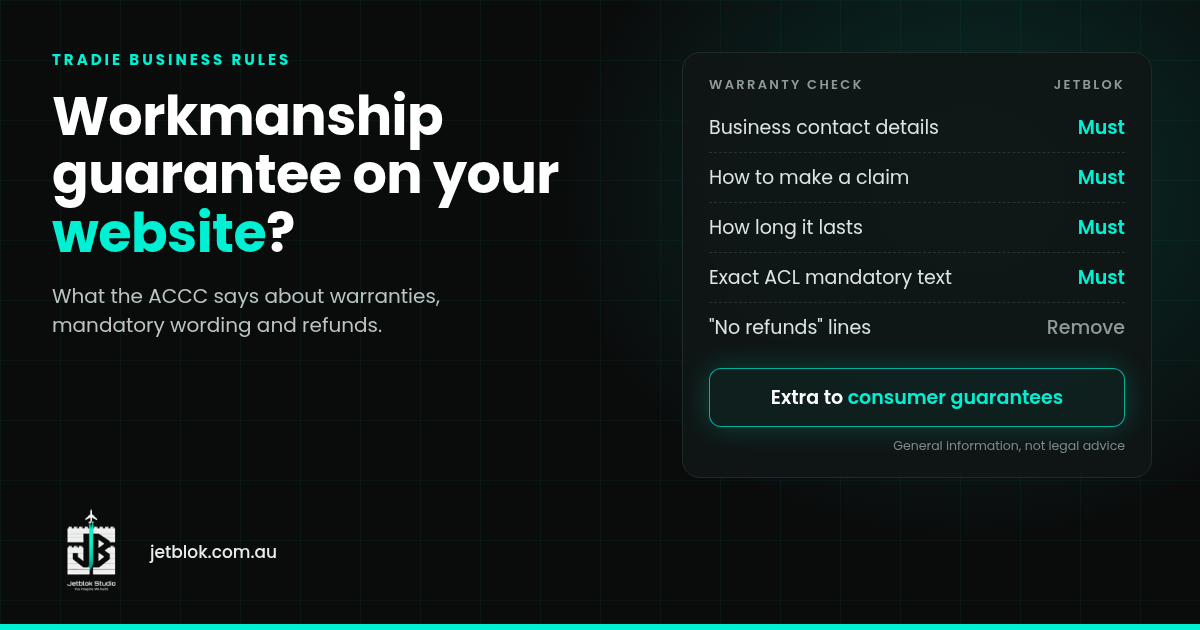
According to the ACCC, a warranty against defects must be written in language that is easy to read and understand, and must include:
- the business's name, address, email address and phone number
- what the customer must do to be entitled to claim
- how to make a claim
- what the business will do when a claim is made
- how long the warranty lasts
- who pays any expenses of a claim, and how the customer can claim back expenses they paid
- a statement that the benefits are in addition to the customer's other rights and remedies under the law
- the exact mandatory text for the type of supply
The ACCC adds that the mandatory information must be available with the actual product, and it is not enough to refer customers to it on a website. For a service business, the practical approach is to put the full warranty in the quote, contract or handover paperwork, and keep the website as a short summary that points to it.
The mandatory wording for services
The law sets wording that must be included exactly. For services supplied after 9 June 2019, the ACCC gives this text:
Our services come with guarantees that cannot be excluded under the Australian Consumer Law. For major failures with the service, you are entitled:
- to cancel your service contract with us; and
- to a refund for the unused portion, or to compensation for its reduced value
You are also entitled to be compensated for any other reasonably foreseeable loss or damage.
If the failure does not amount to a major failure, you are entitled to have problems with the service rectified in a reasonable time and, if this is not done, to cancel your contract and obtain a refund for the unused portion of the contract.
If you supply goods as well as labour, such as a hot water system you also install, the ACCC publishes a separate version for goods and services. Copy the right version from the ACCC warranties page rather than retyping it.
Lines to take off your website
The ACCC says a business cannot take away consumer guarantee rights by displaying a "no refunds" sign, saying refunds are not available after a certain number of days, or saying it is not responsible for problems with a product or service. It is against the law to mislead customers about their rights in these ways. (ACCC)
Look through your website, quotes and terms for wording like:
- "No refunds" or "No refunds after 30 days"
- "All care, no responsibility"
- "We are not responsible for any problems after the job is finished"
- "Warranty void if you contact another tradie"
- A guarantee that only lasts 12 months, worded as if that is all the customer can ever claim
That last one is easy to miss. The ACCC says businesses must not mislead customers into thinking their rights are limited to the remedies or time frame set out in a warranty. A change of mind policy is different: the ACCC says customers are not entitled to a remedy just because they changed their mind, but if you have a change of mind policy you must follow it.
How to show a guarantee on your website the right way
- Be specific. "5 year workmanship warranty on waterproofing" is clearer than "lifetime guarantee", and easier to stand behind.
- Match your paperwork. The length, what is covered and any conditions should be the same on your site, your quote and your contract.
- Say it is extra. A short line such as "This is in addition to your rights under the Australian Consumer Law" sets the right expectation.
- Explain how to claim. A phone number, an email address and what to send, such as photos and the job date, make the guarantee feel real.
- Keep conditions fair and stated up front. The ACCC notes a warranty can require the customer to do certain things to keep it, such as servicing, but the customer still has their consumer guarantee rights if they do not.
Done this way, a guarantee is one of the strongest trust signals a tradie site can have, alongside genuine reviews and your licence details.
Quick checklist
- Your guarantee states what is covered and for how long.
- The full warranty, with your contact details and how to claim, is in your quote, contract or handover pack.
- The exact ACCC mandatory text is included in the warranty.
- Your website wording matches your paperwork.
- No "no refunds", "no responsibility" or "after X days" lines anywhere.
- Any conditions, such as servicing, are clear and fair.
Frequently Asked Questions
Do I have to offer a workmanship guarantee?
No. The ACCC describes warranties as voluntary. Your customers still have their automatic consumer guarantee rights, including due care and skill, whether you offer one or not.
Is "lifetime guarantee" allowed?
The ACCC lists lifetime guarantees as a type of express warranty, so you must honour it. Only offer a lifetime promise if you can stand behind it, and spell out what it covers.
Can my guarantee end the customer's rights after 12 months?
No. The ACCC says consumer guarantee rights can last longer than a business's warranty, and businesses must not mislead customers into thinking their rights are limited to the warranty period.
Can I say "no refunds" on my website?
Not as a blanket statement. The ACCC says "no refunds" signs and policies that deny consumer rights are illegal. Saying you do not give refunds for a simple change of mind is a different thing.
Is putting the mandatory text on my website enough?
The ACCC says the mandatory information must be available with the actual product and it is not enough to refer customers to a website. Put the full warranty in the documents the customer receives for the job.
Sources
- ACCC, Warranties
- ACCC, Consumer rights and guarantees
- ACCC, Repair, replace, refund, cancel (business guidance)
Want a tradie website that builds trust the right way?
JetBlok builds fast, custom tradie websites for businesses in Gosnells, Thornlie, Armadale and across Perth, with guarantees, reviews and licence details that turn visitors into booked jobs. Also worth a read: the ACCC rules for showing prices on your website.
See it first, pay later: 10% deposit (minimum $199) to start, No GST charged. Build your quote or check our pricing.