Quick answer
- You can make environmental claims, but they must be true and accurate. The ACCC says businesses have obligations under the Australian Consumer Law not to make false or misleading claims, and that includes environmental and sustainability claims. (ACCC, Environmental and sustainability claims)
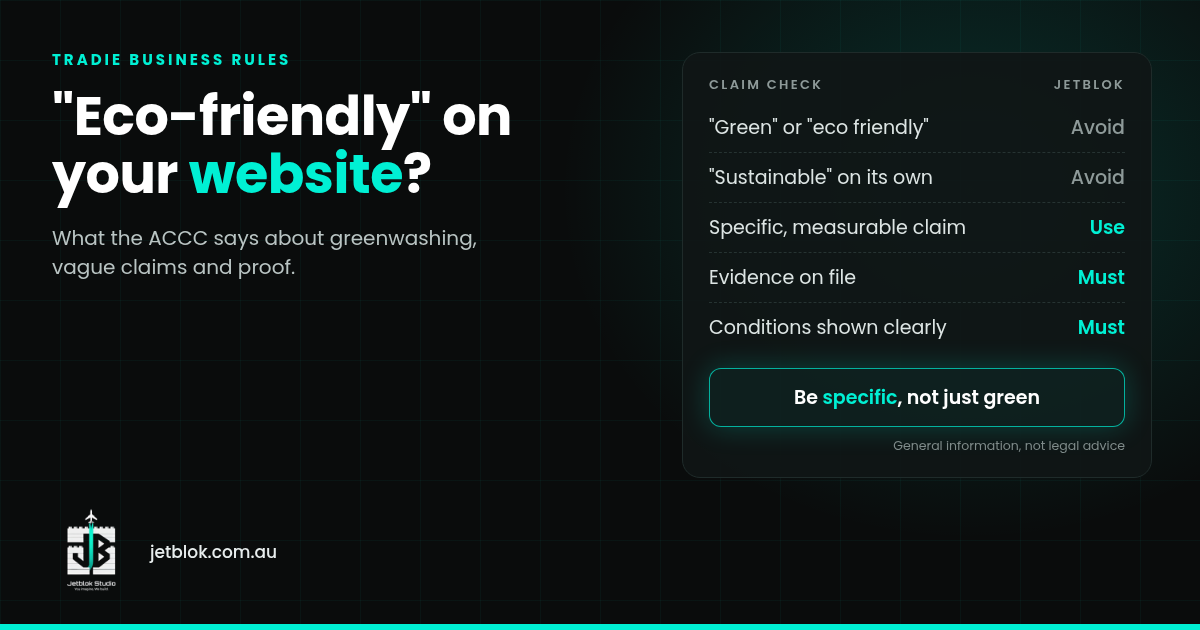
- The ACCC recommends avoiding broad words such as "green", "environmentally friendly", "eco friendly" and "sustainable", because they are vague and can easily mislead.
- Be specific and have evidence. Say exactly what is better, by how much, and keep the proof, such as product data sheets or certificates.
- Pictures count too. The ACCC says green colours, leaves and recycling logos can create a misleading impression on their own.
More Perth customers are asking about water use, power bills, low odour paint and what happens to the waste from their job. So it is no surprise that "eco-friendly plumbing", "green cleaning" and "sustainable building" pop up all over tradie websites. The trouble is that a vague green badge is exactly the kind of claim the ACCC has been targeting. Under the Australian Consumer Law, an environmental claim is treated like any other claim about your service: it has to be true, and it cannot leave people with the wrong impression.
We build websites for tradies across Perth, and the wording on service pages is one of the things we check before anything goes live. This guide sets out what the ACCC says, in plain English, so your site can talk about the good things you do without creating a risk.
This is general information from ACCC guidance, not legal advice. If you are making a big environmental claim, such as "carbon neutral", get advice first.
What "greenwashing" means
The ACCC describes greenwashing as false or misleading environmental claims that make a business appear more environmentally beneficial than it really is. It says a business is greenwashing where it uses any claim that makes a product or service seem better or less harmful for the environment than it really is. (ACCC)
Three points from that guidance matter for small businesses:
- It is not only the words. The ACCC says a business needs to consider the information that is left out and the visual elements, colours and logos used, as well as the claim itself.
- Leaving things out can mislead. The ACCC says omitting information can amount to a false or misleading representation, depending on the overall impression created.
- Accidents still count. The ACCC notes that businesses sometimes mislead consumers by accident, and that following its guidance makes that less likely.
Why the ACCC is paying attention
In its 2022 internet sweep, the ACCC reviewed the websites of 247 businesses and found 57 per cent had made concerning claims about their environmental credentials. (ACCC media release, 2 March 2023) The sectors swept included energy, household and cleaning products, and electronics and home appliances, which overlap with work many tradies do. The ACCC then published its guide, Making environmental claims: a guide for business, which sets out eight principles.
The penalties for false or misleading representations are serious. The ACCC lists maximum court penalties for each breach of up to $2,500,000 for individuals, and much higher for companies. It can also issue infringement notices, which in many cases are $21,840 for a company and $4,368 for an individual. (ACCC, Fines and penalties)
The ACCC's eight principles, in tradie terms
These come from the ACCC guide and its business guidance page. The tradie examples are ours, to show how each principle applies to a service website.
- Make accurate and truthful claims. The ACCC says even claims that are factually correct can still mislead, so think about the overall impression. "We recycle" on a builder's site suggests all job waste is recycled. If it is only the metal offcuts, say that.
- Have evidence to back up your claims. The ACCC says independent, scientific evidence is the most credible. If you say a paint is low VOC, keep the manufacturer's data sheet. If you promise future savings, the ACCC says you must have reasonable grounds for that kind of claim.
- Do not hide or omit important information. The ACCC says small print should not hide the truth or conflict with the main message. A "100% green energy" headline with "on selected jobs" in tiny text is a problem.
- Explain any conditions on your claims. If a benefit only happens in certain circumstances, the ACCC says explain this clearly and prominently. A water saving claim that depends on the customer's household size and usage should say so.
- Avoid broad and unqualified claims. This is where "eco friendly" and "sustainable" sit. More on this below.
- Use clear and easy to understand language. The ACCC says most consumers do not have specialist knowledge, so avoid technical terms that customers may read the wrong way.
- Visual elements should not give the wrong impression. Green colours, leaf icons and recycling logos all send a message. The ACCC gives the example of the recycling symbol, which can suggest a product is made from recycled materials, recyclable, or both.
- Be direct and open about your sustainability transition. The ACCC says be cautious about aspirational goals and do not make claims unless there are legitimate plans in place to meet them. "Going fully electric by 2027" needs a real plan behind it.
The words the ACCC recommends avoiding
The ACCC names some commonly used broad terms and recommends businesses avoid them, because they do not tell consumers what the environmental benefit actually is. (ACCC)
- "Green": the ACCC says it is vague and conveys little information other than a claim to be less damaging than others.
- "Environmentally friendly" or "eco friendly": the ACCC says these risk misleading people into thinking a service causes no harm to the environment, and few, if any, products can truthfully make this claim.
- "Sustainable": the ACCC says it is overly general and risks suggesting resources are only used at a rate that will not contribute to environmental harm.
The ACCC's own example shows the fix. A business claimed its product "does not harm the environment" when only the bottle was recycled. The ACCC suggested a more accurate claim, "reduce harm to the environment", along with saying which parts were made from recycled material.
Vague versus specific: tradie examples
Here is how a few common website lines could be made more specific. These are illustrations only. Every claim still needs to be true for your business and backed by your own records.
- Painter: instead of "Eco-friendly painting", try "We use low VOC interior paints on request, and can show you the product data sheet."
- Plumber: instead of "Green plumbing solutions", try "We supply and install water efficient tapware and toilets, and can show you the WELS star rating before you choose."
- Cleaner: instead of "100% non-toxic cleaning", try "We use plant based cleaning products where suitable. Ask us for the product list."
- Builder or landscaper: instead of "Sustainable building", try "We separate clean timber, metal and concrete from our job sites for recycling where a local facility accepts it."
- Electrician: instead of "Save the planet with LEDs", try "LED downlights use less power than halogen globes. We can talk you through the wattage of each option."
Specific lines like these are also better for customers searching Google, because they match what people actually type, such as "water efficient toilet install" or "low VOC painter Perth". That is the same reason we push for detailed service pages on every Perth web design project.
Certifications, logos and badges
One of the issues the ACCC flagged in its sweep was businesses using third-party certifications and symbols in a confusing way. (ACCC) Before you put a badge on your website:
- Only use a certification logo if you actually hold that certification, and keep it current.
- Make clear what it covers. A certified product you install does not make your whole business certified.
- Do not design your own "eco" seal that looks like an official one.
- Remove expired badges when a certification lapses.
The same thinking applies to other trust signals on a tradie site, such as reviews and testimonials and workmanship guarantees. If it is on the page, you need to be able to back it up.
Quick checklist
- No stand-alone "green", "eco friendly" or "sustainable" claims without detail.
- Every environmental claim says exactly what is better and, where possible, by how much.
- You keep evidence for each claim, such as data sheets, ratings or certificates.
- Conditions are stated clearly near the claim, not hidden in small print.
- Leaf icons, green colours and recycling logos do not suggest more than you can prove.
- Certification badges are current and accurate about what they cover.
- Future goals are backed by a real plan.
Frequently Asked Questions
Is it illegal to say my business is eco-friendly?
The words themselves are not banned, but the ACCC recommends avoiding "eco friendly" because it is vague and risks misleading people into thinking your service causes no harm to the environment. A specific, provable claim is much safer.
Does the ACCC only go after big companies?
The Australian Consumer Law applies to all businesses, and the ACCC's guidance on environmental claims is written for businesses generally. Its penalties page lists amounts for individuals as well as companies.
What counts as evidence for an environmental claim?
The ACCC says independent and scientific evidence is the most credible, and that making your evidence easy for customers to access helps them trust your claims. For tradies, that often means manufacturer data sheets, product ratings or certificates.
Can a green logo or leaf icon be a problem?
It can. The ACCC says visual elements such as green colours and logos can influence a consumer's impression, and businesses should avoid visuals that give the wrong impression about environmental benefits.
Can I say I am working towards being more sustainable?
Yes, if it is true. The ACCC says be direct and open about your transition, be cautious about aspirational goals, and only make claims when there are legitimate plans in place to meet them.
Sources
- ACCC, Environmental and sustainability claims
- ACCC, Making environmental claims: a guide for business
- ACCC, Greenwashing internet sweep unearths widespread concerning claims (2 March 2023)
- ACCC, Fines and penalties
Want a tradie website with claims you can back up?
JetBlok builds fast, custom tradie websites for businesses in Gosnells, Thornlie, Armadale and across Perth, with specific, honest service pages that customers trust and Google understands. Also worth a read: the ACCC rules for showing prices on your website.
See it first, pay later: 10% deposit (minimum $199) to start, No GST charged. Build your quote or check our pricing.