Quick answer
- Yes, you can door knock or cold call, but rules apply. If you approach a householder uninvited, at their door, by phone or in a public place, and the deal is worth more than $100 (or the value is unknown), it is an unsolicited consumer agreement under the Australian Consumer Law. (ACCC, Telemarketing and door-to-door sales)
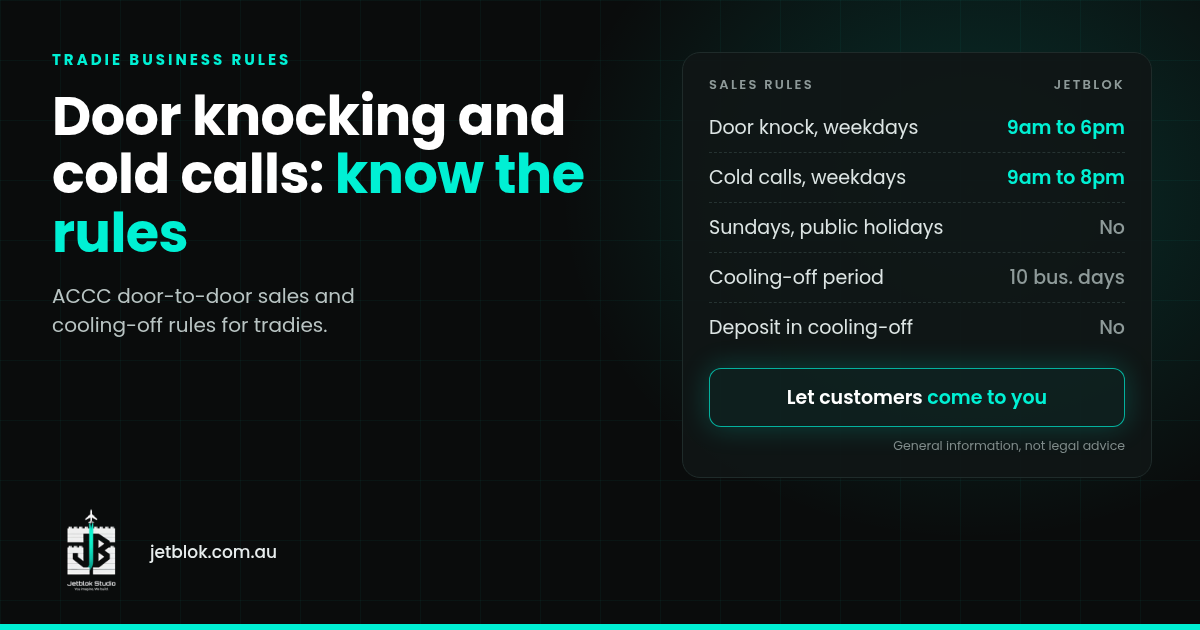
- Set hours. Door knocking is allowed weekdays 9am to 6pm and Saturdays 9am to 5pm. Cold calls are allowed weekdays 9am to 8pm and Saturdays 9am to 5pm. Never on Sundays or public holidays.
- 10 business day cooling-off. The customer can cancel for any reason. During that time you cannot supply services or take payment, except for electricity, gas or emergency repairs.
- Break the rules and the cooling-off stretches to 3 or 6 months.
- Invited enquiries are different. These rules are about uninvited approaches. When a customer finds you and asks for a quote, the unsolicited sales rules are not what governs that job.
Plenty of Perth tradies win work the old way. A solar installer knocks on doors after a hail storm, a roofer spots rusty gutters and leaves a card, a pest controller rings past customers. None of that is illegal. But once you approach someone who did not ask to hear from you and the job is worth more than $100, the law treats the sale very differently from a normal quote.
We build websites for tradies in Gosnells and across south-east Perth, and a big part of the reason is simple: when customers come to you, the sale is easier, faster and carries far fewer strings. This guide sets out what the ACCC says about door-to-door sales and cold calls in plain English.
This is general information from ACCC and state consumer agency guidance, not legal advice. If door knocking or telemarketing is a big part of how you sell, get advice from a lawyer or your industry association.
What counts as an unsolicited consumer agreement?
The ACCC says the rules apply when all of these are true:
- you or your salesperson approach a consumer to sell goods or services without being invited
- the negotiation happens by phone or in person somewhere other than your business premises, such as their front door or a shopping centre
- the total value is more than $100, or was not known when the agreement was made
The ACCC also says a few situations people often think are safe still count as uninvited:
- a customer gave you their details for one purpose, such as a competition entry, and you then contact them to sell something else
- a customer returns a missed call you made to sell to them
So a raffle box at a home show that turns into a sales call list is not a loophole. (ACCC)
When can tradies door knock or cold call?
| Method | Weekdays | Saturday | Sunday and public holidays |
|---|---|---|---|
| Door knocking | 9am to 6pm | 9am to 5pm | Not allowed |
| Cold calls (telemarketing) | 9am to 8pm | 9am to 5pm | Not allowed |
Consumer Affairs Victoria notes that a visit outside these hours is fine if the appointment was made with the customer's consent. (Consumer Affairs Victoria, Door-to-door sales)
What you must do at the door or on the phone
- Say who you are. Give your name, the name and address of the business you represent, and why you are calling or visiting.
- At the door, tell them they can ask you to leave. If they do, you must leave straight away and the business cannot contact them again for 30 days.
- Respect Do Not Knock signs. The ACCC says salespeople must treat the sign the same as a request to leave. The Federal Court has found the same, according to the ACCC's July 2026 review.
- Respect the Do Not Call Register for phone sales.
- No pressure. Physical force, coercion and undue harassment are against the law.
The written agreement you must hand over
If the customer says yes, the ACCC says they must get a typed, easy to read sales agreement, straight after signing in person or within 5 business days after a phone sale. It must include:
- the full terms and conditions
- the total price including any GST, or how the price will be worked out, plus any delivery charges
- the salesperson's name and contact details
- your business address, email and ABN or ACN (see our guide to ABN rules for tradies)
- cooling-off information and a form the customer can use to cancel
The front page must carry the ACCC's Important notice to the consumer about the right to cancel within 10 business days, and be signed and dated by both of you.
The cooling-off period: no work, no payment
This is the part that hurts tradies most. The customer can cancel for any reason within 10 business days, starting the first business day after they sign or receive the agreement. During that time you must not:
- supply any services, except electricity, gas or emergency repairs
- take any payment, including a deposit, except for electricity, gas or emergency repairs
Goods under $500 (including GST) can be supplied. If the customer cancels, you must refund any money straight away and cannot pressure them to change their mind. (ACCC)
In practice, a job you signed at the door on Monday usually cannot start, or take a deposit, for about two weeks. If you normally ask for a deposit, also read our guide to deposit rules in WA.
Break the rules and the cooling-off stretches
| If you... | Cooling-off becomes |
|---|---|
| call or visit outside the allowed hours | 3 months |
| do not give your name or the business name and address | 3 months |
| do not say why you are calling or visiting | 3 months |
| do not tell them about cooling-off | 6 months |
| do not hand over a written agreement, or leave out required details such as the cancel form | 6 months |
| supply services, or goods over $500, during cooling-off | 6 months |
Consumer Affairs Victoria adds that taking or asking for payment during cooling-off also pushes it to 6 months, and services supplied early are treated as unsolicited supplies that the customer does not have to pay for. That means you could finish a job and never be paid for it.
Lead generators are on the ACCC's radar
If you buy leads from a company that door knocks or cold calls for you, the rules still apply to how those customers were approached. In July 2026 the ACCC published a review of unsolicited selling and lead generation that looks at consumer harm and argues for changes to the law. (ACCC review, July 2026) Before you pay for leads, ask how they were collected.
Why inbound enquiries are simpler
The unsolicited rules are triggered by you approaching the customer uninvited. When a homeowner in Thornlie searches for a plumber, finds your site, and fills in your quote form, they invited the contact. You still have to follow the normal rules, such as clear pricing and fair terms (see unfair contract terms for tradies), but you are not working under the uninvited sales regime.
A good tradie website does the knocking for you:
- it shows up when locals search for your trade and suburb, backed by a Google Business Profile
- it answers the price and trust questions before they call, with photos, reviews and your licence details
- it has a short quote form, so leads arrive with the job details already filled in
- every lead is someone who already wants the job done
If you still letterbox drop, point the flyer at your website or a quote page, so the customer chooses to contact you.
Quick checklist before your next door knock or call run
- Check the time and the day, and skip Sundays and public holidays.
- Skip any house with a Do Not Knock sign, and check numbers against the Do Not Call Register.
- Introduce yourself, your business and why you are there.
- Carry compliant written agreements with the cooling-off notice and cancel form.
- Do not book the job or take a deposit until cooling-off ends, unless it is a genuine emergency repair.
- Better still, build a steady flow of inbound enquiries so you rely on cold sales less.
Sources
- ACCC, Telemarketing and door-to-door sales
- ACCC, Unsolicited selling and lead generation review, July 2026
- Consumer Affairs Victoria, Door-to-door sales
Want customers to come to you?
JetBlok builds fast, custom tradie websites for businesses in Gosnells, Thornlie, Canning Vale, Armadale and across Perth, built to bring in inbound quote requests instead of cold leads.
See it first, pay later: 10% deposit (minimum $199) to start, No GST charged. Build your quote or check our pricing.
More Australian tradie rules, from contracts and deposits to what you can claim on a website, are on the tradie rules hub.