Quick answer
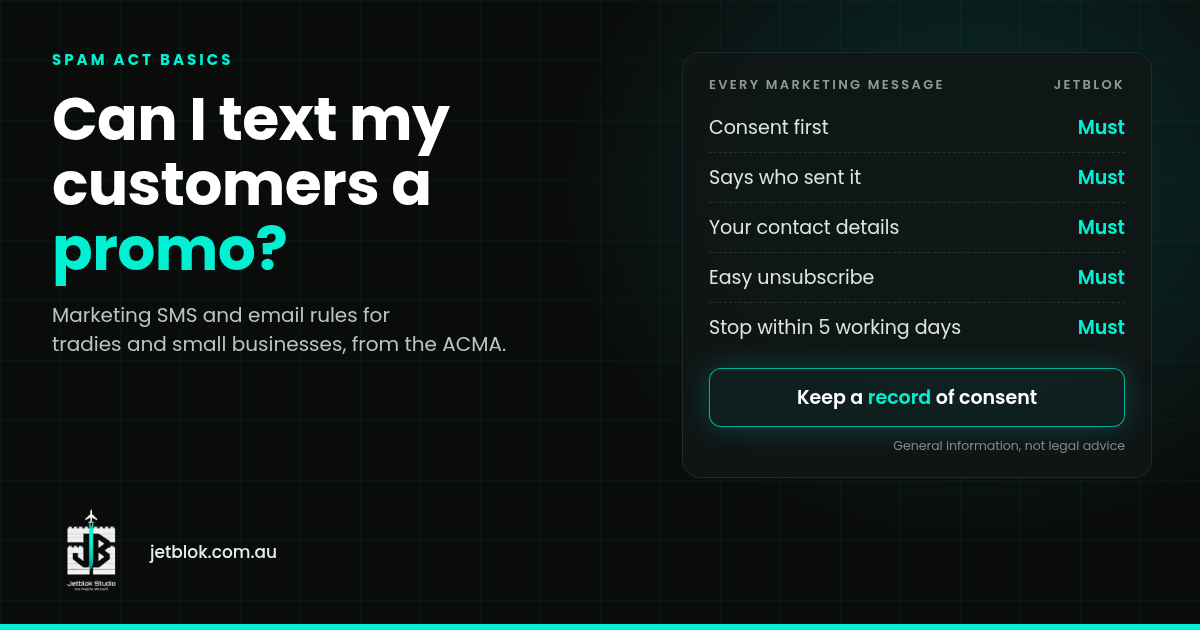
- Yes, you can send marketing texts and emails, but you must have each person's consent first. (ACMA)
- Every marketing message must say who sent it, include your contact details and make it easy to unsubscribe. (ACMA)
- Unsubscribe requests must be honoured within 5 working days, and the unsubscribe option must keep working for at least 30 days after you send. (ACMA)
- The easiest way to stay on the right side of the rules is a clear opt in tick box on your website quote form, plus a record of who ticked it and when.
A quiet month comes along and the idea is obvious: send a quick text to everyone who has ever asked for a quote. "Winter special, 10% off gutter cleans this month." It feels like a friendly nudge. Under Australian law it is a commercial electronic message, and the Spam Act 2003 decides whether you are allowed to send it.
We build websites for tradies in Gosnells and across south-east Perth, and every one of them collects phone numbers and emails through a quote form. So this question comes up often. Here is what the Australian Communications and Media Authority (ACMA) says, in plain English. This is general information, not legal advice.
What counts as a marketing message?
The ACMA says the spam laws apply to commercial electronic messages, such as SMS and email marketing. If a message offers, advertises or promotes a product or service, it must follow the spam laws, and the ACMA notes that sometimes only one part of a message is promotional but the message is still commercial. (ACMA fact sheet)
So a job confirmation text ("we'll be there at 8am Tuesday") is a different thing from a booking reminder that also pushes a discount on your next service. Once you add the promo, treat it as marketing.
Rule 1: get consent before you send
The ACMA is direct about it: if you plan to send marketing messages or emails, you must first have consent from the person who will receive them. That still applies if someone else, like an SMS platform or a marketing agency, sends the messages for you. (ACMA)
Express consent (the safe option)
Express consent means the person knows and accepts that they will get marketing from you. The ACMA calls this best practice, and lists ways people can give it: filling in a form, ticking a box on a website, over the phone, or face to face. (ACMA)
One trap: you cannot send a text or email asking for consent, because the ACMA treats that request as a marketing message itself. (ACMA)
Inferred consent (the shaky option)
In some cases you may be able to infer consent, usually when the person has a provable, ongoing relationship with your business and the marketing is directly related to that relationship. The ACMA says this does not cover sending messages just because someone has bought something from you, and that inferred consent is not as reliable as express consent. (ACMA)
For most tradies, that means a one off customer from last year is not someone you should assume is happy to get promos. Ask properly next time instead.
Bought lists are your problem
If you buy or use a marketing list, the ACMA says you are still responsible for making sure you have consent for every address on it. (ACMA)
Rule 2: say who you are
Every marketing message must accurately identify your name or business name and include correct contact details. If someone sends on your behalf, the message must still identify you as the business that authorised it. The ACMA says to use the correct legal name of your business, or your name and ABN, and that this information must stay correct for at least 30 days after you send. (ACMA)
In a short SMS that can be as simple as your registered business name and your phone number at the end.
Rule 3: make unsubscribing easy
Under the Spam Act, every commercial message must include an unsubscribe option that, according to the ACMA: (ACMA)
- gives clear unsubscribe instructions
- is honoured within 5 working days
- does not charge a fee
- does not cost more than the usual cost of using that address, such as a standard text charge
- works for at least 30 days after the message was sent
- does not make the person give extra personal information, or log in to or create an account, to unsubscribe
The ACMA's own examples include "Reply STOP" for SMS. It also warns that if you send SMS with a name as the sender (an alphanumeric header) instead of a number, those messages generally cannot receive replies, so "Reply STOP" will not work from them. (ACMA)
Rule 4: keep a record
The ACMA says to keep a record when someone gives express consent, including who gave it, when and how, and that under the Spam Act it is up to you to prove you have consent. (ACMA) Its fact sheet adds that your business stays liable even when you use an outside provider: "you cannot outsource your risk". (ACMA fact sheet)
Where your website does the heavy lifting
This is where a well built website saves you hassle. A quote form can collect consent properly at the moment someone is already giving you their details:
- An unticked opt in box. Something like "Send me the occasional special and seasonal reminder. Unsubscribe any time." Leave it unticked so the customer chooses. The ACMA tells consumers to watch for pre-checked boxes, which tells you how they are seen. (ACMA)
- Clear terms next to the box. The ACMA says consumers should expect clear terms at the point of consent, covering what it is for, who will use it, how long it lasts and how to withdraw it. (ACMA)
- A saved timestamp. The form submission records the date, time and the box they ticked, which is the record the ACMA says you need.
- A privacy page in the footer. If you collect personal information, link a short privacy page as well. See our guide on whether your small business website needs a privacy policy.
Quick checklist before you hit send
- Did every person on this list say yes to marketing, and can you show when and how?
- Does the message name your business and include your contact details?
- Is there a clear way to unsubscribe that actually works from this sender?
- Will you remove anyone who opts out within 5 working days?
- If a platform sends it for you, have you checked it follows the rules too?
FAQs
Can I text a customer about their booked job?
The spam rules are about messages that offer, advertise or promote a product or service. A plain job update is a different thing, but if you add a promotion to it, the ACMA says the message can still be commercial. (ACMA fact sheet)
Can I text everyone who ever asked for a quote?
Only if you have their consent. Asking for a quote is not the same as agreeing to marketing, and the ACMA says inferred consent does not cover someone who has just bought from you. (ACMA)
Can I send a message asking if they want to hear from me?
No. The ACMA says a message asking for consent is itself a marketing message. Ask in person, on the phone, or with an opt in box on your quote form instead. (ACMA)
Who enforces this?
The ACMA. It takes complaints and reports from people who think a business has broken the spam rules. (ACMA)
Sources
- ACMA, Avoid sending spam: https://www.acma.gov.au/avoid-sending-spam
- ACMA, Dealing with spam: https://www.acma.gov.au/dealing-with-spam
- ACMA, Email and SMS unsubscribe rules fact sheet: https://www.acma.gov.au/sites/default/files/2024-05/Fact%20sheet%20-%20email%20and%20SMS%20unsubscribe%20rules.pdf
Guidance checked on 28 October 2026. This is general information, not legal advice. Check the ACMA website or speak to a lawyer about your own business.
Want a quote form that collects consent properly?
JetBlok builds fast websites for tradies and small businesses in Gosnells and across Perth, with an opt in box on your quote form, a privacy page and your Google listing sorted. For more on getting found, read our Google Business Profile guide for Perth.
See it first, pay later: 10% deposit (minimum $199) to start, No GST charged. Build your quote or check our pricing.