I'm Rav, and I run JetBlok Studio, a web design and SEO studio in Gosnells, Perth. I write the code myself, so when someone asks me about web dev cost, my honest answer is that you're mostly paying for time. Hours spent planning, designing, building, testing and fixing. The total on a quote is those hours, plus the developer's guess at how much the job might grow.
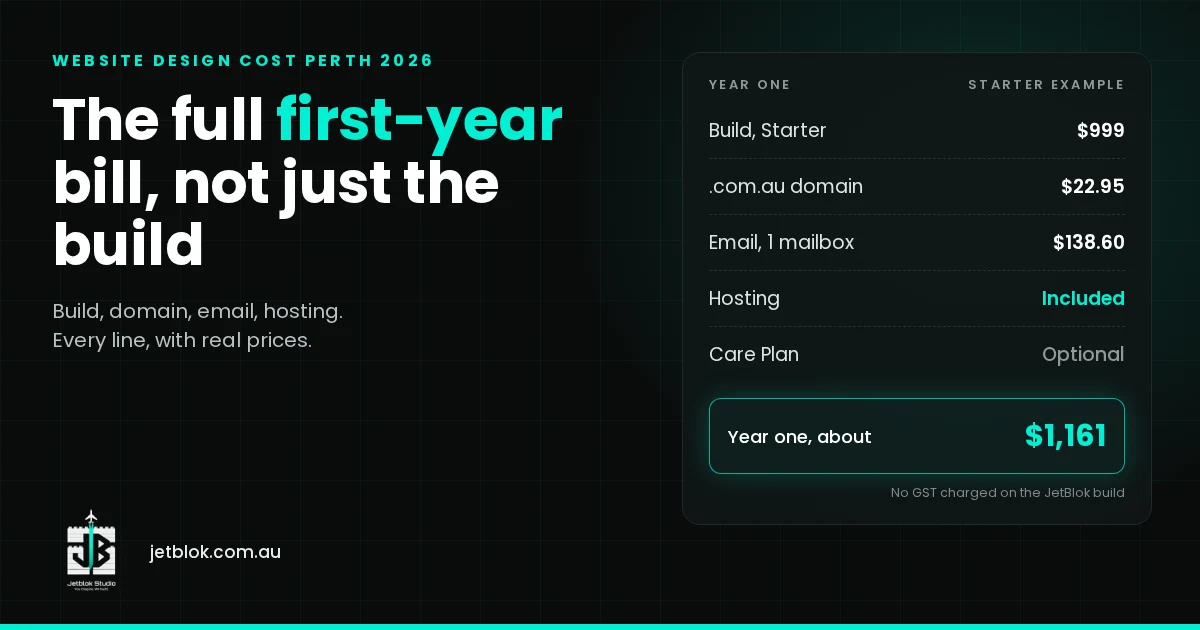
If you want my package prices side by side, they're on my web design cost Perth page, and the full first-year bill (domain, email, hosting) is in my first-year cost guide. This post is about the developer side: where the hours go, how they're billed, and which features push the number up. For how I build, see web design Perth and websites for tradies.
Web dev cost is mostly developer time
A quote is a list of tasks with time attached. When two quotes are thousands of dollars apart, look for the tasks that appear in one and not the other. On a typical small business site, the hours go on:
- Planning: which pages you need, what each one is for, and how they link together. Get this wrong and everything after it gets redone.
- Design: the look of the home page, then every other page that follows it.
- Building: turning the design into a fast site that works on every phone and browser.
- Content: writing the words and preparing your photos. Some quotes include it, some expect you to supply it.
- Features: forms, bookings, galleries, calculators, ordering. Each one has to be built, connected and tested.
- Moving an old site: keeping your old page addresses working so you don't lose the Google traffic you've already got.
- Testing and launch: checking forms actually send, the phone number taps to call, and the site loads quickly on mobile data.
Every one of those is time. A cheap quote usually isn't dishonest, it's just narrower: fewer of those lines, or less time on each. An expensive quote can include work you'll never need. A plumber with five core services and a handful of suburbs doesn't need the same hours as a multi-location retailer.
What does an hour of developer time cost? There's no official freelance rate in Australia. The closest official figures are wages: Jobs and Skills Australia publishes median earnings data for employees in the multimedia specialists and web developers group from ABS data, and says the figures are a guide only. That's what an employee earns, not what a freelancer or studio charges. A business rate also has to cover software, insurance, unpaid quoting time and the weeks between jobs.
Hourly, day rate or fixed: how web dev cost gets billed
There are three common ways developers bill, and the big difference between them is who pays if the job runs long.
Hourly. You pay for the time actually spent. It's fair for small fixes and open-ended work, but if the job takes twice as long, you pay twice as much. If someone quotes hourly, ask for an estimate range and a cap.
Day rate. Common for contract developers working inside a bigger project. In an r/cscareerquestionsOCE thread about Australian freelance rates from 2024, one developer said "I usually bill per day. Range is usually $850~$1000 AUD / day." Another put it "anyway between 600-1200 daily rate", and a third said "Rates I've seen offered on contracts posted on Seek typically range from $100-$120 an hour." Those are individual reports about contract work generally, not small business websites, and they're two years old. They do show why a small business owner rarely sees a day rate: a five-page site isn't usually sold by the day.
Fixed price. You agree on a scope and a number before work starts. If the developer underestimated the hours, that's their problem, not yours. The catch is the scope. A fixed price only stays fixed for the work written down, which is why the list of pages and features matters more than the headline figure.
Business owners mostly want the third one. In an r/ausbusiness thread about website quotes, one owner who'd gone a year without a site said: "Personally I want a decent quote within %10 when I outlay what I want." That's fair, and it's why I sell fixed packages. More on when a fixed package is the wrong tool in my fixed price website design guide, and questions to ask any developer in my guide to choosing a web dev company in Perth.
The features that move web dev cost the most
Pages are the cheap part. Features that do a job, rather than just show information, are where the developer hours stack up. In that same r/ausbusiness thread, a commenter (who disclosed they work for an invoicing software company) put it well: "The part that usually blows up quotes is when the website scope quietly turns into back-office software."
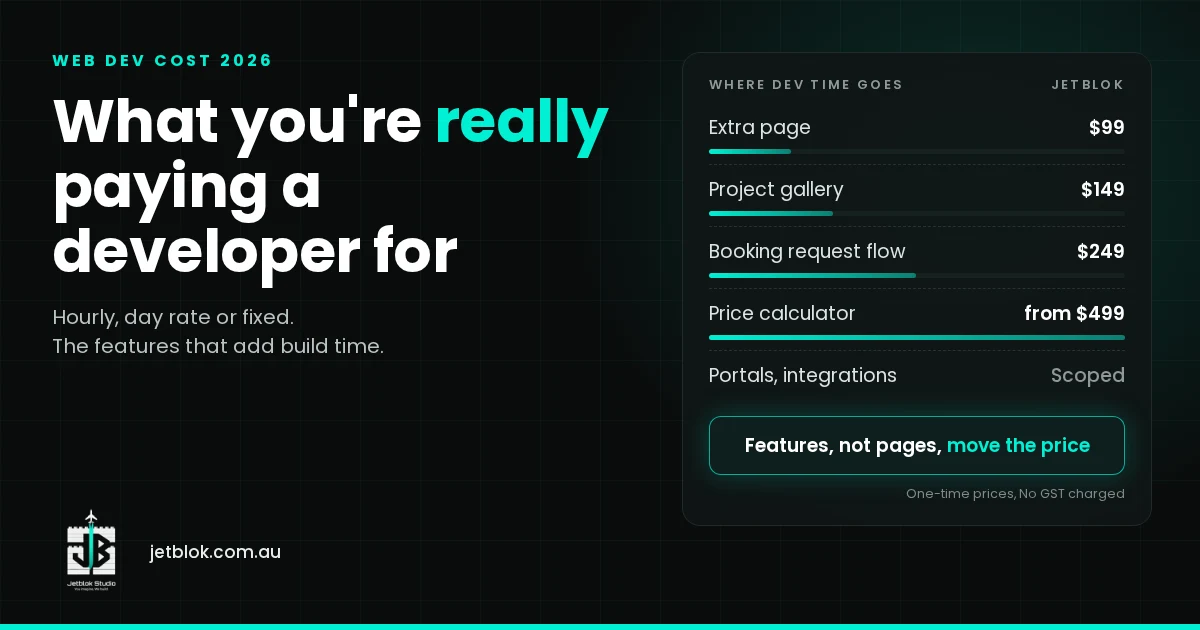
Here's what some of those features cost on my live pricing page, checked on 21 October 2026. All one-time, No GST charged:
| Feature | What it does | JetBlok price |
|---|---|---|
| Home page | Every site starts here, copywriting included | $599 (page-by-page builder) |
| Extra page or suburb page | Another service or suburb explained properly | $99 each |
| Before and after or project gallery | Shows the work, not just the words | $149 |
| Google reviews on site | Lets happy customers sell for you | $149 |
| Quote or booking request flow | Turns visits into booked jobs | $249 |
| Instant price calculator | Customers price the job themselves | from $499 |
| Online ordering (JetBlok Order) | Takes orders without the apps' cut | $499 |
| Customer portals, complex layouts | Logins, dashboards, bigger custom work | Pro, $2,999+, scoped from your feature list |
You can see the jump. A page is mostly writing and layout. A booking flow has to collect details, send them to you, confirm with the customer and be tested on every device. A calculator needs your pricing rules turned into logic that can't give a customer a wrong number. Portals and connections to job or accounting software are bigger again, which is why I scope those individually instead of putting a fixed price on them.
Perth developers on Reddit say the same thing about where the number climbs. In an r/perth thread from a start-up owner asking what a simple site costs, a self-described Perth WordPress developer suggested budgeting roughly $1,500 to $3,500 for a simple site, adding: "Once you start adding things like online bookings, eCommerce, custom functionality, copywriting or more serious SEO work, the price can move up pretty quickly." Another Perth freelancer quoted "starting at $1,000 ex. GST and that'd be 1-2 weeks work" for a simple site. Single reports again, but they line up with the table: features, not pages, move web dev cost.
Before you pay for a custom feature, ask whether you need it on day one. A simple quote request form often does the job of a full booking system for a trade business, and you can add more later.
Custom code, WordPress or a builder: where the hours land
The platform changes where the developer time goes, not whether you pay for it.
- A DIY builder (Wix, Squarespace and similar) moves the hours onto you. The top comment in that r/perth thread, from a Perth web developer, suggested doing it yourself when you're just starting out, because "Any half-decent web dev will charge a few thousand minimum for a simple site like what you're looking for". Honest advice, and sometimes the right call.
- WordPress spends hours on theme setup, plugins and keeping them updated after launch. My WordPress vs custom guide goes through the trade-offs.
- Custom code spends the hours upfront on building exactly what you need. JetBlok builds in Next.js, and hosting is included on the Next.js sites we host, so there's no plugin stack to maintain. My custom website vs Wix guide covers the speed side.
Whatever the platform, compare quotes built on the same one. A template install and a custom build are different products, so their prices aren't really competing.
How web dev cost creeps, and how to stop it
Most budget blowouts aren't the first number. They're the additions. Sprintlaw's guide to website development agreements puts it plainly: "Website builds tend to start simple and grow." It suggests your contract states the "Total price or rate (fixed fee, hourly, or staged pricing)" and "What triggers additional fees", such as extra pages and new features, and it calls a variations clause "your best friend here. It forces transparency about time and cost before the work is done."
In plain terms, before you sign:
- Get the page list and feature list in writing, not "up to X pages".
- Ask how changes are priced, and get a yes that nothing extra is built until you've approved the price.
- Agree who supplies the words and photos, and by when. Waiting on content is one of the most common reasons a build drags.
- If it's hourly, get an estimate range and a cap.
- Ask what a small change after launch costs, and whether ongoing support is optional.
You've also got basic protection. The ACCC says "Service providers must carry out all services using an acceptable level of care and skill", and that "Services must be supplied within a reasonable time, if there's no agreed time frame." Those guarantees cover services bought for a business when they cost less than $100,000 including GST. It's general information, so talk to a lawyer if a job goes wrong.
For scoring two quotes side by side, use my guide to comparing website design Perth quotes.
How I price developer time at JetBlok
I publish my prices so you can see the web dev cost before you talk to anyone:
- Starter, $999: up to 5 pages (or a focused one-pager), mobile-ready design, SEO foundations, enquiry form, click-to-call and a map.
- Growth, $1,999: up to 10 pages, quote or booking-style forms, Google Business Profile setup and 3 months of Local SEO.
- Pro, $2,999+: custom design, before and after, calculators, portals and complex layouts, scoped from your feature list.
- Page by page: from $599 in my quote builder, with copywriting for every page included.
No GST charged on any of it. The Care Plan is optional at $299 a month, and my care plan guide covers when it's worth it.
See it first, pay later. We agree the quote upfront. It's a 10% deposit (minimum $199) to start, and your first preview lands within 3 to 5 business days of your deposit and content. You see the finished site before you pay the balance, and you pay before it goes live. If you want a new page or feature beyond the agreed quote, it's priced with you first, never added to the bill after the fact. You own the domain and, once paid in full, the finished site. No ranking promises.
The bottom line
Web dev cost is developer time, and the biggest swings come from features, not pages. Decide what the site has to do on day one, get the scope and the change process in writing, and pick a billing model that puts the overrun risk where you're comfortable with it. If you want a straight fixed quote to compare, get a quote or call me, and see how I work on web design Perth and websites for tradies.
Cover image: JetBlok Studio. Sources: JetBlok pricing and quote builder (21 Oct 2026); Jobs and Skills Australia (ABS data); Sprintlaw; ACCC; Reddit threads linked above. Reddit figures are individual reports, not benchmarks. This isn't legal or financial advice.
Frequently Asked Questions
What makes up web dev cost?
Mostly developer time: planning the pages, designing the look, building and connecting each feature, testing on real phones, and launching. Content, photos and any links to other software add time too. That's why the same five-page brief can be quoted very differently, so ask every developer to list the work, not just the total.
Is it cheaper to pay a web developer hourly or a fixed price?
It depends on how clear your scope is. Hourly or day rates suit open-ended work, but you carry the risk if it runs long. A fixed price suits a clear brief, because the developer carries the overrun. For a small business site, a fixed quote with a written process for changes is usually the easier one to budget.
How much do web developers charge per hour in Australia?
There's no official freelance rate. On Reddit, Australian contract developers report day rates from about $600 to $1,200, but those are single reports.
Which website features add the most to the cost?
Anything that does a job, not just shows information: booking or quote request flows, price calculators, online ordering, customer portals and links to job or accounting software. At JetBlok, a quote or booking request flow is $249, an instant price calculator is from $499 and online ordering is $499, all No GST charged. Portals and complex integrations are scoped on Pro.
How do I stop a web dev quote from creeping up?
Get the page list and features in writing, agree how changes are priced before work starts, and supply your content and photos on time. A variation clause means any extra is quoted and approved before it's built. At JetBlok, new pages or features beyond the agreed quote are priced with you first.
What does JetBlok charge for web development?
Starter is $999, Growth is $1,999 and Pro is $2,999+, all one-time and No GST charged, or build page by page from $599 with extra pages at $99 each. It's a 10% deposit (minimum $199) to start, and you see the finished site before you pay the balance. Call or WhatsApp 0431 242 326, email [email protected], or get a quote.