

Here's something that changes how you prepare for PTE Reading: the Reading score isn't only about the Reading part. A big slice of it comes from tasks in other parts of the test. Once you see how PTE's integrated scoring works, you can stop wasting time on low-value tasks and put your effort where it moves your score.
This guide covers where the Reading points come from, the strategies for each task and a time plan for hitting 79+ or 90. The official rules (timings, scoring types, negative marking) come from Pearson's score guide. The percentages and many of the tactics come from PTE coaches and teachers, and I've labelled them that way.
If you haven't yet, start with the PTE Academic 2026 complete guide for the whole test.
Quick Summary (click to expand)
- Coaches estimate about 39% of your Reading score comes from tasks outside the Reading part
- Fill in the Blanks (both types): about 45% of Reading, by coach estimates
- FIB strategy: read around the blank and use grammar clues hard
- Reorder Paragraphs: find the opener and linked pairs, then move on
- Multiple Choice is a time trap, and Multiple Answers has negative marking
- The "2 out of 3" idea: be strong in 2 of the 3 main groups
- Time plan: most of your 23 to 30 minutes goes to the FIBs
- Build collocations, and practise SWT and HIW as Reading tasks too
The Secret: Your Reading Score Starts Outside the Reading Part
This is the biggest insight for PTE Reading, and most people don't know it. Pearson's score guide shows that some tasks in Speaking & Writing and in Listening also feed Reading. Using the weighting table coaches quote from Pearson, here's roughly how much:
- Summarize Written Text (SWT): about 23% of Reading
- Highlight Incorrect Words (HIW): about 13% of Reading
- Highlight Correct Summary (HCS): about 3% of Reading
So, on those estimates, around 39% of your Reading score is decided outside the Reading part. If SWT or HIW goes badly, your Reading score suffers however well you do on the Reading tasks themselves.
Key takeaway: Reading prep doesn't start in Reading. It starts with SWT in Part 1 and HIW in Listening. If your Reading score is below target, check those two first.
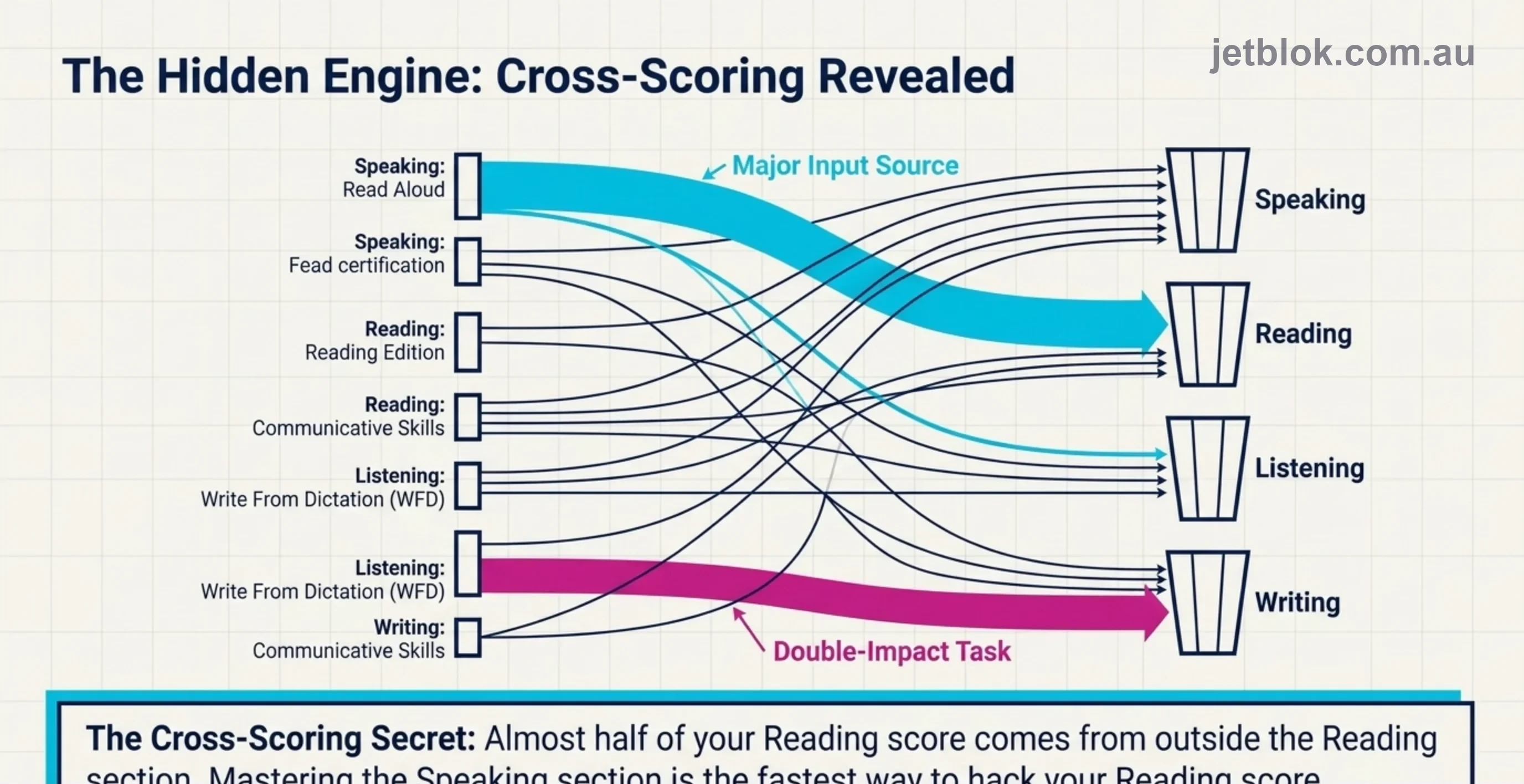
Reading Score Breakdown: Where the Points Come From
Now the tasks inside the Reading part. The item counts and scoring types are from Pearson's score guide. The percentages are coach estimates from the weighting table quoted from Pearson's teacher document. They're averages, not a formula.
| Task | Items (Pearson) | Approx. overall weight | Approx. share of Reading |
|---|---|---|---|
| Fill in the Blanks (Dropdown) | 5 to 6 | 7% | 25% |
| Fill in the Blanks (Drag and Drop) | 4 to 5 | 6% | 20% |
| Reorder Paragraphs | 2 to 3 | 3% | 9% |
| Multiple Choice, Multiple Answers | 2 to 3 | 1% | 5% |
| Multiple Choice, Single Answer | 2 to 3 | under 1% | 3% |
The two Fill in the Blanks tasks together are about 45% of Reading on these numbers. Nearly half your Reading result from two task types. Meanwhile Multiple Choice, Single Answer is under 1% of your overall score.
That tells you where to put your prep time, and where to stop wasting it.

Fill in the Blanks: The Core Strategy
Since the FIBs carry so much weight, let's go through both.
Fill in the Blanks (Dropdown): about 25% of Reading
You read a passage with gaps and pick the right word for each from a dropdown. It's the biggest task in the Reading part. In the current test, Pearson's score guide lists it as a Reading task only. (Older guides call it "Reading & Writing Fill in the Blanks" and say it feeds Writing. That's no longer the case.)
Strategy:
- Read 2 or 3 words either side of the blank first. The answer usually connects to what's right next to it. Skim the passage once for the gist, then let the local clues do the work.
- Read for logic, not synonyms. Don't hunt for the word that "means the same" as something nearby. Ask: "Which word makes this sentence make sense?"
- Use grammar clues hard. Look at the preposition after the blank, the tense of nearby verbs and any article before it. These knock out wrong options faster than trying to understand everything.
Example: "The study was _____ by a team of researchers." The blank needs a past participle (conducted, carried out, led). "Was ... by" tells you it's passive, which rules out the other forms straight away.
Fill in the Blanks (Drag and Drop): about 20% of Reading
You drag words from a box into the gaps. There are more words than gaps, so some won't be used.
Strategy:
- Do the easy blanks first. Once a word is placed, it's out of the box, which makes the harder gaps easier.
- Eliminate, don't guess. For each gap, rule out words that can't fit the grammar or make no sense. "It can't be a noun, it needs a verb" is faster and more accurate than hunting for the "best" word.
- Get it down to two. If you can rule out all but two options, your odds are far better than picking from 6 to 8. FIBs give partial credit, so every correct word counts, and a blank costs you nothing to fill.
Grammar Rules for FIBs: Cheat Sheet
These patterns come up again and again. Learn them and you'll fill blanks faster:
Match the tense: Look at the other verbs in the sentence. "The researchers discovered that the compound _____ significant results" needs a past tense verb (produced, showed, yielded).
Singular or plural:
- "One of the _____" → plural noun (one of the reasons)
- "Another _____" → singular noun (another study)
- "Each _____" → singular noun (each participant)
- "Several _____" → plural noun (several studies)
The comma rule (a coaching rule of thumb):
- Comma before the blank → often which or while (a non-defining clause)
- No comma → often that (a defining clause)
It isn't a grammar law, but it's right often enough to be a useful tiebreaker.
Lean academic: PTE passages come from academic texts. Many coaches say that when two options both seem right, the more formal or precise word is usually the better bet:
- Substantial over big
- Detrimental over bad
- Tremendous over huge
Treat that as a tiebreaker, not a rule. Meaning and grammar come first.
Collocations: Academic English uses fixed pairs. Know them and some blanks fill themselves:
- depend ON / rely ON
- struck BY / affected BY
- involved IN / engaged IN
- conduct research / carry out an experiment
- pose a threat / raise a concern
Reorder Paragraphs: about 9% of Reading
Reorder Paragraphs can feel overwhelming: 4 or 5 jumbled boxes to put in order. With a method, you can reliably get some pairs right, and Pearson scores each correct adjacent pair, so partial answers still earn points.
Step 1: Find the opening sentence
The first sentence usually does NOT contain:
- Pronouns with nothing to refer to: it, they, these point back to something earlier
- Contrast or linking words: but, however, on the other hand need something before them
- Back-reference phrases: these findings, that approach, such methods
It usually introduces a topic, person, place or idea by its full name, or makes a general statement.
Step 2: Find linked pairs
Don't try to order all 5 at once. Look for pairs that clearly belong together:
- Name, then pronoun: "Dr Smith ran a study" then "She found that..."
- Contrast: one view, then "However,..."
- Cause, then effect: "X happened" then "As a result..."
- General, then specific: a broad claim, then the evidence or example
Step 3: Use time and logic markers
For time-based or process texts, words like initially, first, then, subsequently and finally give the order away.
Good enough is good enough
With 5 sentences there are 4 adjacent pairs. Many coaches say getting 2 of the 4 pairs right regularly is enough to support a strong Reading score, because Reorder is a small slice. You don't need perfection.
The time cap
Coaches generally suggest capping each Reorder question at about 90 seconds to 2 minutes. If you're stuck after finding 1 or 2 clear pairs, make your best order and move on. Your time is worth more on the FIBs.
Multiple Choice: The Time Traps
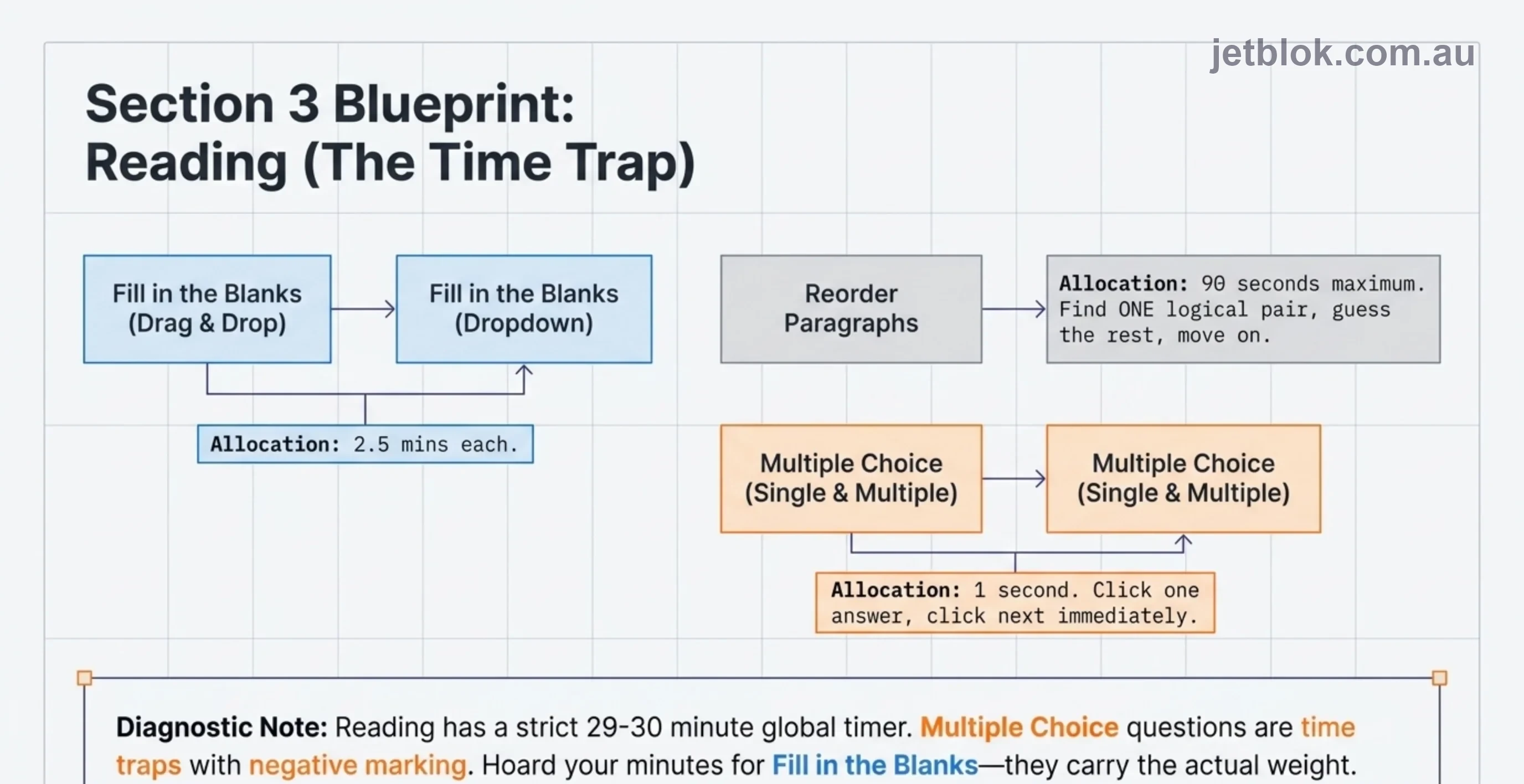
Multiple Choice questions are the biggest time traps in Reading. People spend 5 to 7 minutes agonising over tasks worth very little. Don't.
Multiple Choice, Single Answer: about 3% of Reading
This is worth so little that the plan is simple:
- Read the question quickly
- Scan the passage for the relevant part
- Pick the most likely answer
- Move on
It's right or wrong, no partial credit, and no penalty for a wrong answer. So always answer, but don't overthink it.
Multiple Choice, Multiple Answers: about 5% of Reading
This one is risky because Pearson uses negative marking: each wrong choice takes off a point (the item can't go below zero).
Safest approach: choose only the option(s) you're sure of. Many coaches tell students to pick just one answer they're confident about and move on. You give up a possible extra point, but you avoid losing one.
Time rule: Coaches suggest no more than 60 to 90 seconds on any Multiple Choice question. If you haven't decided by then, make your best call and move on.
The "2 out of 3" Idea for 79+
You don't need to be perfect at everything. A common coaching idea: to reach 79+ in Reading, be strong in 2 of these 3 groups:
- Fill in the Blanks (both types): about 45% of Reading
- Reorder Paragraphs: about 9% of Reading
- The outside tasks (SWT and HIW): about 36% of Reading
If your FIBs and SWT/HIW are solid, you can be average at Reorder and still get there. If FIBs and Reorder are strong, you have some room for SWT slips. Play to your strengths.
Scoring Types: Why They Change Your Strategy
Pearson's score guide uses different scoring for different tasks, and that should change how you play each one:
| Task | Scoring type | What it means for you |
|---|---|---|
| FIB (both types) | Partial credit, 1 point per correct blank | Never leave a blank empty |
| Multiple Choice, Multiple Answers | Partial credit with negative marking | Wrong picks cost points, so pick fewer |
| Multiple Choice, Single Answer | Right or wrong | Always answer, then move on |
| Reorder Paragraphs | Partial credit, 1 point per correct adjacent pair | Two correct pairs still earn points |
The short version: partial credit rewards having a go. Fill every FIB blank even if you're unsure. On Multiple Answers, it's the opposite: holding back protects your score.
Time Plan: Your Reading Blueprint
Time management is the difference between knowing the material and scoring well. Pearson gives the Reading part about 23 to 30 minutes, depending on your test version. Here's a coach-style split per question:
| Task | Time per question | Priority |
|---|---|---|
| Fill in the Blanks (Dropdown) | 2 to 2.5 minutes | HIGHEST |
| Fill in the Blanks (Drag and Drop) | 1.5 to 2 minutes | HIGH |
| Reorder Paragraphs | 1.5 to 2 minutes | MEDIUM |
| Multiple Choice, Multiple Answers | 60 to 90 seconds max | LOW |
| Multiple Choice, Single Answer | whatever time is left | LOWEST |
Watch the timer on screen and adjust to how many items you get. The golden rule: if time is running out, sacrifice the Multiple Choice questions. A quick guess on Single Answer costs you almost nothing. Running out of time on a FIB costs a lot.
Pro tip: switch gears fast after the essay
Reading comes straight after the writing tasks in Part 1, and Pearson's handbook confirms there are no scheduled breaks (you can ask for one, but the clock keeps running). Many people lose a few minutes because their head is still in "essay mode" and they read the instructions slowly. You already know what the tasks look like, so you don't need to read every instruction word by word. Those saved minutes can be one more FIB done properly, which can be the difference between 78 and 80.
Your FIB Practice Routine
Since FIBs are such a big chunk of Reading, your practice should reflect that.
Weeks 1 to 2: Build your collocation bank
- Read academic texts and highlight word pairs that sound natural together
- Note preposition patterns: contribute TO, result IN, lead TO, account FOR
- Learn adjective and noun pairs: significant impact, substantial evidence, fundamental principle
- Practise on a PTE platform with AI scoring, such as APEUni
Weeks 3 to 4: Speed and accuracy
- Set a timer for 2 to 2.5 minutes per question, no extensions
- Practise the "context window": read 2 or 3 words either side of each blank
- After each set, sort your mistakes: vocabulary gap, grammar or a collocation you didn't know?
- Track your accuracy. Aim for 70%+ on Dropdown and 65%+ on Drag and Drop to start
Week 5 onwards: Full section practice
- Use a strict timer of about 25 to 30 minutes
- Follow your time plan exactly
- Practise the switch: write an essay first, then go straight into Reading
- Review your time, not just your answers. Did Multiple Choice eat too much?
Common Mistakes That Kill Reading Scores
These are the patterns I see most often in people who underperform in Reading:
Mistake 1: Equal time on every task
Spending 3 minutes on a Single Answer question and 2 on a Dropdown FIB is backwards. Match your time to the value.
Mistake 2: Reading every word of the passage before answering FIBs
You need the gist and the local clues, not a full close reading. Reading every word first eats 30 to 60 seconds a question.
Mistake 3: Picking lots of answers in Multiple Answers
Negative marking means each wrong pick costs a point. Choosing 3 when you're sure of 1 is a losing game.
Mistake 4: Ignoring SWT and HIW
If you only practise Reading-part tasks, you're leaving a big chunk of your Reading score to chance. SWT and HIW need their own practice.
Mistake 5: Chasing perfection on Reorder
Getting stuck for 5+ minutes is one of the most common time disasters. Find your pairs, make your best order, move on.
Your Score 90 Action Plan
If you're aiming for 90 in Reading, here's the order:
- Master both FIB types. Practise collocations, grammar rules and elimination daily. Aim for 80%+ accuracy.
- Nail Summarize Written Text. It's in Part 1 but feeds Reading. Write one sentence of 5 to 75 words (ideally 35 to 55). See my PTE Writing guide.
- Practise Highlight Incorrect Words. This Listening task feeds Reading too. Only click words you're sure about. See my PTE Listening guide.
- Build a Reorder system. Find the opener and linked pairs. Accept "good enough" and protect your time.
- Keep Multiple Choice in its place. Practise it now and then, but never at the expense of FIBs or SWT.
People who score 90 in Reading aren't always better readers than people scoring 70. They're better strategists. They know where the points are, they guard their time, and they don't get stuck on low-value tasks.
Frequently Asked Questions
How long is the PTE Reading section?
Pearson gives about 23 to 30 minutes for Part 2 (Reading), depending on your test version. It has 5 task types.
Which task is worth the most in PTE Reading?
Fill in the Blanks. Coaches estimate the Dropdown version at about 25% of Reading and Drag and Drop at about 20%, so about 45% between them, based on a weighting table they quote from Pearson.
Is there negative marking in PTE Reading?
Yes, on Multiple Choice, Multiple Answers. Each wrong choice loses a point, though the item can't go below zero. Single Answer has no penalty, so always answer it.
Do other tasks affect my PTE Reading score?
Yes. Pearson's score guide shows Summarize Written Text, Highlight Incorrect Words and Highlight Correct Summary also feed Reading. Coaches estimate they make up about 39% of it together.
How long should I spend on Reorder Paragraphs?
Most coaches suggest about 90 seconds to 2 minutes per question. Find the opener and one or two clear pairs, then move on.
Start today. Read the PTE Academic 2026 complete guide for the full picture, then come back here and build your Reading plan. And check the 10 Critical PTE Mistakes so you don't give points away.