

Here's something most people don't realise until it's too late: your Writing score isn't only built in the writing tasks. Tasks in the Listening part feed points into Writing too, and if you ignore them you're losing marks before you've even seen an essay prompt. In this guide I'll show you where your Writing score comes from, then give you the rules, frameworks and practice routine to get every point. For the whole test, start with the PTE Academic 2026 complete guide.
Quick Summary (click to expand)
- Coaches estimate about 41% of your Writing score comes from Listening tasks (WFD and SST)
- SWT: one sentence, 5 to 75 words. Coaches suggest 35 to 55
- Essay: full form marks for 200 to 300 words. Many coaches aim for about 270 to 290
- Memorised answers can score zero for content. Use flexible frameworks
- Humans review the content of SWT and the Essay
- Grammar is the factor you can control most
- Daily practice: 5 SWTs, an essay every other day and WFD drills
- Writing roadmap: WFD, Essay, SWT, then SST
Where Your Writing Score Actually Comes From
Pearson's score guide lists four tasks that feed Writing: Write Essay and Summarize Written Text in Part 1, and Write from Dictation and Summarize Spoken Text in Part 3. The percentages below are coach estimates from a weighting table they quote from Pearson. They're averages, not a formula.
| Task | Where it is | Approx. share of Writing | Approx. overall weight |
|---|---|---|---|
| Write Essay | Speaking & Writing | 31% | 7% |
| Summarize Written Text (SWT) | Speaking & Writing | 28% | 7% |
| Write from Dictation (WFD) | Listening | 23% | 5% |
| Summarize Spoken Text (SST) | Listening | 18% | 4% |

Look at that table. Write from Dictation, a Listening task, is about 23% of Writing. Summarize Spoken Text adds about 18%. So, on these estimates, roughly 41% of your Writing mark comes from Part 3. For WFD in depth, read my Write from Dictation guide, and for SST see the PTE Listening complete guide.
The two writing tasks in Part 1, SWT and the Essay, make up the other 59% or so, and each is about 7% of your overall score. That sounds small, but when 2 or 3 points can separate a 79 from an 82, you can't give them away.
Summarize Written Text (SWT): One Sentence, Big Impact
SWT feeds two skills: coaches estimate about 28% of Writing and about 23% of Reading. That makes it one of the most valuable tasks in the test. You get 10 minutes per passage, and usually 2 of them.
The rules you can't break (Pearson)
- Your answer must be one complete sentence. No full stop in the middle
- It must be between 5 and 75 words
- Fewer than 5 words, more than 75, more than one sentence, or all capitals scores zero for form, and Pearson says a zero for form means no points for the answer
- Coaches suggest 35 to 55 words: enough to cover the key ideas, short enough to keep the grammar under control
How SWT is scored
Pearson's score guide scores SWT on:
- Content: does your sentence capture the main ideas?
- Form: one sentence, 5 to 75 words
- Grammar: is it correct?
- Vocabulary: are your word choices appropriate?
Spelling mistakes still hurt, because they affect grammar and vocabulary and how your answer reads.
Most people get the order wrong here: correct grammar matters more than fancy vocabulary. A clean sentence with simple words beats a broken sentence with big words. There's no bonus for complexity, only a cost for errors.
The SWT strategy: 4 steps in 10 minutes
Step 1: Find the core ideas (3 minutes)
Read the passage once. On a second read, flag 3 to 6 key ideas:
- The main topic or claim
- The supporting points or evidence
- Any conclusion or implication
Step 2: Build a skeleton (2 minutes)
Put your ideas in a cause and effect or argument chain. Linking words help:
- "because", "therefore", "as a result"
- "which leads to", "consequently", "while also"
- "although", "despite", "in addition to"
These let you join several ideas into one correct sentence without it feeling forced.
Step 3: Write and rephrase (3 minutes)
Write your one sentence. Don't copy the passage word for word. Coaches suggest rephrasing roughly 40 to 50% of the wording. Pearson's top content score asks you to reformulate and synthesise, and copying whole chunks scores lower.
Also skip the tired openers like "The passage discusses...". Lead with the actual subject.
Weak opening: "The passage discusses how climate change affects agriculture." Stronger opening: "Climate change is disrupting farm output by..."
Step 4: Check form and grammar (2 minutes)
Before you submit, check three things:
- Is it really one sentence? (one full stop, at the very end)
- Is it between 5 and 75 words (ideally 35 to 55)?
- Does every verb agree with its subject?
SWT flexible framework
This is a framework, not a script. Change it for each passage:
"[Main idea], while [supporting detail], which suggests that [conclusion or implication]."
Mix it up. Sometimes lead with the conclusion, sometimes with a concession. You want a safety net, not a memorised line.
SWT traps
- Two sentences: any full stop in the middle means zero for form, and so zero for the answer
- Trying to include everything: you're summarising, not copying
- Going over 75 words: clauses add up fast, so count
- Words you're unsure of: a misspelled fancy word hurts more than a correct simple one
Write Essay: The Words That Matter
Coaches estimate the essay is about 31% of Writing and about 7% of your overall score. You get a prompt, usually an opinion or discussion topic, and 20 minutes to write.
The word count rules (Pearson)
- 200 to 300 words: full marks for form
- 120 to 199 or 301 to 380 words: part marks for form
- Under 120 or over 380 words (or all capitals): zero for form, and Pearson says that means no points for the essay
- Many coaches suggest a sweet spot of about 270 to 290 words
Why 270 to 290? It gives you room for two body paragraphs with examples while staying well inside 200 to 300. 250 is fine. 310 still gets part marks for form, but every extra word is another chance for a mistake with nothing gained.
Essay structure that scores
High-scoring essays usually follow a clean, predictable shape. Pearson's essay criteria include development, structure and coherence:
Paragraph 1: Introduction (2 sentences)
- Sentence 1: set up the topic
- Sentence 2: state your view
Paragraph 2: Body 1 (3 or 4 sentences)
- Your main argument
- A specific example
- What it shows
Paragraph 3: Body 2 (3 or 4 sentences)
- A second point or the other side
- A different example
- Link back to your view
Paragraph 4: Conclusion (1 or 2 sentences)
- Sum up your position
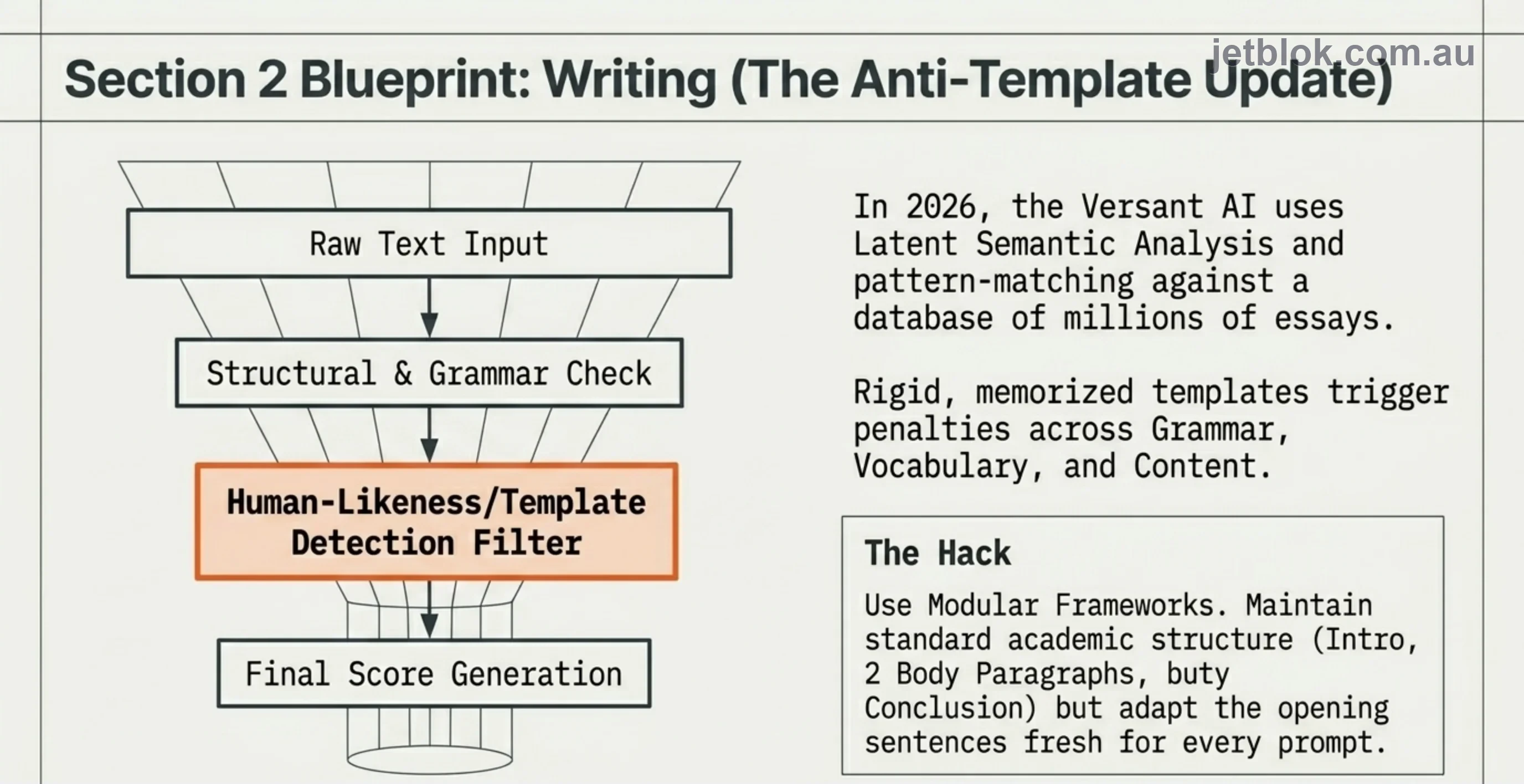
Template Safety: Why Rigid Scripts Fail
Pearson's score guide says a response that leans on lots of pre-prepared or memorised material can score zero for content. Coaches often describe this as the engine spotting "rhythmic monotony", meaning the same sentence patterns, openers and paragraph shapes used by thousands of people. Pearson doesn't use that term, but the risk is real: humans now review essay content, structure and range, and a rehearsed essay that doesn't really answer the prompt gets marked down.
Template safety rules
- Don't memorise word for word. Learn the structure, not the sentences
- Change your sentence patterns. If you opened with a plain statement last time, try a concession
- Let vocabulary fit the topic. Don't force the same "impressive" words into every essay
- Match the context. A tech essay should sound different from an education essay
- Build your own framework so no one else has the same one
A flexible essay framework
Use this as a starting point, then make it yours:
Introduction:
"In recent years, [topic] has drawn a lot of attention. In my view, it brings both clear benefits and real challenges."
Body paragraph opening:
"One major reason is [argument]. This can be seen when [example]. As a result, [implication]."
Conclusion:
"Overall, while [topic] raises some concerns, its benefits can outweigh the drawbacks if it's managed well."
Now the important bit: don't use it exactly as written. Swap "In recent years" for "Over the past decade" or "In many countries". Replace "In my view" with "I believe" or just state your view. The framework is the skeleton. You add the rest.
Accuracy over creativity
This surprises people: simpler essays with clean grammar beat complex essays with errors. Compare:
Complex but flawed: "The multifaceted ramifications of technological ubiquity has permeated every facets of contemporary society." Simple but correct: "Technology has changed many parts of modern life."
The second scores better. The first has two errors ("has" should be "have", and "every facets" should be "every facet").
Essay mistakes that cost points
- Memorised openers: "This essay will discuss" screams template
- The same connector every time: starting every sentence with "Furthermore"
- Under 200 words: you're probably missing a paragraph or examples
- Long sentences you can't control: if a 25-word sentence gets messy, split it
- Off-topic examples: if the prompt is about education, don't drift into economics
- Over 300 words: more chances for errors, no extra reward
Human Review: What Changed With the August 2025 Update
Pearson's current score guide says SWT, the Essay and SST all get a human review of content on top of AI scoring, and the Essay also gets human review of structure, coherence and language range. Here's what that means in practice:
- Relevance: did you answer this prompt, or paste in something pre-prepared?
- Your own words: does it show you read and understood the passage or question?
- Logical flow: do the ideas connect, or is it a pile of memorised phrases?
Humans use the same rating scales as the AI, so the two don't pull in different directions. But a template-driven answer that might once have slipped through is now much more likely to be caught.
Grammar: The Foundation
Grammar is the part of your Writing score you can control most. It follows rules you can practise. Focus on these five:
1. Subject-verb agreement
The most common PTE writing error, especially when a long phrase sits between subject and verb:
Wrong: "The impact of rising temperatures on coastal regions are significant." Right: "The impact of rising temperatures on coastal regions is significant."
The subject is "impact" (singular), not "regions".
2. Articles (a, an, the)
The most common slip is dropping them: "Government should invest in education" instead of "The government should invest in education."
3. Prepositions
"depend on" not "depend of", "result in" not "result to", "contribute to" not "contribute for".
4. Punctuation
In SWT, punctuation decides whether you've written one sentence or two. Use commas, semicolons and linking words to join clauses, never a full stop in the middle.
5. Consistent tense
Pick a tense and stick to it within each paragraph. Jumping from past to present to future in three sentences hurts coherence.
A Practice Routine That Works
Writing without feedback won't move your score. You need a routine and a way to measure progress.
Daily SWT practice
- Do 5 SWTs a day
- Use an AI-scored platform (APEUni, PTE Tools) for quick feedback
- After each one, check word count, sentence count (must be 1) and grammar
- Keep a log of repeat mistakes and target them
Essay practice
- Write 1 full essay every other day
- Time yourself strictly at 20 minutes
- Find your own grammar errors before you look at the AI feedback
- Practise until 270 to 290 words feels natural
Don't forget the Listening tasks
Since a big chunk of Writing comes from Listening tasks, include:
- Daily Write from Dictation practice (10 to 15 sentences)
- Summarize Spoken Text practice (2 or 3 per session, 50 to 70 words)
- Spelling drills on common academic words
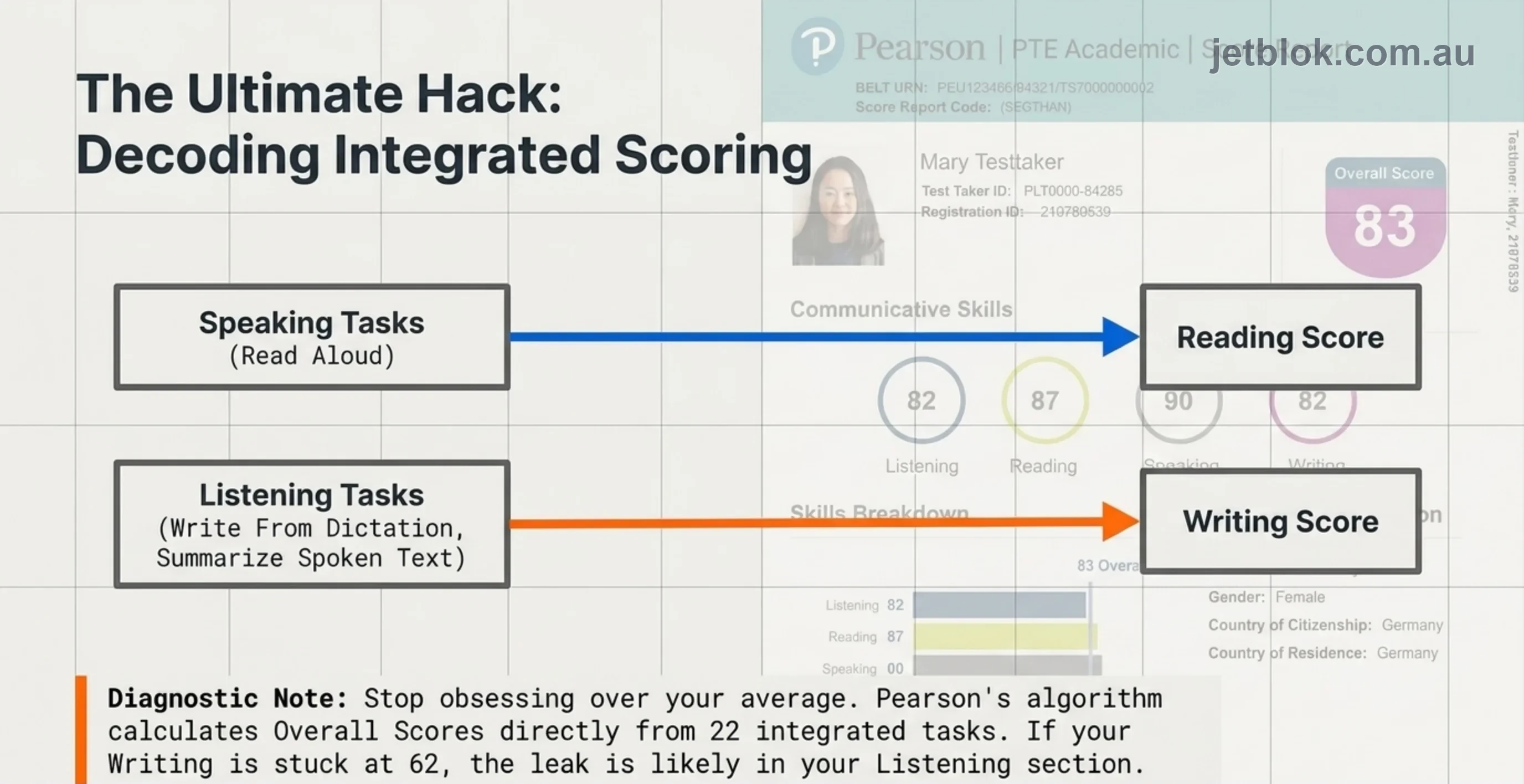
The Writing Score Roadmap
If you're aiming for 79+ in Writing, here's where to focus, in order:
- Write from Dictation (about 23% of Writing): nail phrase mapping. Every correctly spelled word counts, and it's the quickest win.
- Write Essay (about 31% of Writing): 4 paragraphs, 200 to 300 words (ideally 270 to 290), grammar first.
- Summarize Written Text (about 28% of Writing): one sentence, 5 to 75 words (ideally 35 to 55). It also feeds Reading.
- Summarize Spoken Text (about 18% of Writing): 50 to 70 words, main ideas, clean grammar.
See the pattern? Accuracy beats complexity every time. Correct spelling in WFD, correct grammar in the Essay and SWT, correct word counts everywhere. People scoring 85+ aren't the ones with the fanciest words. They make the fewest mistakes.
Quick Reference: Writing Task Cheat Sheet
Word count rules are from Pearson's score guide. Targets are coach suggestions.
| Task | Full form marks | Zero for form | Target | Key focus |
|---|---|---|---|---|
| SWT | 5 to 75 words, one sentence | under 5, over 75, or more than one sentence | 35 to 55 words | One sentence, grammar |
| Essay | 200 to 300 words | under 120 or over 380 | 270 to 290 words | Structure, accuracy, flow |
| WFD | Exact sentence | n/a (1 point per correct word) | Every word | Spelling, word order |
| SST | 50 to 70 words | under 40 or over 100 | 55 to 65 words | Main ideas, grammar |
Frequently Asked Questions
What is the word limit for the PTE essay?
Pearson gives full form marks for 200 to 300 words and part marks for 120 to 199 or 301 to 380. Under 120 or over 380 words scores zero for form, which means no points for the essay.
How many words should a Summarize Written Text answer be?
It must be one sentence of 5 to 75 words. Coaches generally suggest 35 to 55 words so you cover the key ideas without losing grammar control.
Do Listening tasks affect my PTE Writing score?
Yes. Pearson's score guide lists Write from Dictation and Summarize Spoken Text as feeding Writing. Coaches estimate they make up about 41% of the Writing score between them.
Can I use a template for the PTE essay?
A loose structure is fine. A memorised essay isn't: Pearson can give zero for content if an answer relies heavily on pre-prepared material, and humans now review essay content.
Is British or American spelling better in PTE?
Both are accepted. Pick one and use it consistently.
Final Advice
PTE Writing rewards discipline, not brilliance. You don't need to be a gifted writer. Follow the rules: hit the word counts, keep your grammar clean, answer the actual prompt and use flexible frameworks instead of scripts. The people who treat Writing as a process rather than a chance to impress are the ones who get above 79.
- Back to the hub: PTE Academic 2026 complete guide
- The biggest Writing win: Write from Dictation strategy
- SST and the rest of Part 3: PTE Listening complete guide
- Traps to avoid: 10 Critical PTE Mistakes