
PTE Academic changed in a big way in August 2025, and plenty of guides online still teach the old version. If you're sitting the test in 2026, you need to know the 22 question types, how the AI and human scoring fit together, which tasks carry the most weight, and the new Australian visa scores that catch a lot of people out. I've checked the official facts here against Pearson's own score guide and the Home Affairs rules. Where a tip comes from PTE coaches and teachers rather than Pearson, I say so.
Quick Summary (click to expand)
- PTE Academic is a computer-based English test of about 2 hours, scored by AI with human checks on some tasks
- 22 question types across 3 parts, including 2 tasks added in August 2025
- AI scores everything, and humans also review content on 7 tasks
- Your overall score is NOT the average of your four skills
- Coaches estimate 6 tasks make up about half your overall score, with Describe Image the biggest
- Summarize Group Discussion and Respond to a Situation have been in the test since 7 August 2025
- For IELTS 7.0, Pearson's concordance puts PTE Speaking at 76 to 82
- Australian visa scores changed on 7 August 2025, and every skill must be met on its own
- Flow over perfection: keep your speech moving
- A 90-day plan built around the tasks that matter most
What is PTE Academic?
PTE Academic (Pearson Test of English Academic) is a computer-based English test accepted by universities and governments in Australia, New Zealand, Canada, the UK, the USA and many other places. It tests Speaking, Writing, Reading and Listening in one sitting of about 2 hours at a Pearson test centre (or at home, if you book the PTE Academic Online version and your purpose accepts it). Pearson's test taker handbook says results are typically ready within 48 hours, but can take up to 5 days. That's a lot faster than many other tests.
What makes PTE different is that AI scores every answer. Pearson's scoring engine checks pronunciation, fluency, grammar, vocabulary, spelling and content. On top of that, Pearson's score guide says humans review the content of seven longer tasks before the score is final. So it's consistent, and it's harder to game with memorised scripts.
2026 PTE Test Structure: 3 Parts, 22 Question Types
The test runs for about 2 hours and has three parts with 22 question types, up from 20 before August 2025. The two tasks added for tests taken from 7 August 2025 are Summarize Group Discussion and Respond to a Situation. Pearson says the part timings below don't add up exactly because each test version is balanced for total length.
| Part | Time (Pearson) | Question types | Tasks |
|---|---|---|---|
| Part 1: Speaking & Writing | about 76 to 84 minutes | 9 scored types, plus an unscored Personal Introduction | Read Aloud, Repeat Sentence, Describe Image, Retell Lecture, Answer Short Question, Summarize Group Discussion (added Aug 2025), Respond to a Situation (added Aug 2025), Summarize Written Text, Write Essay |
| Part 2: Reading | about 23 to 30 minutes | 5 types | Fill in the Blanks (Dropdown), Multiple Choice Multiple Answers, Reorder Paragraphs, Fill in the Blanks (Drag and Drop), Multiple Choice Single Answer |
| Part 3: Listening | about 31 to 39 minutes | 8 types | Summarize Spoken Text, Multiple Choice Multiple Answers, Fill in the Blanks (Type In), Highlight Correct Summary, Multiple Choice Single Answer, Select Missing Word, Highlight Incorrect Words, Write from Dictation |
Pearson's 2025 update also raised the number of questions: the July 2025 institution score guide says you'll answer 65 to 75 questions across the 22 types. Coaches often compare this with about 52 before the update.
There are no scheduled breaks. Pearson's July 2025 test taker handbook says you can ask the test administrator for an unscheduled break, but the test clock keeps running while you're away. So treat the whole test as one continuous block and plan your water and bathroom stop before you start.
The Scoring System: AI First, Humans on Content
This is the part most people get wrong. Here's how it works, using Pearson's own score guide.
How AI scoring works
AI scores every response. Depending on the task, it looks at traits like:
- Pronunciation: clear sounds, word stress and natural intonation
- Oral Fluency: smooth rhythm and phrasing, without long hesitations or restarts
- Content: how well you answered the actual prompt
- Grammar, vocabulary and spelling: on the written tasks
- Form: things like word count and, for Summarize Written Text, writing one sentence
Where humans come in
Pearson's score guide lists seven tasks where a trained human also reviews the content before the score is final:
- Describe Image
- Retell Lecture
- Respond to a Situation
- Summarize Group Discussion
- Summarize Written Text
- Write Essay (humans also review structure, coherence and language range here)
- Summarize Spoken Text
Humans don't score your accent or pronunciation. That stays with the AI, and it's built to handle a wide range of accents. What matters is being easy to understand.
Templates warning: Pearson's score guide says a response that relies on large amounts of pre-prepared or memorised material can get zero for content, and zero content means zero for that answer. Coaches often say the engine "flags rhythmic monotony". Pearson doesn't use that phrase, but the advice behind it holds: use a flexible structure, not a word-for-word script.
Your Overall Score is NOT the Average of Your Four Skills
Most people assume Overall = (Speaking + Writing + Reading + Listening) ÷ 4. It isn't. Pearson says it directly: the overall score is not an average of the four skill scores.
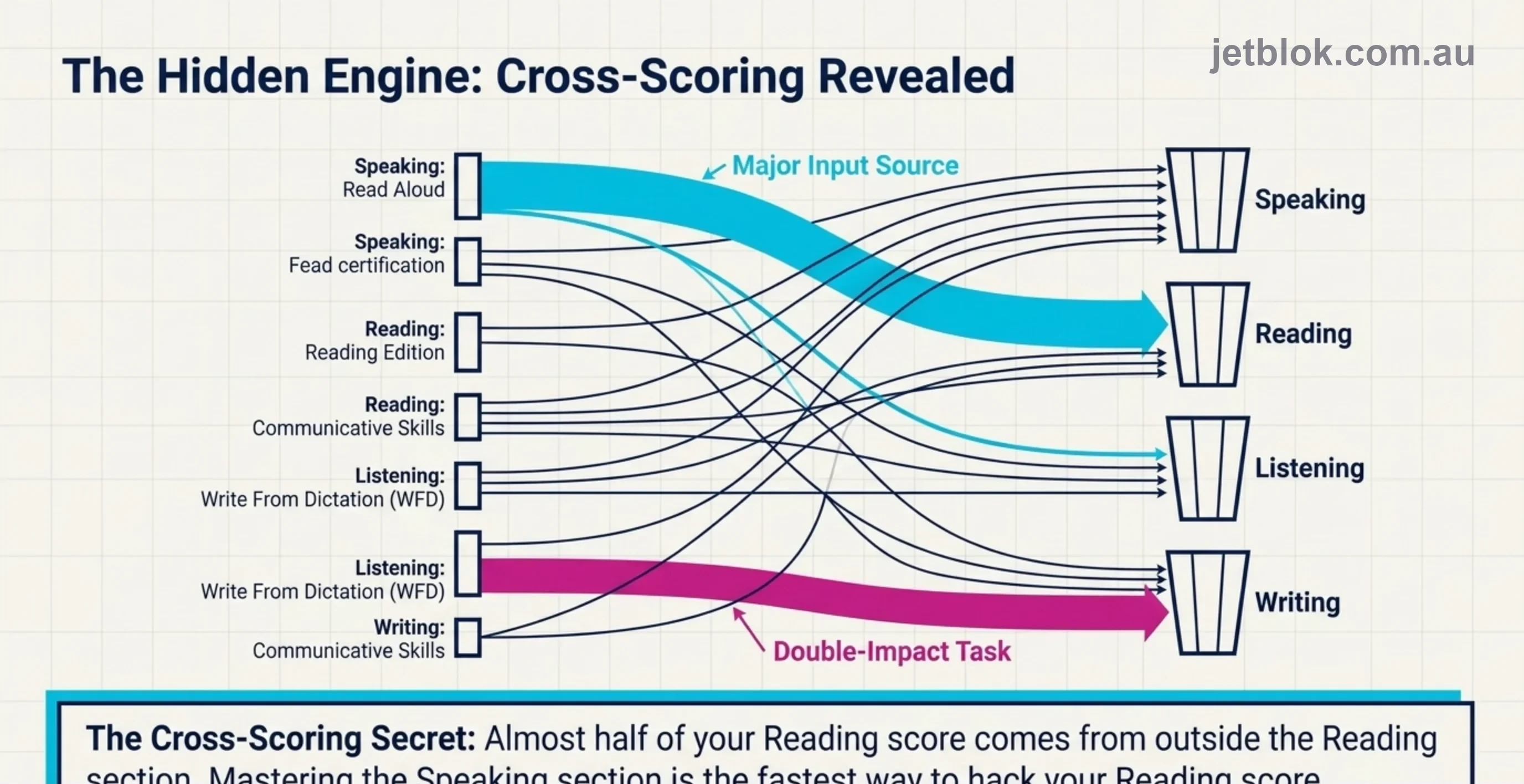
Pearson works out the overall score from your performance on all the items, and each skill score is calculated on its own from overlapping sets of tasks. One task can feed two skills. Repeat Sentence counts for Listening and Speaking. Write from Dictation counts for Listening and Writing.
So a weak task can pull down more than one skill, and getting good at the high-weight tasks lifts several scores at once.
Score Weightings: Where Your Points Come From
Pearson's score guides (including the July 2025 institution edition) tell you which skills each task feeds, but they don't publish percentages. The percentages below come from a weighting table that PTE coaches quote from a separate Pearson document, "Scoring Information for Teachers and Partners". I haven't been able to check that document directly, so I'm treating these as coach-reported numbers. Treat them as average, indicative weights, not a formula. Pearson's algorithm also accounts for question difficulty, so you can't work out your score from them. Based on that table, coaches generally estimate these top 6 tasks make up about half your overall score:
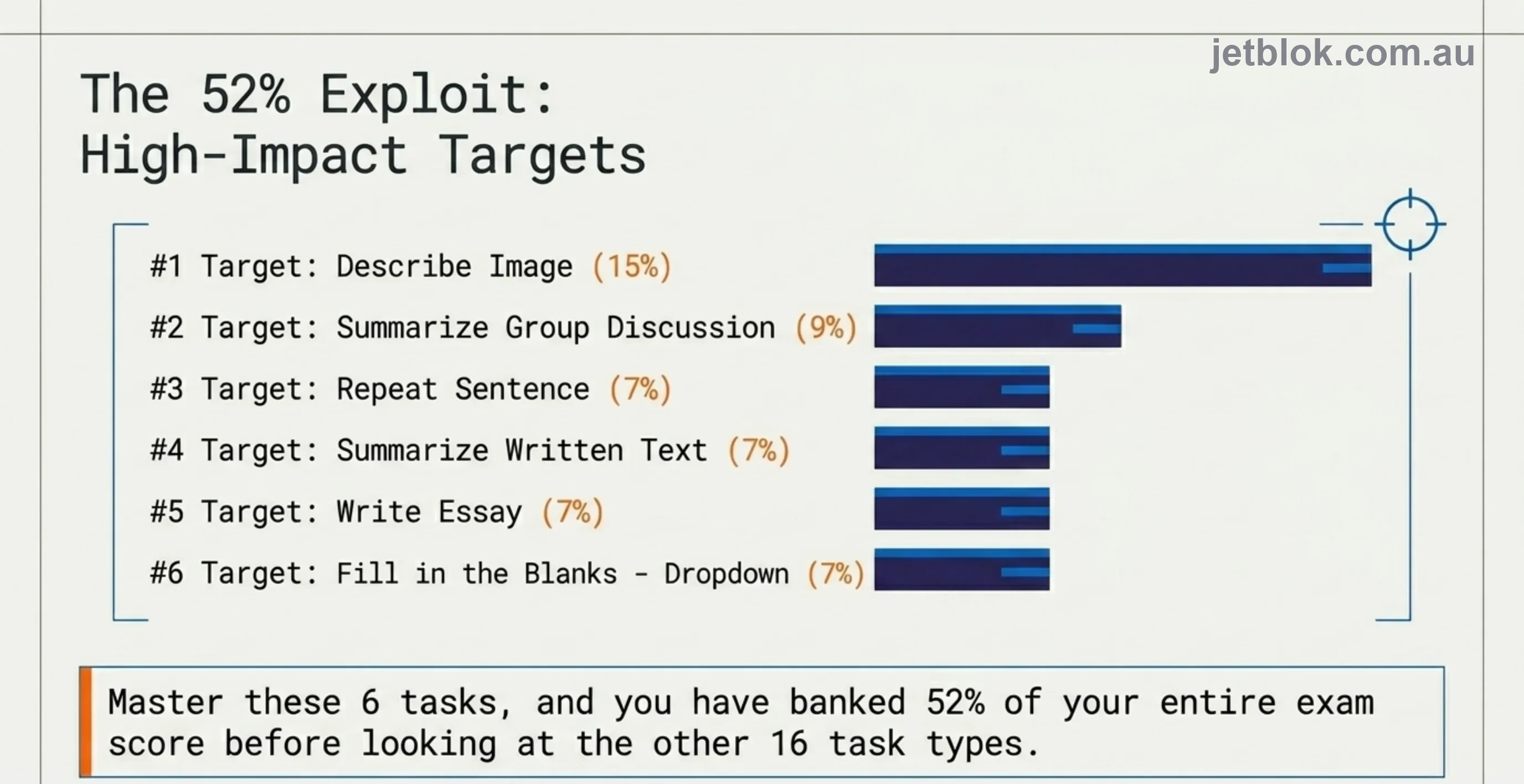
| Rank | Task | Approx. overall weight | Approx. skill share |
|---|---|---|---|
| 1 | Describe Image | 15% | 31% of Speaking |
| 2 | Summarize Group Discussion | 9% | 20% of Listening, 19% of Speaking |
| 3 | Repeat Sentence | 7% | 17% of Listening, 16% of Speaking |
| 4 | Summarize Written Text | 7% | 23% of Reading, 28% of Writing |
| 5 | Write Essay | 7% | 31% of Writing |
| 6 | Fill in the Blanks (Dropdown) | 7% | 25% of Reading |
On these estimates, Describe Image is about 15% of your overall score, roughly double any other single task. If you only have two weeks, give Describe Image a big chunk of that time. The newer Summarize Group Discussion already sits second.
The hidden giant: Write from Dictation
Write from Dictation isn't in the top 6 overall (coaches put it at about 5%), but look at the skill level: the same table puts it at about 23% of Writing and 13% of Listening. If you need a set Writing score for a visa, WFD matters a lot. Read my Write from Dictation guide for the phrase mapping technique.
Tasks Added in August 2025
The two tasks added on 7 August 2025 carry real weight and test skills the old format didn't:
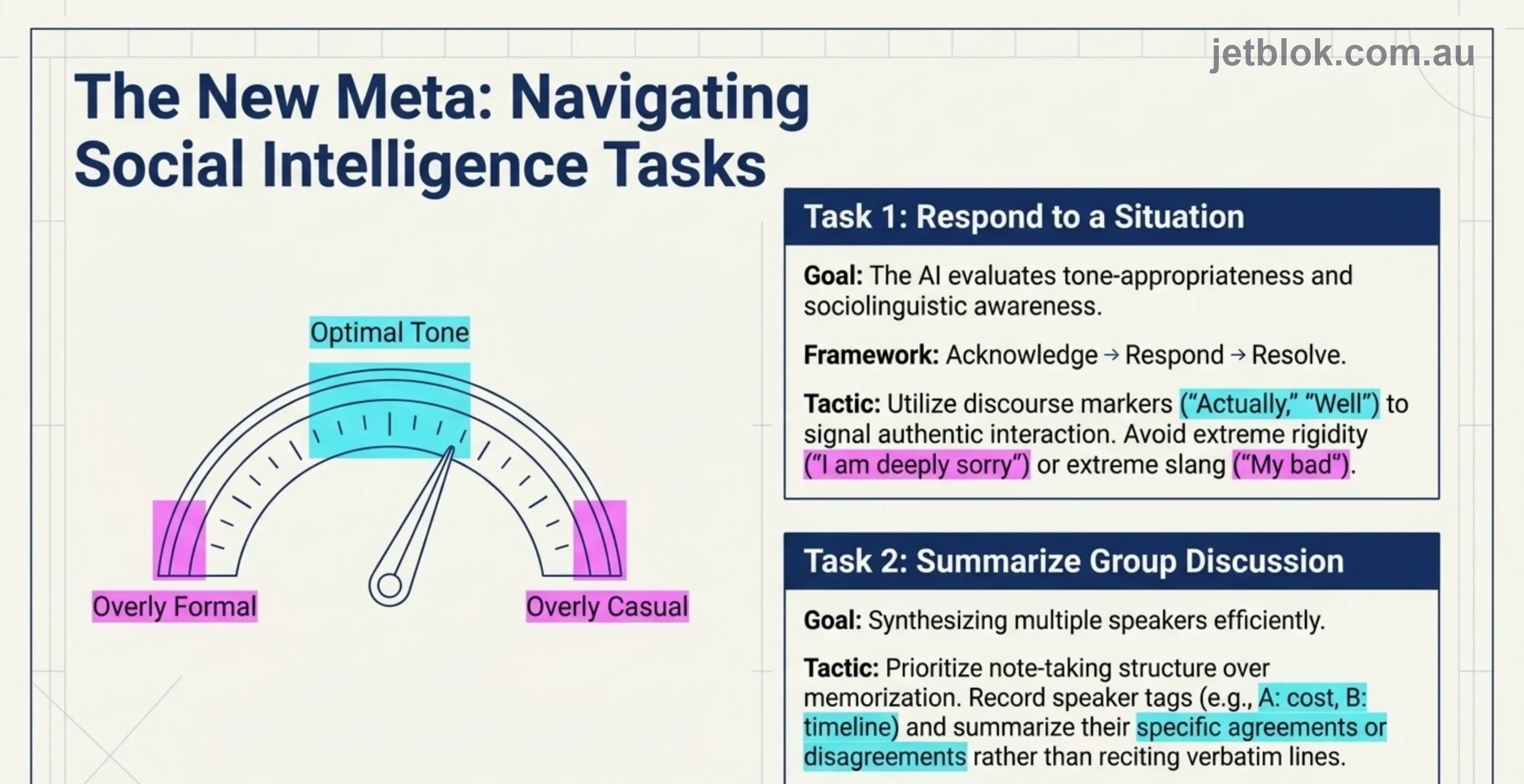
1. Summarize Group Discussion (SGD)
Format (Pearson): You hear three people discuss an academic topic for up to 3 minutes (most coaches say 2.5 to 3). The audio plays once. You get 10 seconds to prepare, then up to 2 minutes to speak your summary.
What's different: Unlike Retell Lecture (one speaker), SGD asks you to say who said what. Pearson says you need to cover all three speakers to get full content marks. "The speakers discussed climate change" earns far less than "The first speaker argued renewable energy should come first, the second worried about the cost, and the third suggested a phased approach."
Strategy:
- Set up three columns before the audio starts (S1, S2, S3) and note each person's view
- Speakers won't go in a neat 1, 2, 3 order, so stay alert
- Note where they agree and disagree
- Structure: topic, speaker 1, speaker 2, speaker 3, where they ended up
- Use attribution phrases: "The first speaker said...", "The second speaker disagreed and...", "The third speaker suggested..."
2. Respond to a Situation (RTS)
Format (Pearson): You read and hear a short university scenario (asking a lecturer for help, sorting out a problem with library staff, asking a classmate for a favour). You get 10 seconds to prepare and 40 seconds to respond.
What it tests: Whether you can handle a real situation with the right tone and polite, useful language. Pearson scores content (0 to 6), pronunciation (0 to 5) and oral fluency (0 to 5), and it counts for Speaking only.
Strategy:
- Speak in the first person, as if you're really there
- Open to suit the person ("Excuse me, Professor" or "Hi, Sam")
- State your main request or point early
- Explain the problem briefly and add relevant detail
- If you're saying no, offer another option
- Stick to the facts in the prompt. If it says "her office", don't suggest the library
- Use most of the 40 seconds, not a one-line answer
PTE to IELTS Score Conversion (Pearson, July 2025)
Many people need to compare PTE and IELTS. This table comes from Pearson's July 2025 concordance study, which for the first time gives separate ranges for each skill. Pearson stresses that these are estimates, not exact conversions.
| IELTS band | PTE Overall | PTE Listening | PTE Reading | PTE Speaking | PTE Writing |
|---|---|---|---|---|---|
| 6.0 | 47 to 54 | 47 to 52 | 48 to 53 | 54 to 65 | 51 to 59 |
| 6.5 | 55 to 62 | 53 to 57 | 54 to 58 | 66 to 75 | 60 to 68 |
| 7.0 | 63 to 70 | 58 to 63 | 59 to 64 | 76 to 82 | 69 to 76 |
| 7.5 | 71 to 78 | 64 to 68 | 65 to 69 | 83 to 87 | 77 to 84 |
| 8.0 | 79 to 85 | 69 to 74 | 70 to 74 | 88 to 89 | 85 to 89 |
| 8.5 | 86 to 89 | 75 to 80 | 75 to 80 | 90 | 90 |
| 9.0 | 90 | 81 to 90 | 81 to 90 | n/a | n/a |
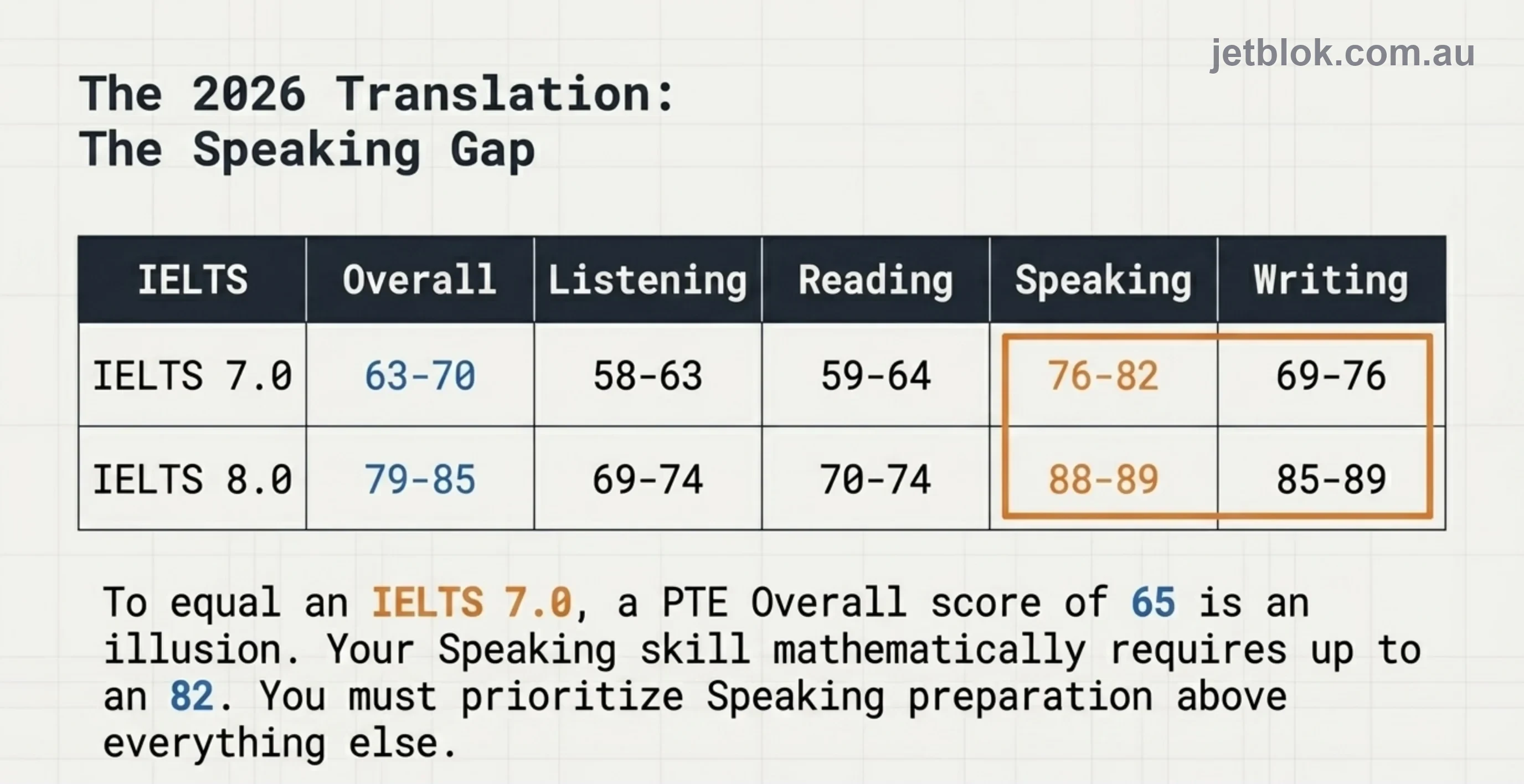
Worth knowing: For IELTS 7.0, Pearson's table puts PTE Speaking at 76 to 82, well above the 63 to 70 overall range. If you need an IELTS 7.0 equivalent in every skill, plan for a Speaking score in the high 70s, not the mid 60s.
Australian Visa Score Requirements (2026)
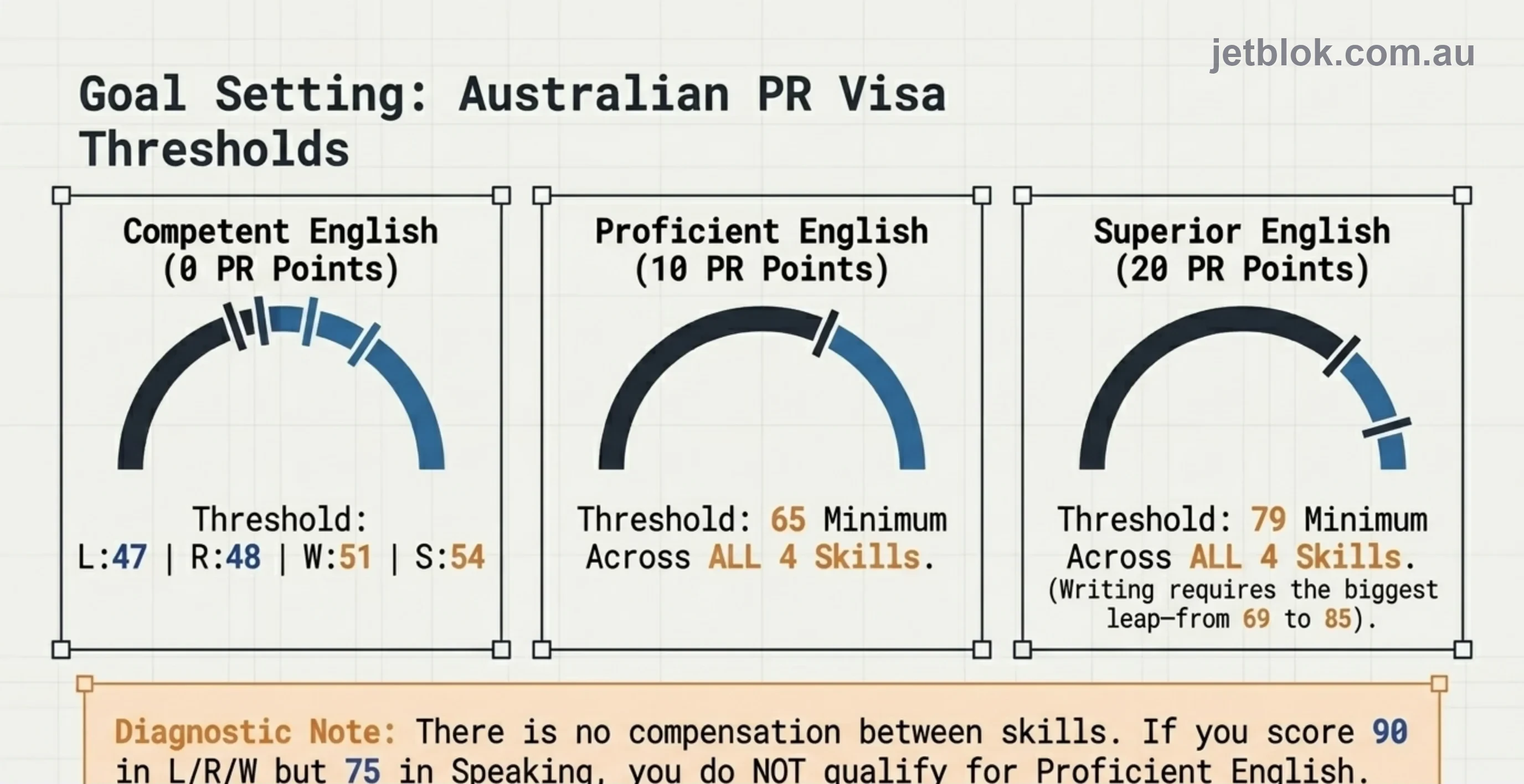
For tests taken from 7 August 2025, Home Affairs uses new PTE Academic scores for each English level. Each skill has its own minimum and must be met separately. You can't average them, and missing one skill by a single point means you don't reach that level. The table follows Pearson's order: Listening, Reading, Writing, Speaking.
| English level | Listening | Reading | Writing | Speaking | Skilled visa points |
|---|---|---|---|---|---|
| Functional | overall 24 (no minimum for each skill) | n/a | |||
| Vocational | 33 | 36 | 29 | 24 | n/a |
| Competent | 47 | 48 | 51 | 54 | 0 |
| Proficient | 58 | 59 | 69 | 76 | 10 |
| Superior | 69 | 70 | 85 | 88 | 20 |
A few things people miss:
- Watch the column order. Writing and Speaking need the highest scores, and Speaking is last in this table. Read across carefully.
- Results from tests taken on or before 6 August 2025 use the old bands: overall 30 for Functional, 36 in each skill for Vocational, 50 for Competent, 65 for Proficient and 79 for Superior. Home Affairs says those older results can be used until 6 August 2028, depending on the visa (for Functional English the cut-off was 6 August 2026, so older results no longer count there).
- Student visa (subclass 500): for tests from 7 August 2025, the student visa English instrument (LIN 25/090) sets an overall score of 47. It drops to 39 if you're also doing at least 10 weeks of ELICOS, or a foundation or eligible pathway program, and to 31 with at least 20 weeks of ELICOS. The test must have been taken in the 2 years before you apply. Your university may ask for more.
- I've checked every number above against the Home Affairs pages for each English level and the student visa instrument (October 2026). Still check the current numbers with Home Affairs, the student visa instrument and Pearson before you book. Rules can change.
The jump from Proficient to Superior isn't the same for every skill:
- Listening: +11 (58 to 69)
- Reading: +11 (59 to 70)
- Writing: +16 (69 to 85), the biggest jump
- Speaking: +12 (76 to 88)
Writing needs the biggest jump for Superior. On the coach estimates above, Write from Dictation (about 23% of Writing), Summarize Written Text (about 28%) and Write Essay (about 31%) are where those 20 points are won or lost.
How Integrated Scoring Works (Cross-Skill Contributions)
Tasks in one part of the test feed scores in other skills. Pearson's score guide confirms which skills each task feeds. The percentages are the coach estimates from above:
- Repeat Sentence feeds Listening (about 17%) and Speaking (about 16%)
- Write from Dictation feeds Writing (about 23%) and Listening (about 13%)
- Summarize Written Text feeds Reading (about 23%) and Writing (about 28%)
- Summarize Group Discussion feeds Listening (about 20%) and Speaking (about 19%)
- Highlight Incorrect Words feeds Listening and Reading (coaches put it at about 13% of Reading)
So there's no such thing as "just a Listening task". A weak Repeat Sentence hurts Listening and Speaking at the same time.
Partial Credit and Negative Marking: Know the Rules
Most PTE tasks use partial credit, so every correct part earns points even if the whole answer isn't perfect. But Pearson's score guide lists three tasks with negative marking, where a wrong pick costs a point (the item can't go below zero):
- Multiple Choice, Multiple Answers (Reading)
- Multiple Choice, Multiple Answers (Listening)
- Highlight Incorrect Words (Listening)
The rule: on these three, only choose what you're sure of. A wrong pick cancels out a right one.
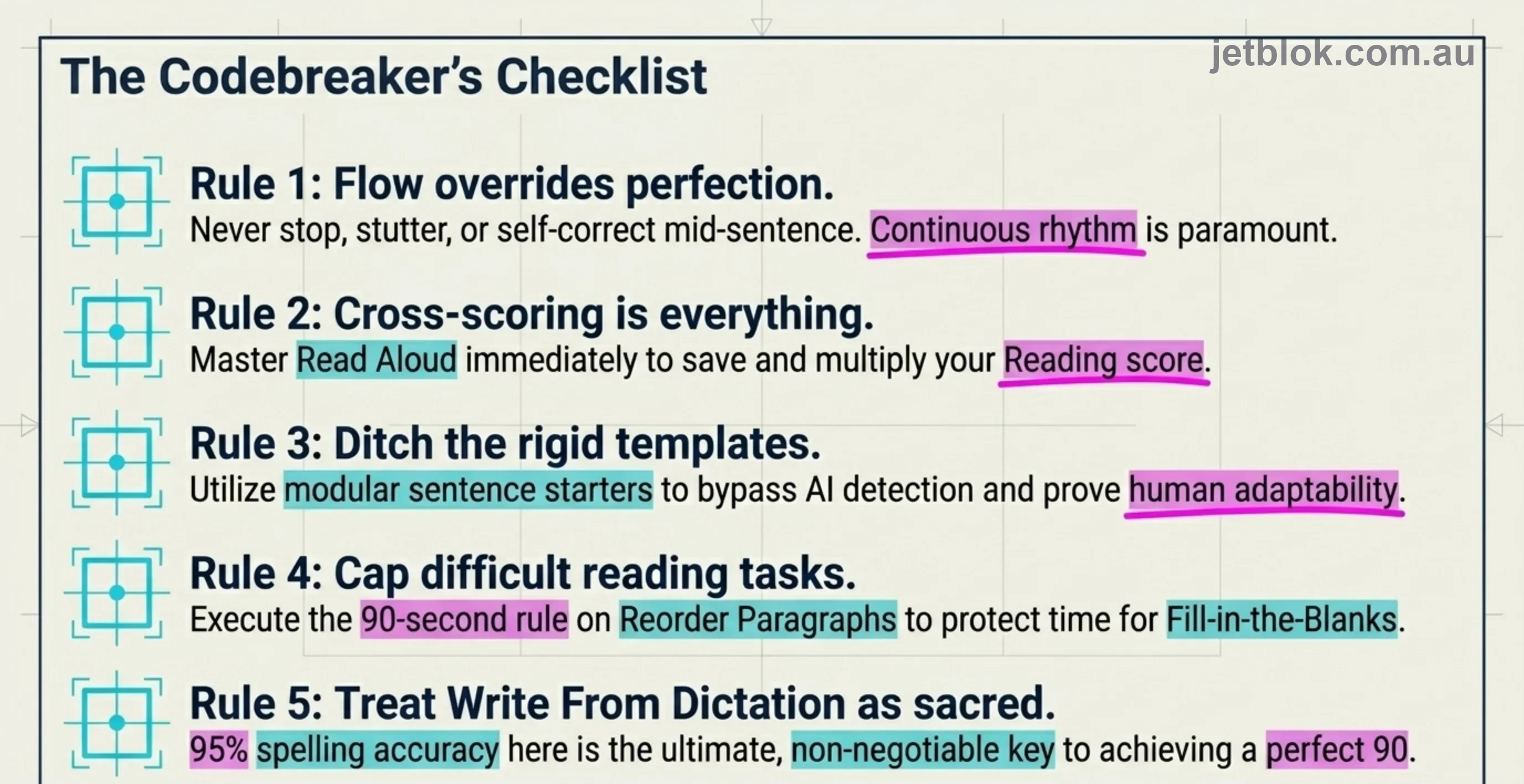
The #1 Rule: Flow Over Perfection
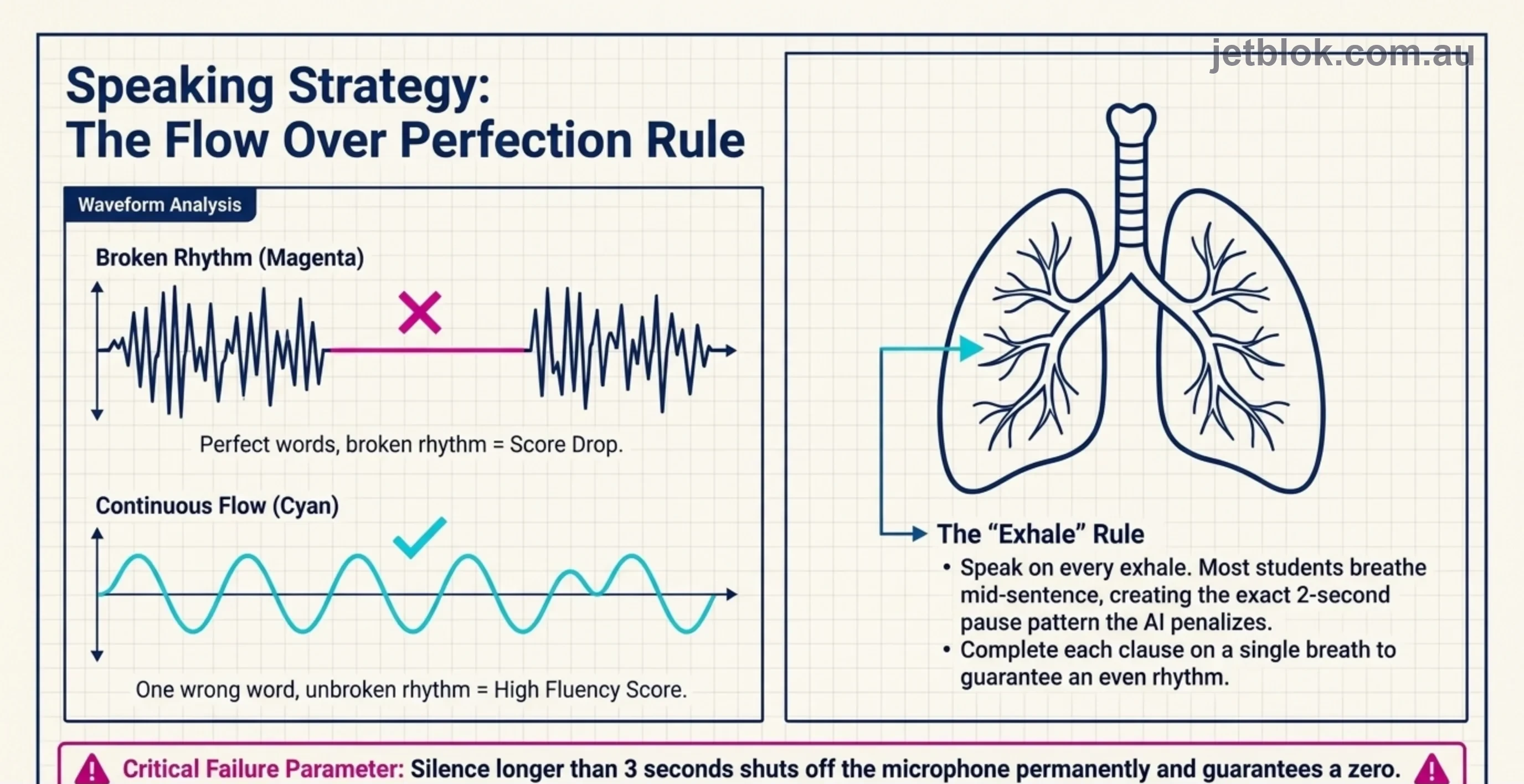
If you remember one thing, make it this: smooth, steady speech matters more than perfect speech. A continuous answer with a few small slips usually beats a choppy answer full of restarts, even if the choppy one has fewer mistakes. Pearson's fluency scale rewards smooth phrasing and penalises hesitations, repetitions and false starts.
Coaches who've studied many high-scoring answers say the same thing: people scoring 85+ in Speaking still make small errors, but they don't stop.
The 3-second rule
In speaking tasks, if you go silent for about 3 seconds, the microphone stops recording. Anything you planned to say after that isn't captured, and if you haven't started speaking at all, you get nothing for that item. It doesn't wipe what you already said, but it can cost you a lot of content and fluency.
How to avoid it:
- Have a few linking phrases ready: "Also...", "On top of that...", "Another point is..."
- If you lose your place, rephrase what you just said while you think
- Practise speaking for the full time in every session
- Don't stop to think in silence. Think out loud
Study Priority Plan Based on Task Weight
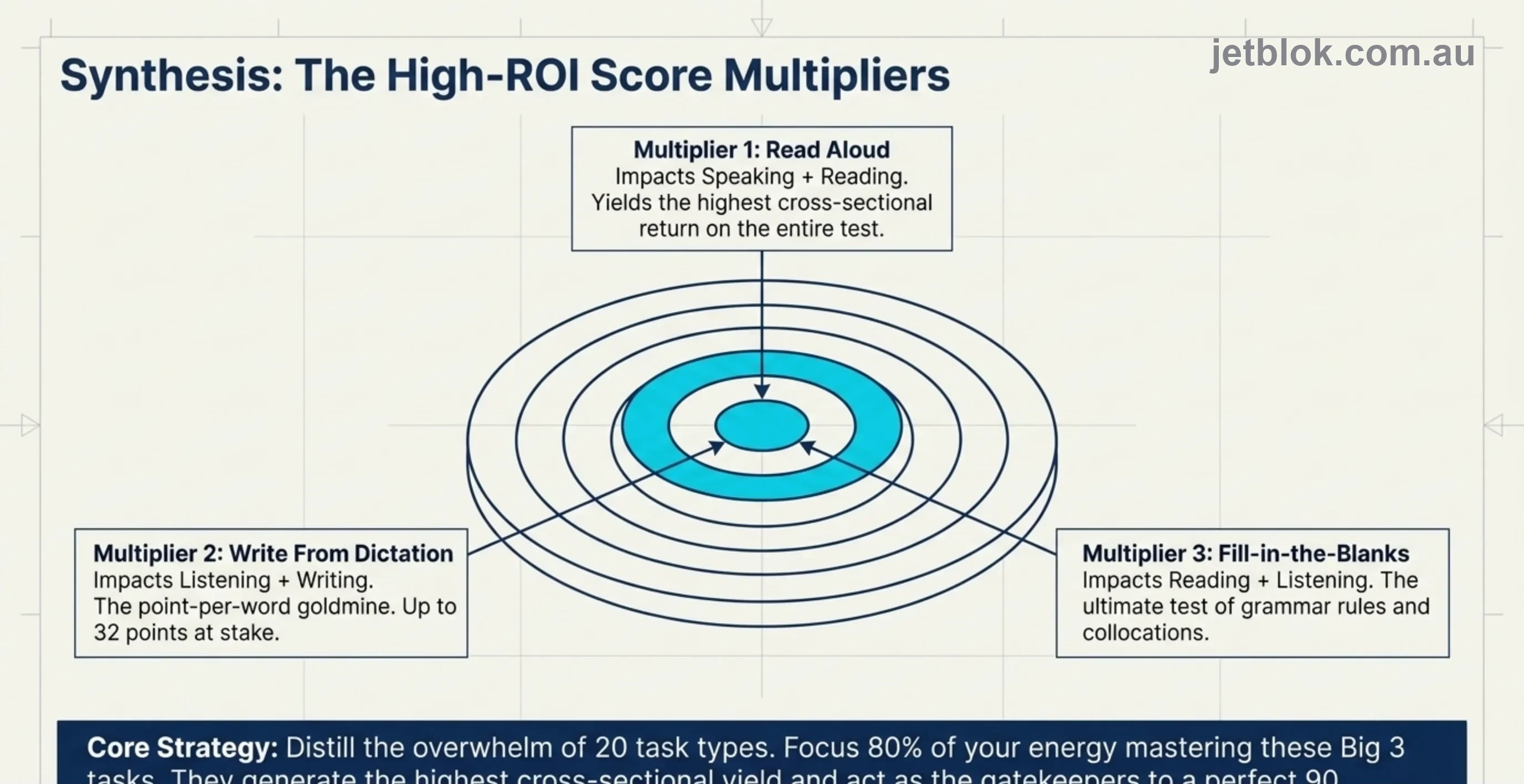
If your time is limited, spend it where the points are. Here's the order coaches generally recommend:
Tier 1: Biggest impact (master these)
- Describe Image (about 15% of overall, coach estimate): your biggest lever. Practise graphs, charts, maps, diagrams and processes. Describe trends and relationships, not every number. Use a loose structure: type, main trend, highest and lowest, one observation, conclusion.
- Summarize Group Discussion (about 9%): practise listening to panel discussions and saying who said what.
Tier 2: High impact (about 7% each)
- Repeat Sentence: counts for Listening and Speaking. Practise with longer and longer sentences. Remember 3 or 4 meaning groups, not 12 single words.
- Summarize Written Text: counts for Reading and Writing. Write one correct sentence between 5 and 75 words. Coaches suggest aiming for about 35 to 55 words.
- Write Essay: about 31% of Writing. Pearson's top form score is for 200 to 300 words. Use a 4-paragraph structure but vary your language.
- Fill in the Blanks (Dropdown): about 25% of Reading. Build collocations: words that go together, like "conduct research", "pose a threat" and "draw conclusions".
Tier 3: Strategic impact
- Write from Dictation (about 5% of overall, but about 23% of Writing): key if you need a set Writing score. See my WFD strategy guide.
- Retell Lecture: paraphrase, don't parrot. Humans review the content.
- Read Aloud: about 9% of Speaking. Since the August 2025 update, Pearson's score guide lists it as a Speaking task only.
Tier 4: Protect your score
- Multiple Choice, Multiple Answers: don't guess. Wrong picks cost points.
- Reorder Paragraphs: coaches suggest capping it at about 90 seconds to 2 minutes. Find one sure pair and build from there.
- Highlight Incorrect Words: only click words you're sure about.
Task-by-Task Strategies for Scoring 90
Speaking tasks
Read Aloud: Group words into meaning chunks of 3 to 5 words. Pause between chunks, not between words. Drop your voice at full stops. Never go back to fix a word.
Repeat Sentence: The start and end are easiest to remember. If you miss a middle word, put in something that fits and keep going. Copy the speaker's rhythm.
Describe Image: Use the 25 seconds of prep to spot the image type, the main trend, the highest and lowest points and one interesting detail. Speak for most of the 40 seconds: introduction, main trend, details, conclusion.
Respond to a Situation: Opening, request or answer, reason, detail, polite close. Match your tone to the person. Use most of the 40 seconds.
Retell Lecture: Note keywords only. Catch the topic, 2 or 3 main points and the conclusion. Put it in your own words, because humans review the content.
Summarize Group Discussion: Three columns of notes, one per speaker. Cover all three, then say where they agreed or disagreed.
Answer Short Question: One word or a short phrase is enough. Answer straight away.
Writing tasks
Summarize Written Text: Write ONE sentence between 5 and 75 words (Pearson's rule). Coaches suggest 35 to 55 words. Join ideas with "which", "while", "although" and "because".
Write Essay: Pearson gives full form marks for 200 to 300 words. Under 120 or over 380 words scores zero for form, and Pearson says a zero for form means no points for the essay. Use 4 paragraphs: introduction with your view, body 1, body 2, conclusion. Check spelling before you submit.
Reading tasks
Fill in the Blanks (Dropdown): Look for collocations and grammar clues (articles, prepositions, verb forms). Coaches put this at about 25% of Reading, so give it time.
Fill in the Blanks (Drag and Drop): Check each word fits the grammar (noun, verb, adjective) and the meaning. Read the sentence back in your head.
Reorder Paragraphs: Find the opening sentence (usually a general statement, not one starting with "this" or "they"). Look for words that point back to an earlier sentence. Don't let it eat your time.
Listening tasks
Summarize Spoken Text: Pearson gives full form marks for 50 to 70 words, part marks for 40 to 49 or 71 to 100, and zero under 40 or over 100. Aim for 55 to 65. Note the topic, main points and conclusion.
Write from Dictation: Jot the first letter of each word as you hear it, plus 2 or 3 anchor words. Rebuild the sentence straight away. Each correctly spelled word earns a point.
Highlight Incorrect Words: Follow the transcript while you listen. Click only words you're sure are different. Wrong clicks cost points.
For the full Listening walkthrough, read my PTE Listening complete guide.
Common Mistakes That Kill Your Score
I've covered these in detail in a separate post, but here are the big ones:
- Template dependence: Pearson can give zero content to memorised answers
- Self-correcting in Speaking: the pauses hurt your fluency score
- 3 seconds of silence: the mic stops recording
- Word counts: Essay under 120 or over 380 words scores nothing. SWT outside 5 to 75 words, or more than one sentence, scores nothing
- Guessing on negative-marking tasks: wrong picks cost points
- Bad mic position: breath noise on P, B and T sounds hurts how clearly you come across
Read the full list: 10 Critical PTE Mistakes That Kill Your Score.
Microphone Setup: The Two-Finger Rule
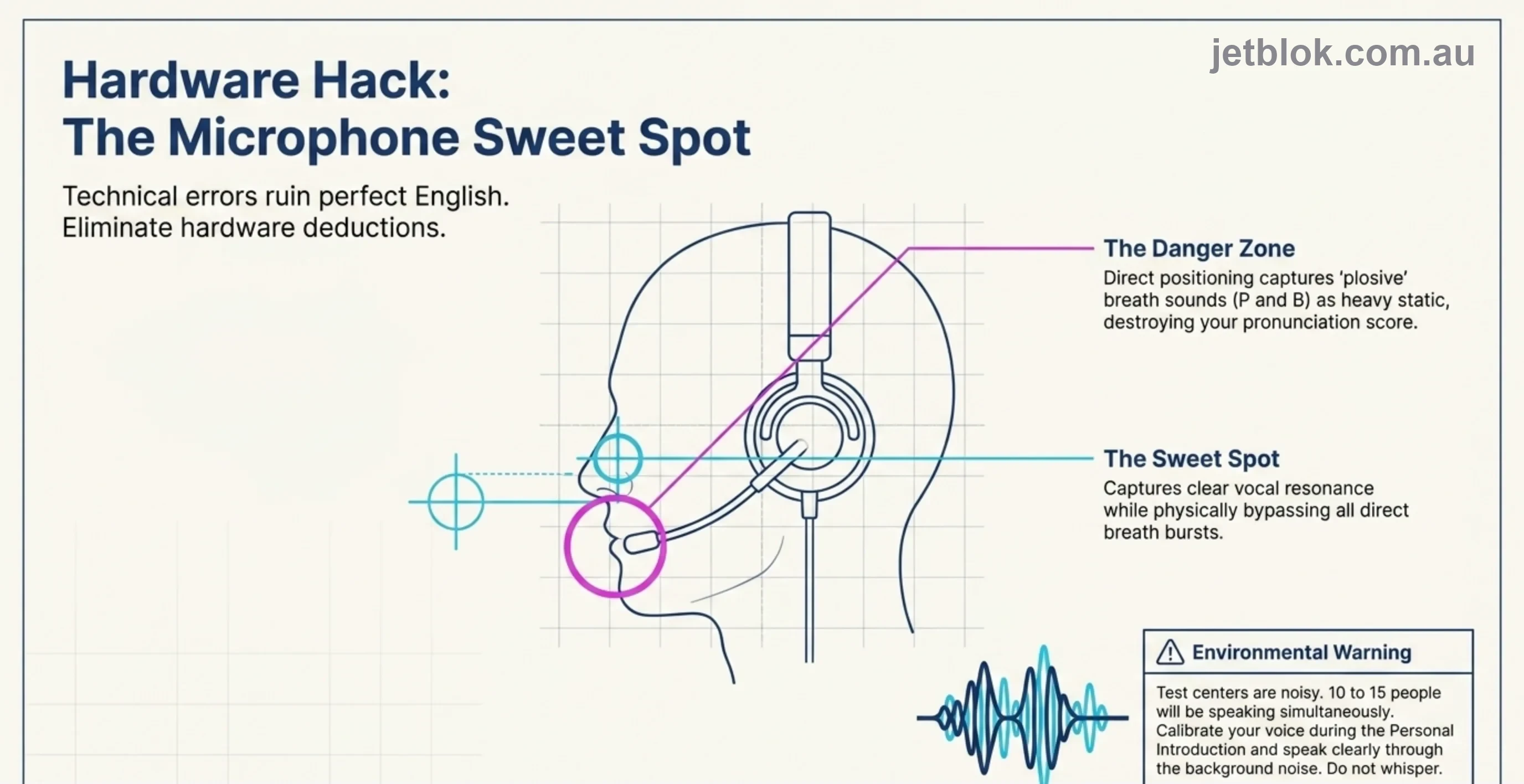
Your setup affects your Speaking score:
- Put the microphone about level with your nose or chin, off to the side, not right in front of your mouth
- Keep it about two fingers' width (3 to 4 cm) from your face
- This stops breath bursts from P, B, T and D sounds
- Always do the sound check at the start, and use the Personal Introduction to settle your volume
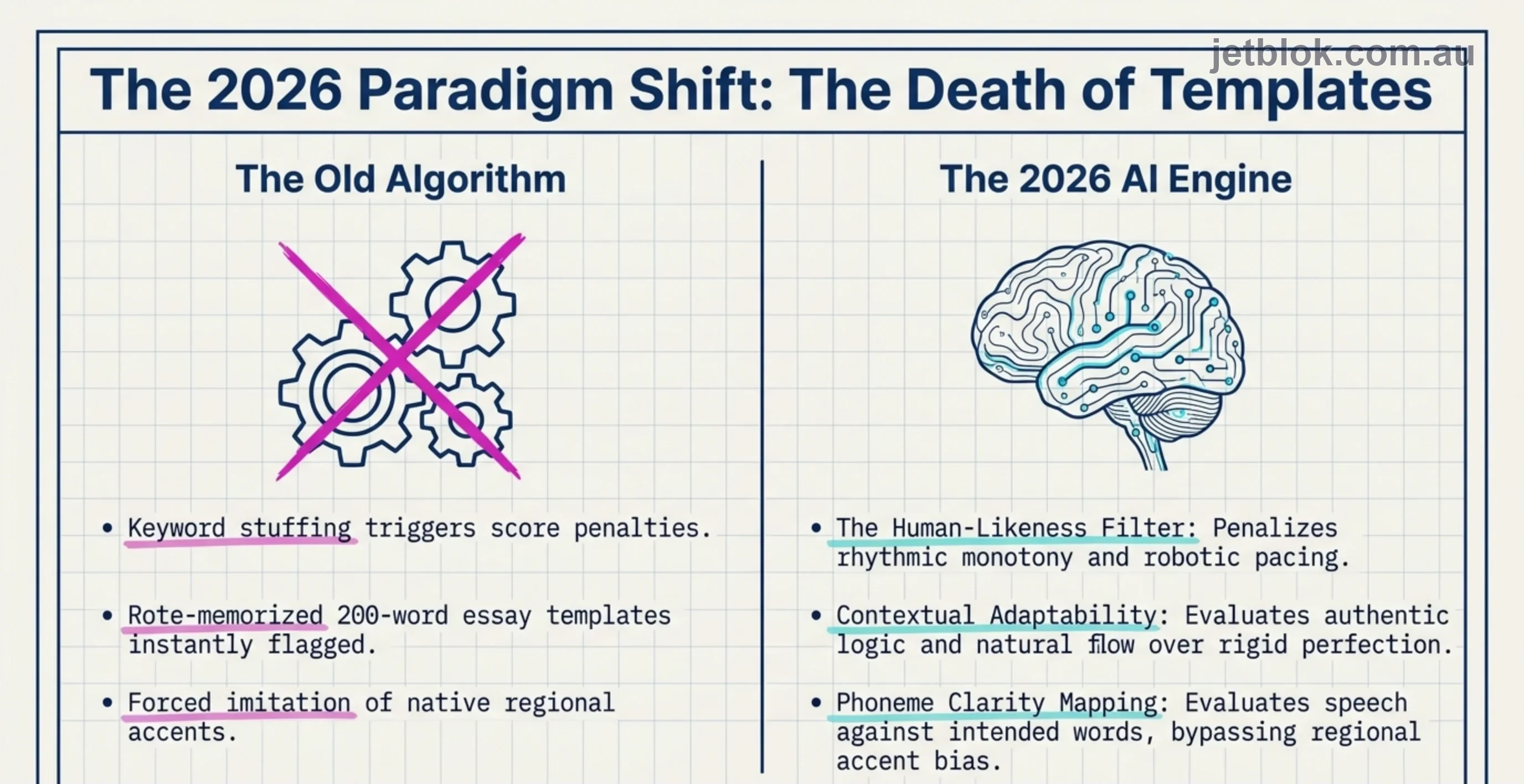
Templates in 2026: What Still Works
Templates aren't dead, but word-for-word scripts are risky. What works:
- Flexible frameworks: know the structure (intro, body, conclusion) but change your words each time
- Opening and closing lines: having 3 or 4 different ways to start a Describe Image or essay is fine
- Linking phrases: learn 8 to 10 and rotate them naturally
What doesn't work:
- Pasting the same 50-word introduction thousands of others use
- Reading out a flat, robotic answer
- Using the same template for every Describe Image, whatever the image
90-Day Study Plan for Scoring 90
Weeks 1 to 2: Foundations and diagnosis
- Take a full practice test to find your weakest skills
- Learn how scoring works and which tasks weigh most (this article)
- Set a daily routine: 1 hour Speaking, 30 minutes Reading, 30 minutes Listening
- Start WFD now (10 sentences a day)
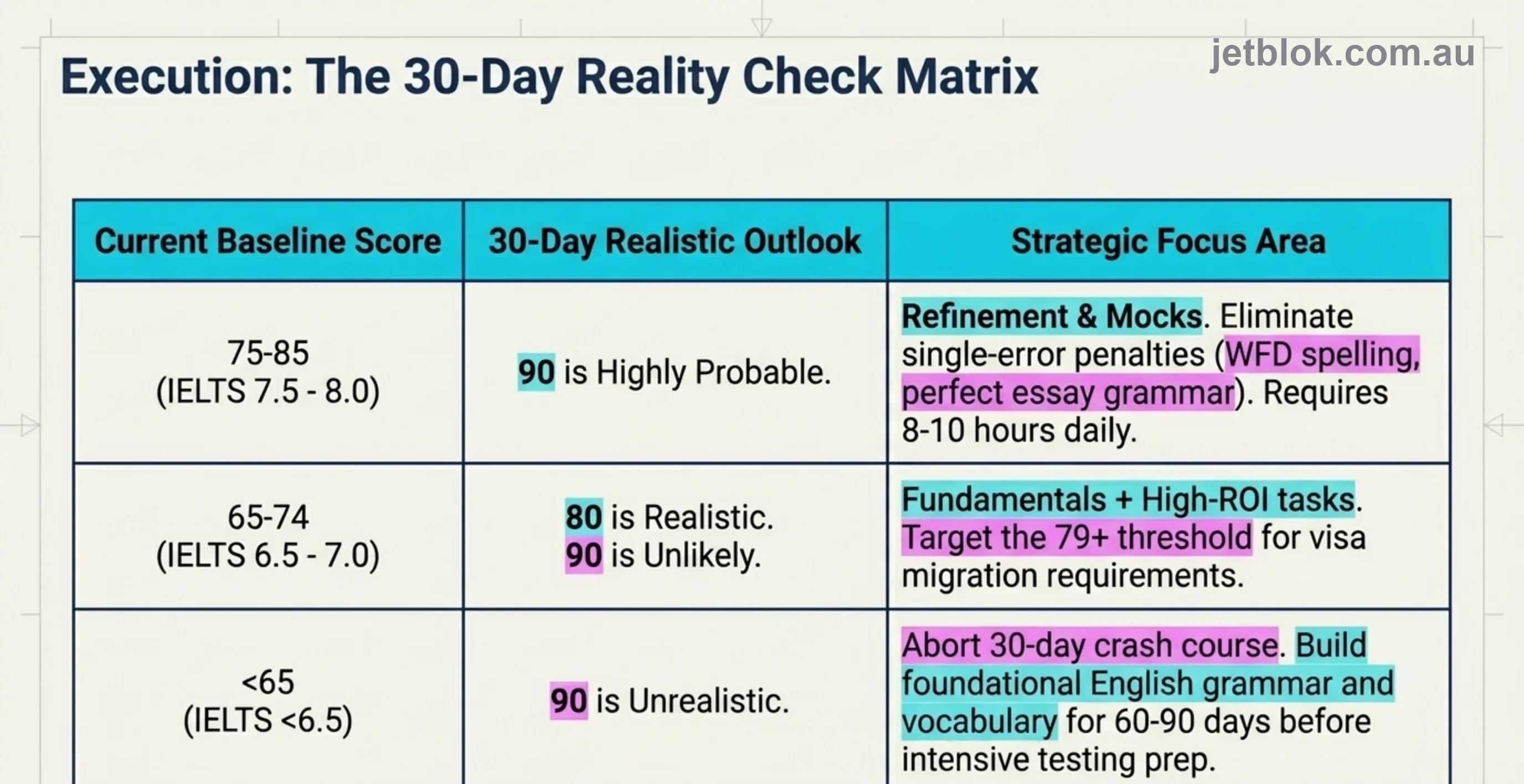
Weeks 3 to 6: Build the skills that count
- Spend about 40% of practice time on Describe Image
- Practise Summarize Group Discussion with podcast panel discussions
- Work on Repeat Sentence with longer sentences
- Write 2 timed essays a week
- Build collocations for the Fill in the Blanks tasks
- Read my guides on Speaking, Writing, Reading and Listening
Weeks 7 to 10: Practice tests
- Take a practice test every 5 days
- Review every scored answer and look for patterns in your mistakes
- Practise under exam conditions: no pausing, strict timing
- Focus on smooth delivery, not perfection
Weeks 11 to 12: Final polish
- Take 2 full practice tests a week
- Review your spelling traps
- Practise your mic setup and how you sit
- Rest for the last 2 days. Cramming doesn't help a skills test
Practice Platforms
- APEUni: popular AI-scored practice. Many coaches rate its scoring as a fair guide, but it isn't Pearson's engine.
- PTE Tools: good for drilling Repeat Sentence and Write from Dictation.
- E2Language: structured courses with feedback, good for beginners.
- Pearson's official practice tests (PTE Study): scored with Pearson's own engine. They cost money but are worth it near the end.
Test Day Checklist
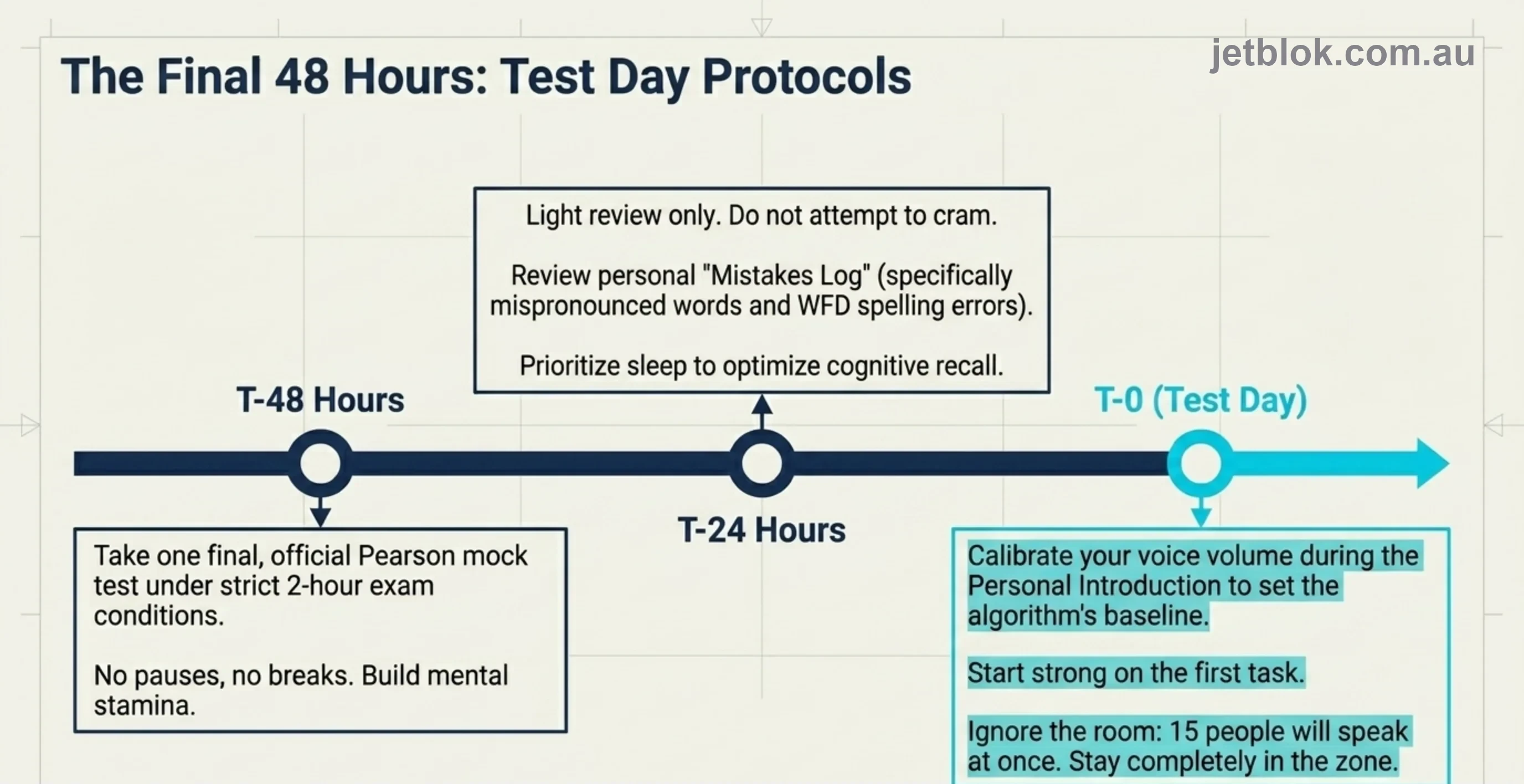
- Arrive at least 30 minutes early. Late arrivals can be turned away
- Bring your valid passport (check the ID rules for your country when you book)
- Do the mic check carefully
- In Speaking, keep sound flowing. Never let it go quiet for 3 seconds
- In Reading, give most of your time to the Fill in the Blanks tasks
- In Listening, save your sharpest focus for Write from Dictation at the end
- Use American OR British spelling and stick with it
Frequently Asked Questions
Is there a break in PTE Academic?
No scheduled break. Pearson's handbook says you can ask for an unscheduled break, but the test clock keeps running, so most people go straight through.
How long is the PTE Academic test in 2026?
About 2 hours. Pearson gives these part timings: Speaking and Writing about 76 to 84 minutes, Reading about 23 to 30 minutes and Listening about 31 to 39 minutes. They don't add up exactly because each test version is balanced for total length.
What changed in PTE Academic in August 2025?
For tests taken from 7 August 2025, Pearson added two speaking tasks (Summarize Group Discussion and Respond to a Situation), and raised the number of questions to 65 to 75. Pearson's current score guide also lists human content review on seven tasks. At the same time, Home Affairs brought in new PTE scores for Australian visas.
Is the PTE overall score the average of the four skills?
No. Pearson works out the overall score from all your answers, and says it is not an average of your Listening, Reading, Speaking and Writing scores.
What PTE score do I need for Proficient or Superior English in Australia?
For tests from 7 August 2025, Proficient needs Listening 58, Reading 59, Writing 69 and Speaking 76. Superior needs Listening 69, Reading 70, Writing 85 and Speaking 88. Each skill must be met on its own. Results from tests taken on or before 6 August 2025 use 65 (Proficient) and 79 (Superior) in each skill.
Can I still use templates in PTE?
A loose structure is fine. Memorised, word-for-word answers are risky: Pearson's score guide says responses with lots of pre-prepared material can get zero for content.
Keep Going: The PTE Skill Guides
This guide is the overview. Each skill has its own deep dive:
- PTE Speaking 2026: the 7 Speaking tasks, including SGD and RTS
- PTE Writing 2026: Summarize Written Text and Write Essay
- PTE Reading 2026: Score 90 with these strategies
- PTE Listening: the complete guide to all 8 Listening tasks
- PTE Write from Dictation: the phrase mapping technique
- 10 Critical PTE Mistakes That Kill Your Score
- Every way to self-practise for PTE: free to paid options compared
Your 90 is doable. The test isn't measuring how clever you are or your accent. It's measuring whether you can communicate smoothly, clearly and accurately under time pressure. Learn how the scoring works, put your time into the tasks that count, keep your speech flowing and trust your practice.