
Speaking is where a lot of people win or lose their PTE. Since August 2025 there are more speaking tasks, humans now check the content of the longer ones, and memorised scripts can get you a zero for content. Part 1 of the test (Speaking & Writing) has 9 scored question types: 7 speaking tasks plus Summarize Written Text and Write Essay. This post covers the 7 speaking tasks. For the two writing tasks, see my PTE Writing guide. For the whole test, start with the PTE Academic 2026 complete guide.
Quick Summary (click to expand)
- Pearson scores speaking on content, oral fluency and pronunciation
- Read Aloud: meaning chunks, not word by word
- Repeat Sentence: remember 3 or 4 meaning groups and never stall
- Describe Image: coaches rate it the biggest single task in the test. Describe trends, not every number
- Respond to a Situation (added August 2025): situation, person, goal, then a 5-step answer
- Retell Lecture: paraphrase, don't parrot. Humans review the content
- Summarize Group Discussion (added August 2025): 3-column notes, every speaker, how their views connect
- Two-finger rule for your microphone
How Speaking Is Scored
Before the tasks, know what's being measured. Pearson's score guide uses these traits for most speaking tasks:
- Content: did you answer what was asked, and cover the key points?
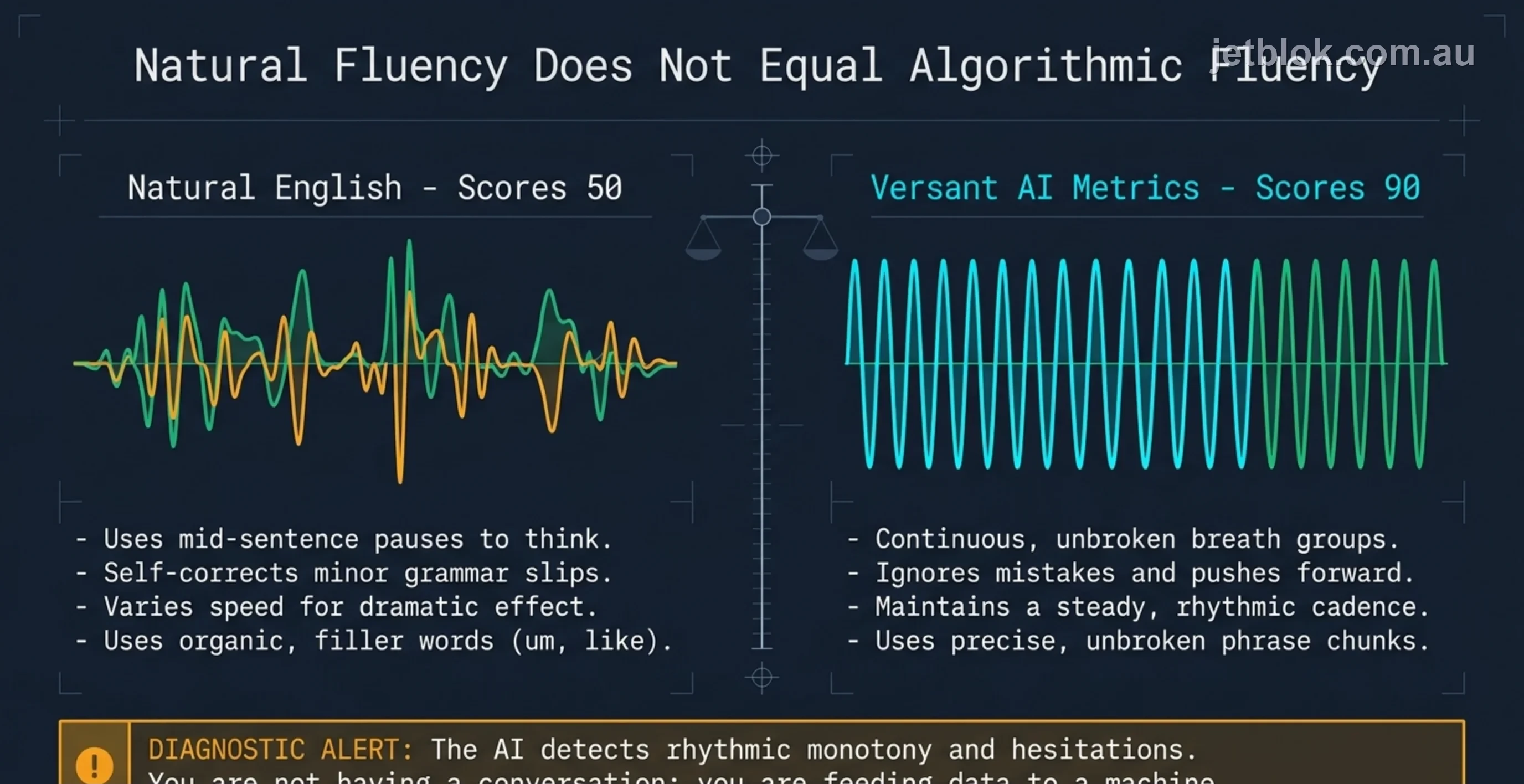
- Oral Fluency: smooth rhythm and phrasing, without long hesitations, repeats or restarts
- Pronunciation: clear sounds and natural stress, so a listener understands you easily
AI scores all of it. For Describe Image, Retell Lecture, Respond to a Situation and Summarize Group Discussion, a human also reviews the content before the score is final. You'll see coaches quote a split like "content 40%, fluency 30%, pronunciation 30%". Pearson doesn't publish that, so take it as a rough idea, not a rule.
The rule that matters most: pauses and restarts hurt more than small mistakes. A smooth answer with a slip usually beats a choppy "perfect" one.
Task 1: Read Aloud (RA)
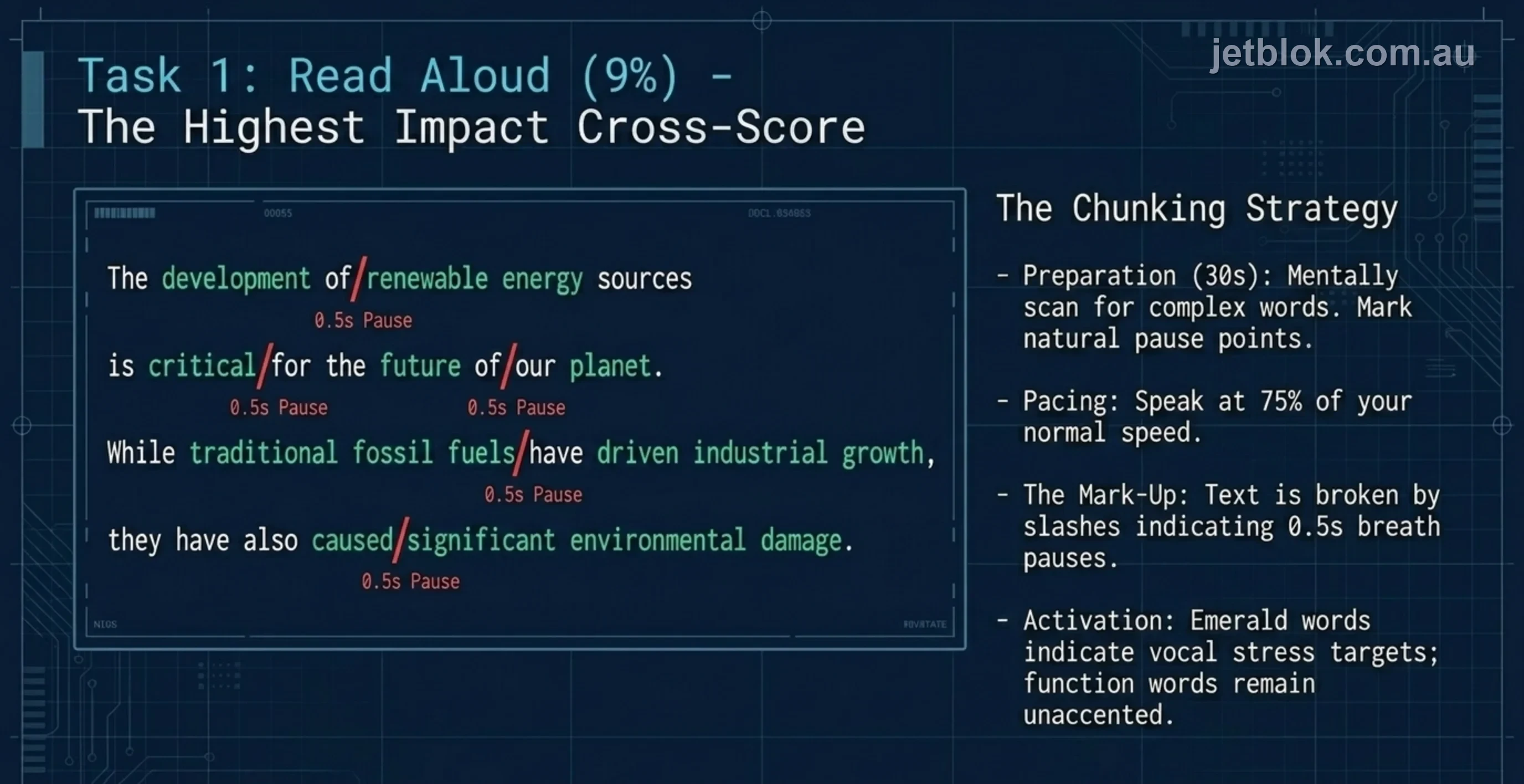
What it is: Read a short text (up to about 60 words) aloud. You get about 30 to 40 seconds to prepare, depending on length. Expect 6 or 7 of these.
Score contribution: Since August 2025, Pearson lists Read Aloud as a Speaking task only. Coaches put it at about 9% of Speaking.
Strategy: meaning chunks, not word by word
Don't read word by word. Group words into meaning chunks of 3 to 5 words that belong together:
"The university library / has recently introduced / a new digital system / that lets students / access resources from home."
Pause slightly between chunks, not between words.
Key tips
- Use the prep time to mark where the chunks break
- Never go back to fix a word. Keep moving
- Keep a steady pace
- Let your voice drop at full stops
Task 2: Repeat Sentence (RS)
What it is: Hear a sentence once and repeat it exactly. Expect 10 to 12 of these.
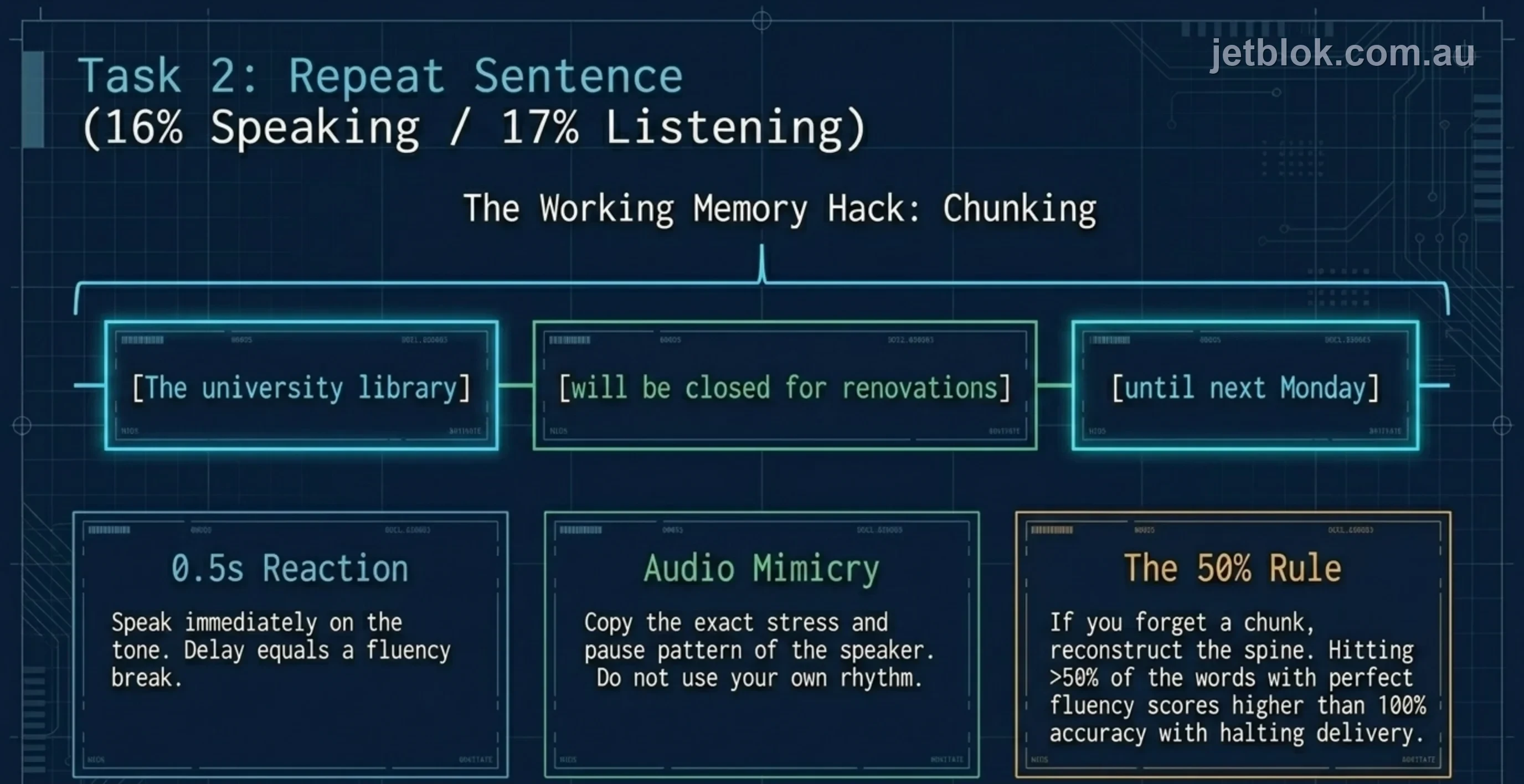
Score contribution: Counts for Listening and Speaking. Coaches estimate about 16% of Speaking and 17% of Listening, which makes it one of the highest-value tasks.
Strategy: chunk it
You can't hold 12 to 15 single words. Hold 3 or 4 meaning groups instead:
Sentence: "The professor emphasised that students should complete their assignments before the deadline." Chunks: [The professor emphasised] [that students should complete] [their assignments] [before the deadline]
Key tips
- The start and end are easiest to remember
- If you miss a word, put in something close and keep going
- Copy the speaker's rhythm and stress
- Start speaking straight after the tone
- Practise with longer and longer sentences
Task 3: Describe Image (DI)
What it is: Describe a graph, chart, map, process or picture. You get 25 seconds to look and 40 seconds to speak. Expect 5 or 6.
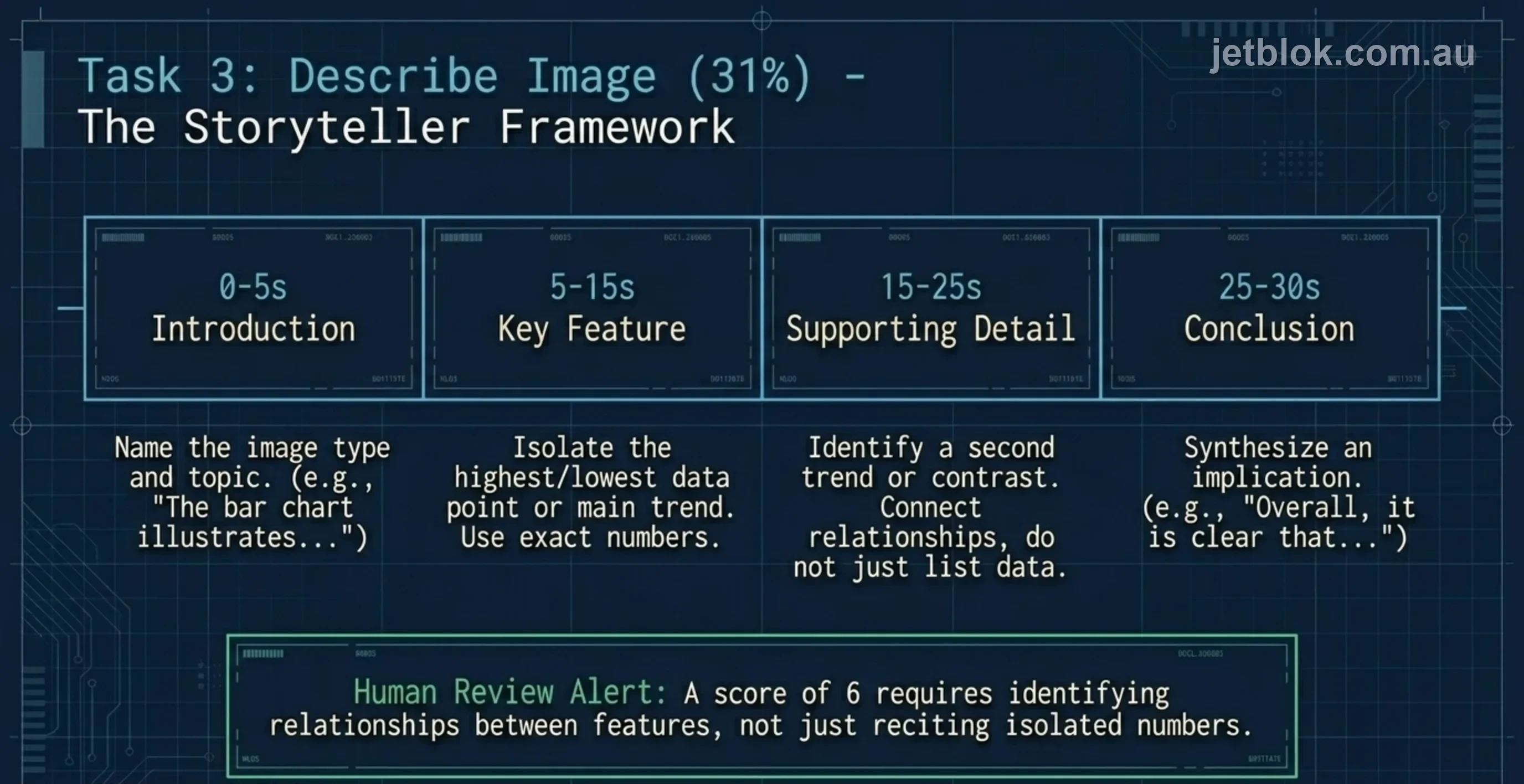
Score contribution: Coaches estimate about 15% of your overall score and about 31% of Speaking, based on a weighting table they quote from Pearson. Either way, it's the big one.
Strategy: relationships, not lists of numbers
Don't read out every number. Describe trends and relationships:
- What's the overall trend? (rising, falling, up and down)
- What are the highest and lowest points?
- Is there a pattern or something unusual?
- How do the parts compare?
Pearson's top content score asks you to describe the main features and how they relate, so a comparison or trend is worth more than a single figure.
Simple framework (not a rigid template)
"This [type of image] shows [topic]. Overall, [main trend]. The highest is [X], while the lowest is [Y]. Interestingly, [one observation]. Overall, it suggests [summary]."
Change the wording each time so it fits the image.
Task 4: Respond to a Situation (RTS), added August 2025
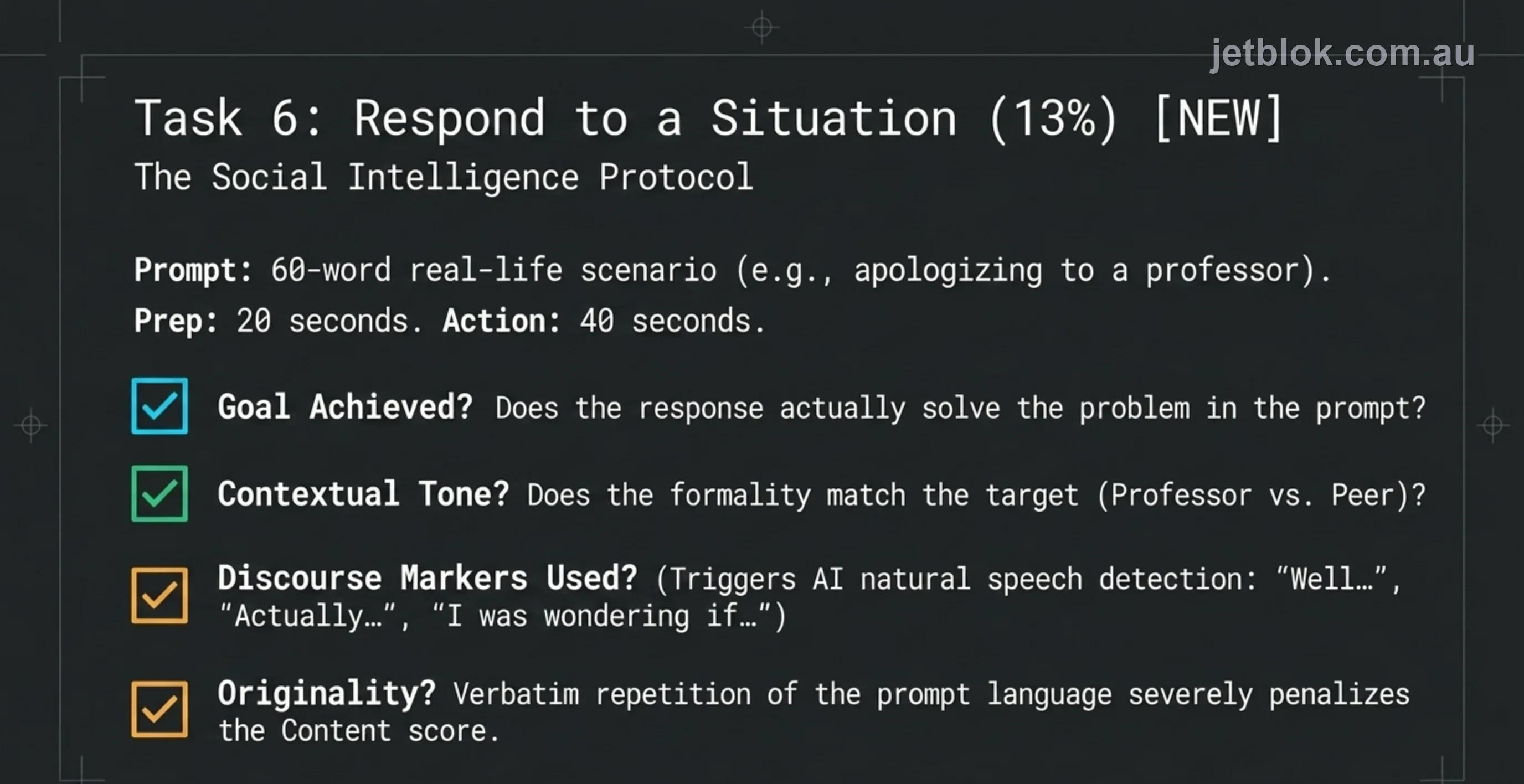
What it is (Pearson): You read and hear a short description of an everyday university situation (up to about 60 words), then say what you'd say in it. You get 10 seconds to prepare and 40 seconds to speak. The audio plays once and you record once. Expect 2 or 3 of these.
Score contribution: It counts for Speaking only. Coaches estimate about 13% of Speaking and about 6% of your overall score.
How Pearson scores it
| Trait | Scale | What earns the top band (Pearson's score guide) |
|---|---|---|
| Content | 0 to 6 | Handles the situation effectively, achieves the main goal with full attention to the details in the prompt, and goes beyond the prompt's wording with clear, flexible, appropriate language |
| Pronunciation | 0 to 5 | Easy for most listeners to understand, with correct sounds and stress |
| Oral fluency | 0 to 5 | Smooth, natural pace and phrasing, without hesitations, repeats or false starts |
AI scores all three, and a human expert also reviews the content. Two things to know:
- Zero content means zero for the item. Pearson's score guide says no points are given when content scores 0, so pronunciation and fluency can't rescue an answer that's off-topic, memorised or too short.
- Details matter. Pearson's own example: if the prompt says you need the slides by Friday and you say Sunday, that's a misinterpretation and costs content marks. Echoing the prompt's wording without adding anything also keeps you in the lower bands.
Example scenario
"A classmate who's been sick asks to copy your assignment. What do you say?"
Use your 10 seconds: situation, person, goal
Pearson and most coaches suggest pulling three things out of the prompt before you speak:
- The situation: what's happening? (You're struggling with an essay.)
- The person: who are you talking to? This sets your tone. A professor or library staff member needs a more formal register. A classmate or flatmate can be casual.
- The goal: what do you need to achieve? (Ask for a meeting, say no politely, sort out a problem.)
A structure that works
Many coaches (PTE Classes among them) teach a five-step shape. It isn't a script, just an order to follow:
- Greeting that fits the person: "Excuse me, Professor..." or "Hey, Sam..."
- Situation in a sentence, in your own words
- Main request or answer, early: say what you want or what you'll do in the first 10 seconds or so
- Reason and a detail or two: why, plus something relevant that wasn't in the prompt
- Polite close: a next step or a question ("Would tomorrow morning work?")
Speak in the first person, as if it's really happening. Aim to use most of the 40 seconds. A one-liner like "Sure, no problem" is relevant but too thin for a good content score.
Useful language
- Polite requests (formal): "Would it be possible to...", "I was wondering if I could...", "Could I possibly..."
- Saying no kindly: "I'd really like to help, but...", "I'm not comfortable doing that because..."
- Offering another option: "What I can do is...", "How about we..."
- Apologising: "I'm really sorry about...", "I should have let you know earlier..."
- Closing: "Would that work for you?", "Thanks so much for your time."
Sample response
"Hey, I'm really sorry you've been sick, that sounds rough. I can't share my assignment though, because if the uni thinks we copied, we could both get into trouble for academic misconduct. What I can do is send you my lecture notes tonight, and if you like, we could meet in the library tomorrow and I'll walk you through how I approached it. Would that help?"
Why it works: it greets the person in a fitting, casual tone, gives a clear answer early, explains why, offers two concrete alternatives that weren't in the prompt, and closes with a question. It's about 35 seconds at a natural pace.
RTS mistakes coaches see most
- Describing the situation ("My classmate is asking me...") instead of speaking inside it
- Getting a detail wrong (day, time, place, person)
- The wrong tone, like slang with a professor
- An all-purpose memorised script that ignores the prompt
- Stopping after 15 seconds
Task 5: Retell Lecture (RL)
What it is: Hear a lecture of up to about 90 seconds, then retell it. You get 10 seconds to prepare and 40 seconds to speak. Expect 2 or 3.
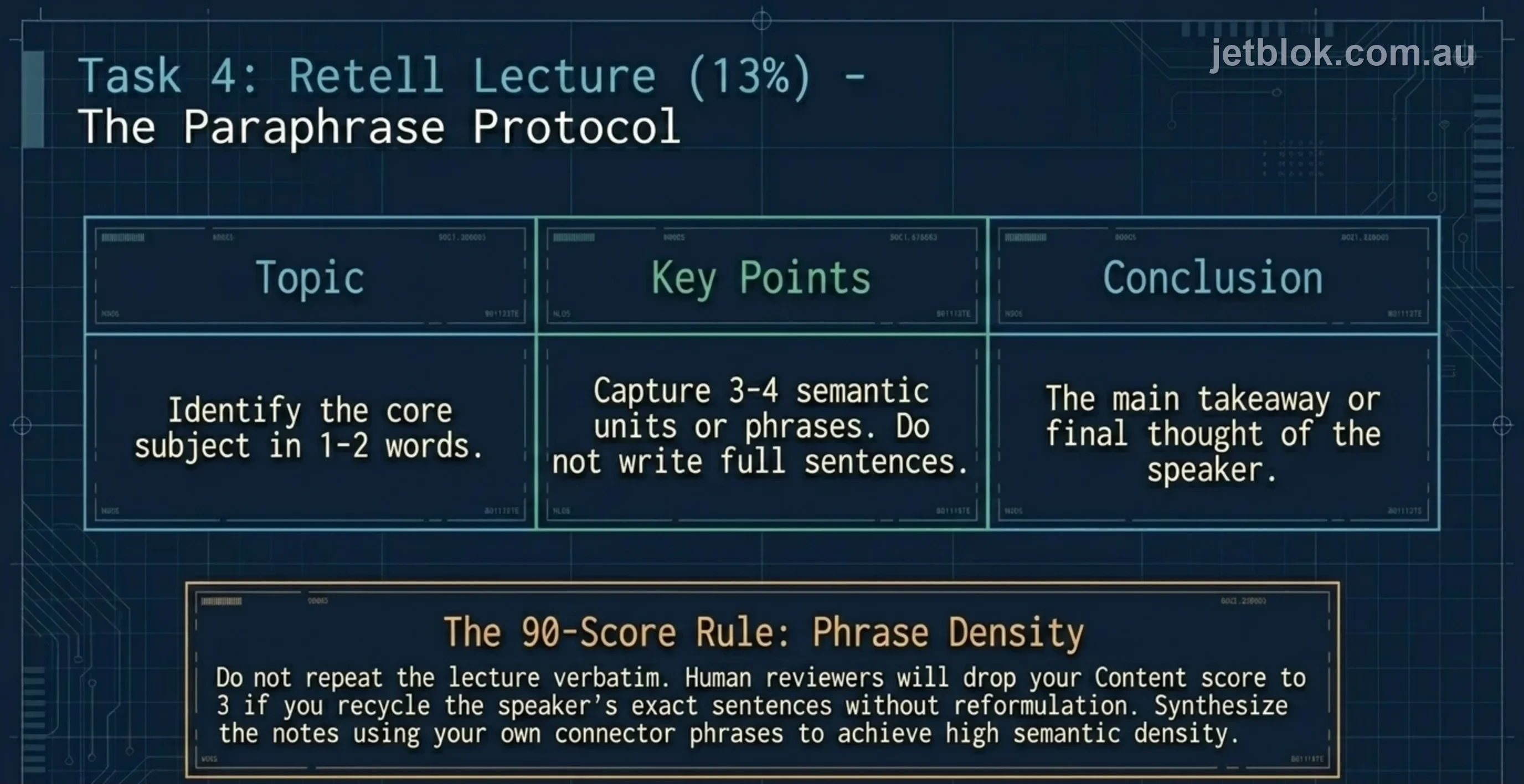
What to know: A human reviews the content. Pearson's top content score asks you to paraphrase the main ideas in your own words. Repeating isolated words and phrases from the lecture scores low.
Strategy: paraphrase, don't parrot
- Take short notes (keywords only)
- Catch the topic, 2 or 3 key points and the conclusion
- Say it in your own words
- Don't try to include everything. Stick to the main ideas
Task 6: Answer Short Question (ASQ)
What it is: Answer a simple question with one word or a short phrase. Expect 5 or 6.
Score contribution: Coaches put it at about 4% of Listening and about 2% of the overall score.
Strategy: answer fast
- Answer straight away. No full sentences needed
- Common topics: science, geography, everyday knowledge
- If you're not sure, give your best guess clearly
Task 7: Summarize Group Discussion (SGD), added August 2025
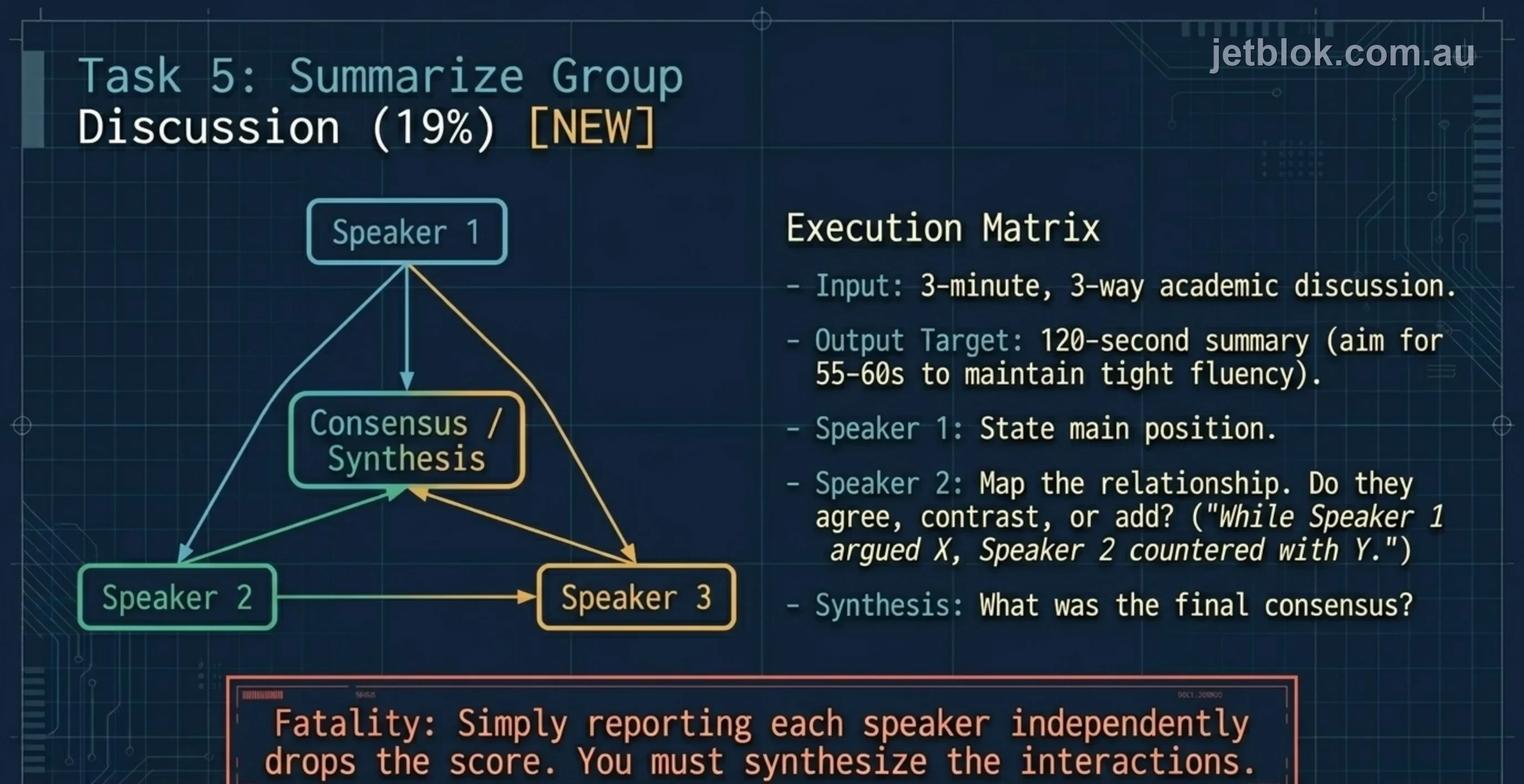
What it is (Pearson): Three people discuss an academic topic for up to 3 minutes (most coaches say 2.5 to 3). It plays once, with no transcript, and you can take notes. You then get 10 seconds to prepare and up to 2 minutes to speak. Expect 2 or 3.
Score contribution: It counts for Listening and Speaking. Coaches estimate about 9% of your overall score, about 19% of Speaking and about 20% of Listening, which makes it the second biggest task in the test on their numbers.
Typical topics (Pearson): students discussing a lecture, a group struggling with an assignment or project, or a professor guiding students who raise concerns.
How Pearson scores it
| Trait | Scale | What earns the top band (Pearson's score guide) |
|---|---|---|
| Content | 0 to 6 | Paraphrases the main ideas in your own words, develops each speaker's contribution with specific detail, explores how their views relate and pulls them together, with varied language and a logical, well-connected order |
| Pronunciation | 0 to 5 | Easy for most listeners to understand |
| Oral fluency | 0 to 5 | Smooth, natural pace, without hesitations, repeats or restarts |
AI scores all three, and a human expert also reviews the content. As with RTS, zero content means zero for the item, and Pearson says memorised or unoriginal responses get no credit.
Pearson's test format page sums up what a strong answer does: start with the main topic, then cover the subtopics with details, including which speaker said what. Just retelling the discussion without paraphrasing hurts your score. Pearson's SGD article adds that you need all three speakers' views for full content marks.
Notes: the 3-column method
Set this up on your erasable noteboard before the audio starts:
| Topic: ________ | ||
|---|---|---|
| Speaker 1 | Speaker 2 | Speaker 3 |
| view + reason | view + reason | view + reason |
| feeling? | feeling? | feeling? |
| Agree / disagree: | Outcome / next step: |
- Speakers won't take neat turns, so jot each point in the right column as it comes
- Note keywords, not sentences
- Listen for feelings as well as facts ("stressed", "frustrated", "excited"). Pearson asks you to cover what people say, think and feel
- Mark where they agree or clash, and how it ends (a decision, a next step or no agreement)
A structure that works
Coaches (Next Step IELTS, EnglishWise, BandLadder) all teach roughly the same order:
- Topic: "The three speakers were discussing..."
- Speaker 1: main view plus a reason or example
- Speaker 2: main view plus a detail, linked to speaker 1 ("In contrast...", "Building on that...")
- Speaker 3: main view plus a detail
- Connections: where they agreed or disagreed
- Outcome: what they decided, or that no agreement was reached
One coaching timing guide for the 2 minutes: about 10 seconds for the topic, 20 to 25 seconds per speaker, 25 seconds on how their views connect, and 15 to 20 seconds on the outcome. Most coaches suggest using most of the 2 minutes, as long as you aren't padding. Covering everything clearly matters more than filling time.
Useful language
- Opening: "The discussion focused on...", "The speakers debated whether..."
- Attribution: "The first speaker argued that...", "The second speaker was worried about...", "The third speaker suggested..."
- Linking views: "By contrast...", "Building on this point...", "Both the first and third speakers agreed that..., although..."
- Feelings: "She seemed frustrated by...", "He was clearly enthusiastic about..."
- Outcome: "In the end, they agreed to...", "They didn't reach a final decision, but..."
Short sample (based on Pearson's time management example)
"The three students were talking about how hard it is to manage time at university. The first speaker felt stressed by the workload and said she struggles to keep a consistent routine across different courses. The second speaker agreed, but said his main problem is procrastination, because he focuses on interesting tasks instead of urgent ones, and he compared this with high school, where teachers set the schedule. The third speaker shared the same procrastination issue and added that long-term planning and multitasking are hard for her too. In the end, she suggested they all attend a university seminar on time management, and the others seemed keen."
Why it works: topic first, every speaker covered with a detail, links between their views ("agreed", "shared the same issue"), and the outcome at the end, all in plain language.
SGD mistakes coaches see most
- Leaving out a speaker or getting their view wrong
- Retelling the speakers one after another with no comparison
- Running out of time before the outcome
- Spending too long on one speaker's example
- Reading out keywords from your notes without joining them up
- A memorised template that doesn't match what was said
Microphone Setup: The Two-Finger Rule
Your setup matters more than you'd think:
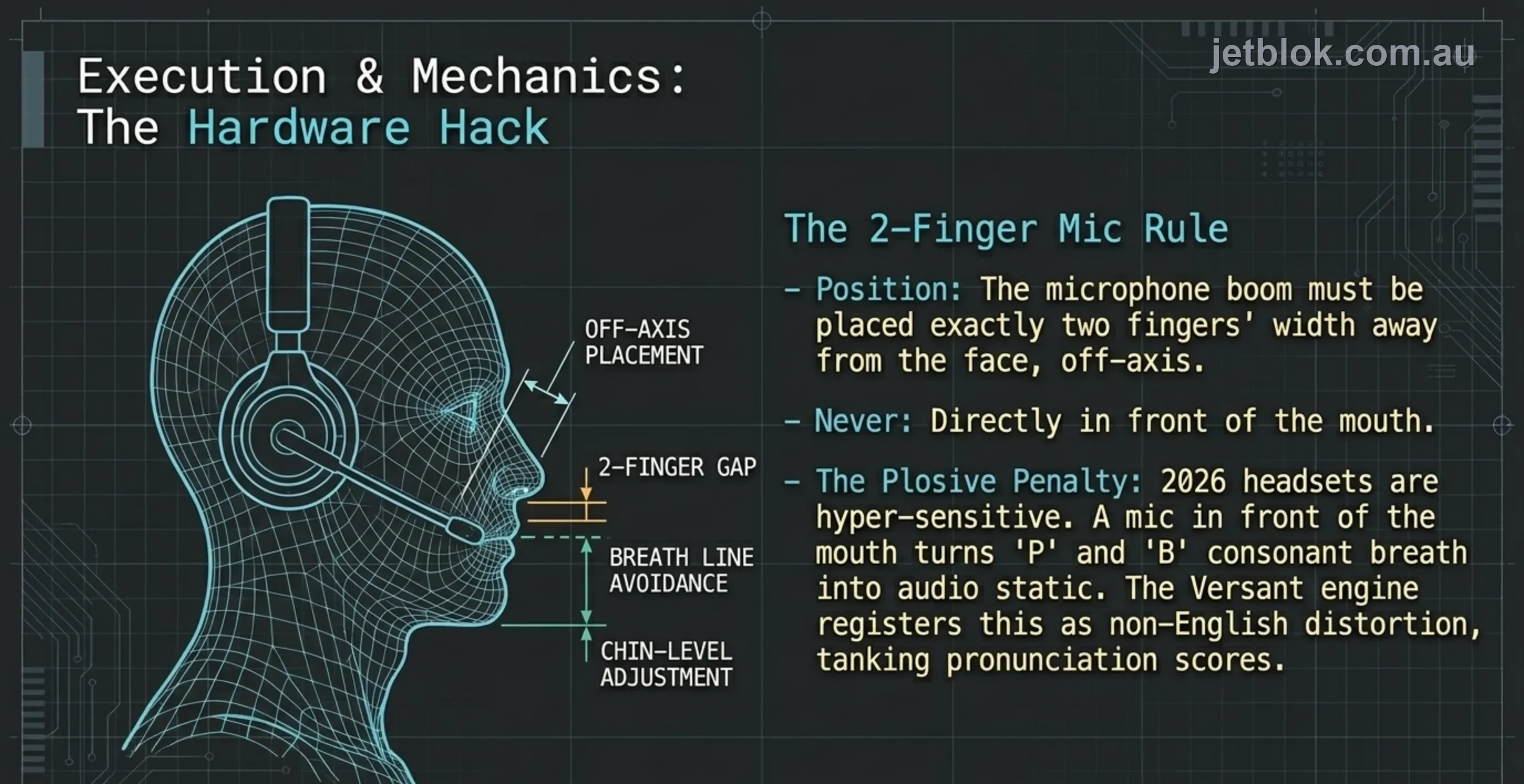
- Put the mic about level with your nose or chin, slightly to the side
- Keep it about two fingers' width from your face
- This stops breath bursts on P, B and T sounds
- Do the sound check, and use the Personal Introduction to settle your volume
- Don't stay silent for 3 seconds. The mic stops recording
Practice Resources
Use platforms with AI scoring for feedback, but remember none of them is Pearson's engine:
- APEUni: popular for AI-scored speaking practice
- PTE Tools: good for Repeat Sentence drills
- E2Language: structured courses with feedback
- Pearson's official practice tests: scored with Pearson's own engine, good near test day
Frequently Asked Questions
How many speaking tasks are in PTE Academic now?
Seven speaking tasks: Read Aloud, Repeat Sentence, Describe Image, Retell Lecture, Answer Short Question, Summarize Group Discussion and Respond to a Situation. Together with Summarize Written Text and Write Essay, that's 9 scored question types in Part 1 (Speaking & Writing). There's also an unscored Personal Introduction.
When were Summarize Group Discussion and Respond to a Situation added?
Both apply to tests taken from 7 August 2025. They aren't new in 2026.
How long do I get to speak in Summarize Group Discussion?
Up to 2 minutes, after 10 seconds of prep. The discussion audio is up to 3 minutes and plays once.
What happens if I stop talking for 3 seconds?
The microphone stops recording. You won't lose what you already said, but nothing after that is captured, and if you never started, you score nothing for that item.
How are SGD and RTS scored?
Both are scored on content (0 to 6), pronunciation (0 to 5) and oral fluency (0 to 5). AI scores everything and a human also reviews content. If content scores 0, the whole item scores 0. SGD counts for Listening and Speaking. RTS counts for Speaking only.
Does my accent affect my PTE speaking score?
Not on its own. Pearson scores pronunciation on how easy you are to understand, not on sounding like a native speaker. Clear sounds, natural stress and smooth phrasing matter more than any accent.
Next Steps
- Back to the hub: PTE Academic 2026 complete guide
- Next skill: PTE Writing guide for SWT and Essay
- Avoid the classic traps: 10 Critical PTE Mistakes
- Listening tasks that also feed Speaking: PTE Listening complete guide